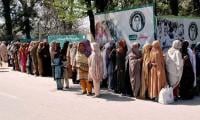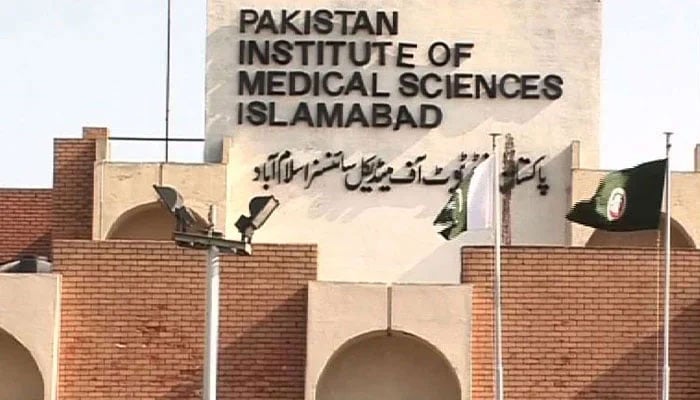
She arrived at PIMS before seven in the morning. By noon, she had moved through four counters, waited for a token that never came, and been redirected twice without explanation. By evening, she left without seeing a doctor. She was not unlucky – just ordinary. And her story repeats itself thousands of times every day in Pakistan’s federal capital.
The Pakistan Institute of Medical Sciences was designed to handle between 2,000 and 3,000 outpatients per day. According to a written reply submitted by the Ministry of National Health Services to the Senate, PIMS now receives over 8,000 patients daily -- more than three times its built capacity. Both PIMS and Polyclinic operate evening OPD shifts, but these remain limited to selected specialities, leaving patients requiring surgery, orthopaedics, gynaecology and many other departments with no recourse beyond the morning shift.
Together, PIMS and Polyclinic serve not just Islamabad but Rawalpindi, adjoining Punjab districts, Khyber Pakhtunkhwa, Azad Jammu and Kashmir and Gilgit-Baltistan. The result is entirely predictable: overcrowded OPDs, overwhelmed emergencies, delayed diagnostics and patients who lose not hours but entire days.
Behind this crisis lies a deeper structural failure. According to the Pakistan Economic Survey 2025-26, total public health expenditure reached Rs942.2 billion in FY2025, yet this represents only 0.8 per cent of GDP, declining from 0.9 per cent the year before. Health financing literature and international development benchmarks consistently cite at least 5.0 per cent of GDP as a threshold for making meaningful progress towards universal health coverage. Pakistan is spending less than one-fifth of that benchmark.
The numbers in the same survey tell a stark story. Pakistan’s life expectancy stands at 67.8 years, compared with a South Asian average of 72.6 years. Infant mortality is 47 per 1,000 live births against the South Asian average of 23.2. Pakistan ranked 140th out of 167 countries in the 2025 Sustainable Development Report. Despite a 5.3 per cent increase in registered doctors -- bringing the total to 336,582 -- supply remains acutely inadequate for a population of over 257 million. The overcrowding at PIMS and Polyclinic is not an accident. It is the arithmetic consequence of sustained underinvestment.
What makes the federal government’s position particularly difficult to defend is the direction of its own spending. While Punjab increased its health budget by 17 per cent to Rs630.5 billion for FY2025-26, the Federal Ministry of National Health Services budget was cut from Rs54.87 billion to Rs46.10 billion -- a reduction of nearly 16 per cent. The federal PSDP development allocation for health fell from Rs27 billion to Rs14 billion -- a cut of nearly 48 per cent. These are not neutral accounting adjustments. They are choices with direct consequences for patients standing outside PIMS.
This is where Punjab offers a lesson that goes beyond politics. As documented in the Economic Survey 2025-26, Punjab launched a comprehensive reform programme under the Punjab Primary and Secondary Healthcare Services Act 2025. Over 50,000 health workers were deployed, 45 million premises digitally mapped and 2,506 Maryam Nawaz Health Clinics operationalised with electronic records, CCTV monitoring and pay-for-performance accountability. The Directorate of Monitoring and Evaluation conducted 29,499 facility visits between September 2025 and March 2026 alone. Over six million consultations have been recorded since the programme’s launch. These are operational realities happening 280 kilometres from Islamabad, documented in Pakistan’s own official survey.
The question is straightforward: if Punjab can build this, why can’t the federal capital?Prime Minister Shehbaz Sharif now governs from Islamabad. He built much of this model in Punjab. He knows that hospitals do not improve through statements. They improve when someone checks whether doctors are present, medicines are in stock, triage is functioning and administrators are personally answerable. The Economic Survey records Pakistan’s Universal Health Coverage index at only 45.2 out of 100. The prime minister has the data. The obligation now is to act on it where he holds direct federal authority.
Islamabad is not without institutions. The Islamabad Healthcare Regulatory Authority has existed since 2018. The Ministry of National Health Services, CDA and ICT Administration all operate here. The problem is not the absence of offices. It is the absence of unified authority, clear accountability and political ownership. When a patient waits all day without seeing a doctor, no single authority is unambiguously answerable. That is the real governance failure.
What Islamabad needs is a fully empowered Federal Capital Health Authority, with operational control over PIMS, Polyclinic, Basic Health Units and Rural Health Centres, mandatory inspection powers, digital monitoring and public reporting obligations. Three things should happen immediately. Functional triage counters should be installed at both hospitals within 90 days. Monthly performance scorecards covering bed occupancy, medicine availability and complaint resolution should be published publicly. And a single patient complaint number should be staffed and widely publicised, because a complaint system patients cannot find is not a complaint system at all.
Pakistan’s life expectancy of 67.8 years -- nearly five years below the South Asian average -- is not a statistical curiosity. It reflects choices made year after year about what matters and what does not.
The federal capital, where those choices are made, should at the very least demonstrate that they can be made differently.
The woman who left PIMS in the evening without a consultation will return tomorrow. She has no alternative. She is not waiting for a policy paper, a governance report or a Senate question hour. She is waiting for someone in authority to decide -- clearly, finally and without further delay -- that her time, her pain and her dignity matter as much as the institutions that surround her.Islamabad’s hospitals need more than sympathy. They need someone to be responsible.
The writer is a communications specialist at the Pakistan Institute of Development Economics (PIDE). He can be reached at: [email protected]
The views expressed are his own.