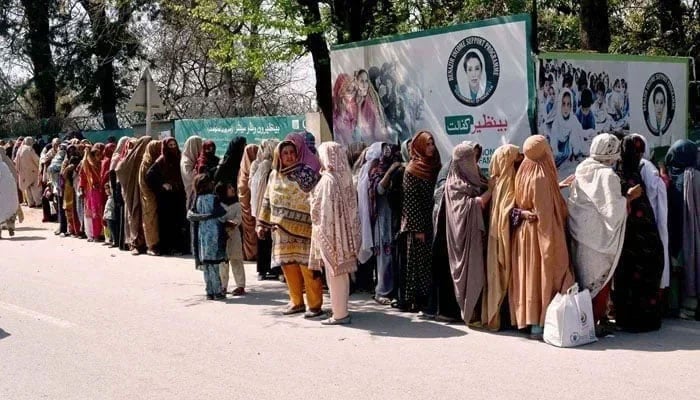
Budget 2026-27 appears to end the dispute over the future of the Benazir Income Support Program (BISP). The government, led by the PML-N and its coalition partner, the PPP, had been embroiled in a dispute over whether to reform the programme, hand it down to the provinces or keep it as an important federal project.
Some members of the PML-N went further, saying the programme created dependency among beneficiaries. The PPP, which had created the BISP, called any move to devolve it a red line. On the evidence of this budget, the PPP’s position has prevailed: far from being cut or devolved, BISP has been expanded, with its allocation reportedly rising from around Rs716 billion to about Rs838 billion.
However, both sides are missing a harder point. BISP is not the cause of this dependency. Dependency is a symptom of a state that has failed to create decent work, affordable services and reliable routes to alleviate poverty. The political economy where poor families remain alive through transfers but lack the resources, services, and bargaining power required to escape poverty. Poor people do not become poor because of quarterly cash transfers. Poor households remain poor due to informal labour markets, underperforming educational and healthcare institutions, high financing costs, unequal land distribution, high energy costs and extractive local politics.
However, the imbalance in public spending deserves further attention. The BISP has been raised to roughly Rs838 billion for 2026–27, while reported federal development allocations, for example, for higher education, remain far smaller. The Higher Education Commission’s development allocation, for instance, has fallen from around Rs105 billion to about Rs46 billion -- less than a tenth of the BISP allocation. These are not perfectly comparable categories; BISP is a transfer programme, while the others are development allocations, but the contrast is politically revealing.
Pakistan is prepared to spend heavily on relief, while the institutions that might reduce the need for relief remain underfunded and underdeveloped. This is not an argument against helping the poor. It is an argument about balance, sequencing and the absence of a credible exit strategy.
Therefore, the programme should be maintained as a protective measure. A country with this much poverty and so little social insurance needs one. Its most important achievement is that it reaches poor women directly and gives them a claim to the state. It cushions families from hunger, debt and shocks. However, cash alone is not a solution. It softens the effects of deprivation; however, it does not create a durable exit from poverty.
However, the purpose of the BISP should be changed. Transfers should be a gateway, not destinations. Every beneficiary household should have a case file, not just payment records. The poverty registry built at such cost should become a live social-protection system, linking households to health cover, school enrolment, identity documentation, skills training, bank accounts and local employment opportunities -- with the federal government retaining financing and the national registry, and provinces and district administrations leading delivery and case management.
The graduation approach also deserves to be taken seriously, rather than being piloted, praised and forgotten. Cash support should be combined with productive assets, training, coaching, savings support and market access. Pakistan’s National Poverty Graduation Programme already rests on this logic. The task is not to invent another slogan but to fund, scale, and monitor what already makes sense and to apply it selectively.
Not all BISP households require the same interventions. Elderly persons, widows without family support, and persons with disabilities may need long-term protection rather than graduation, whereas younger households with working-age adults need skills, tools, credit and market access. A serious system would segment households rather than treat all poverty as a single condition.
Women are central to this shift in the workforce dynamics. BISP reaches women, which is a key achievement of the programme. The next step is harder: women must not remain merely cash recipients. They must become earners, producers and owners. This requires safe transport, childcare, women’s markets, protection for home-based workers, digital financial inclusion, and inheritance rights that exist in practice rather than only in law.
Harder work is unglamorous, local and politically unrewarding. Districts need support for the few occupations they can genuinely sustain: livestock, dairy, horticulture, crafts, repair, processing and local services. Skills programmes that lead nowhere merely create certified unemployment. A training certificate is not an income-generating strategy for the workers. If there are no employers, markets, transport or working capital, training only converts poverty into further disappointment.
Health and education must also be treated as poverty-reduction instruments, not only as social-sector expenditure. Illness is one of the fastest routes to debt. Primary healthcare, maternal care, nutrition and protection from catastrophic medical costs can do more for poor households than many fragmented schemes. Schools should be judged not by enrolment alone, but by whether children can read, count, remain in school and eventually work.
None of this is cheap. However, the state cannot complain about the cost of poverty reduction while protecting the privileges of its elite citizens. Energy, property, agriculture, imports, and large business interests remain shielded in ways that the poor never are. These protected bargains should be reduced, and the money redirected to services and livelihoods that change life chances. Energy must also become cheaper and more reliable, or small entrepreneurs will never employ workers on a large scale.
Above all, Pakistan should change its measurement of success. BISP must not be evaluated merely on the basis of the sum total of money disbursed or the number of recipients. It must rather be assessed based on how many families climb out of poverty and manage to stay above the poverty line, how many women work independently, how many children go to school and learn something there, how many families cut down on their debts, and how many recipients stop depending on BISP.
Unfortunately for Pakistan, its political elites prefer cash transfers because they are tangible, centralised, and useful at election time. Addressing structural poverty, however, requires tackling issues such as land inequality, elite subsidies, empty local governments, poor-quality schools, discrimination against women, exploitation in the informal sector and the interconnection between the state and privilege.
BISP is not a villain in this story. It is the symptom. The poor do not remain poor because payments arrive every three months. They remain poor because almost everything around them, from the labour market to the local patwari, is arranged against them. The real question is whether the state has the nerve to rearrange it.
The writer is a policy analyst and researcher with a PhD in Social Anthropology. He is the author of a Routledge-published book on Pakistan’s tribal borderlands.