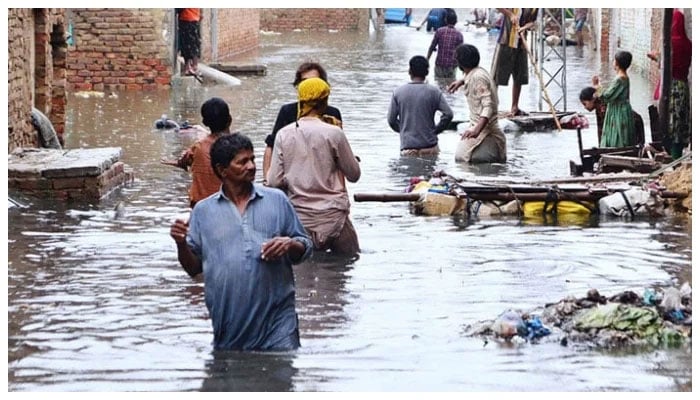
Three years after the catastrophic floods of 2022, Pakistan once again found itself battling devastating monsoon floods in 2025. More than 1,000 people lost their lives, nearly seven million people were affected, millions were displaced, and vast areas of agricultural land were inundated. According to assessments, more than 17,000 square kilometres of land were flooded, including approximately 14,500 square kilometres of agricultural land, exposing over 11 million people to floodwaters.
The tragedy was a reminder that, despite the lessons of 2022, Pakistan remains trapped in a cycle of disaster response rather than disaster resilience. In recent years, Pakistan has become a prominent voice in global climate discussions. The country has rightly advocated for greater climate finance, adaptation funding and loss-and-damage mechanisms. Yet the experience of both 2022 and 2025 tells a critical reality: climate resilience cannot be financed through climate projects alone.
Pakistan has a development challenge fundamentally. Floods destroy homes, but they also expose weaknesses in infrastructure, governance, urban planning, water management, healthcare systems, agricultural productivity and economic inclusion. For Pakistan, climate finance should therefore be viewed as one component of a broader development finance strategy rather than an end in itself.
Development finance refers to investments that generate long-term economic, social and environmental outcomes. It encompasses infrastructure, education, healthcare, digital transformation, clean energy, governance reforms, innovation, disaster resilience and climate adaptation. Unlike traditional climate finance, development finance addresses the systems that determine whether societies can withstand and recover from shocks.
This distinction matters for international investors. Pakistan faces a convergence of challenges: climate vulnerability, energy insecurity, water stress, infrastructure deficits, rapid urbanisation, and persistent human development gaps. Fiscal constraints mean that public resources alone cannot meet these needs. The country must therefore compete for development capital from multilateral development banks, sovereign wealth funds, impact investors, institutional investors, and private finance providers that increasingly seek measurable development outcomes alongside financial returns.
Fortunately, Pakistan possesses assets that many investors find attractive. More than 60 per cent of Pakistan’s population is under the age of 30, making it one of the world’s youngest countries. Women constitute approximately 49 per cent of the population, yet their economic participation remains significantly below regional and global averages. Together, these demographics represent one of Pakistan’s greatest untapped development opportunities.
Countries that have successfully leveraged development finance have recognised the importance of investing in people alongside infrastructure. Bangladesh strengthened resilience not only through flood protection but through investments in education, healthcare, women’s economic participation and disaster preparedness. Vietnam combined infrastructure investment, industrial policy, renewable energy expansion and human capital development to become a major destination for international investment.
The lesson is clear: investors are attracted not merely by financing needs but by credible development strategies supported by effective institutions. Pakistan already has many of the institutional foundations required to build such a strategy. The Ministry of Planning, Development and Special Initiatives, the Ministry of Finance and the Ministry of Climate Change and Environmental Coordination collectively shape national development priorities. The National Disaster Management Authority (NDMA) and the National Disaster Risk Management Fund (NDRMF) play critical roles in disaster risk reduction and resilience-building. Provincial governments, planning and development departments and Provincial Disaster Management Authorities are responsible for translating policy into implementation. The challenge is coordination. Too often, development planning, climate adaptation, disaster risk management, and investment promotion operate in separate silos. The result is fragmented projects, duplicated efforts and missed opportunities.
Pakistan should establish a national development finance platform that aligns federal ministries, provincial governments, disaster management institutions, regulators, development partners, academia and private investors around a common pipeline of investment-ready projects. Such a platform could help convert national priorities into bankable opportunities that attract international capital.
Equally important is the need to place innovation at the centre of development finance. The future of resilience will not be built solely through concrete infrastructure. It will also depend on technology, data and entrepreneurship. Pakistan could become a regional leader in climate-tech, agritech, fintech, and digital public services if development finance is directed toward innovation ecosystems rather than isolated pilot projects. For example, development finance could support satellite-based flood forecasting, AI-powered agricultural advisory systems, digital water monitoring, climate-risk insurance products and early-warning technologies that reduce losses before disasters occur. Universities and research institutions can play a critical role by providing risk assessments, adaptation metrics, impact evaluations and evidence-based policy recommendations that strengthen investor confidence.
Women and youth must also become central beneficiaries of development finance rather than be treated as peripheral considerations. Dedicated financing facilities for women-led enterprises, climate-smart agricultural businesses and youth-led technology ventures would not only advance inclusion but also expand Pakistan’s productive economy. International investors increasingly view gender-responsive and youth-focused investments as indicators of long-term sustainability and economic resilience.
The global development finance landscape is evolving rapidly. Capital is increasingly directed toward countries capable of demonstrating institutional coordination, innovation capacity, measurable outcomes and long-term policy commitment.
For Pakistan, the policy challenge is therefore not simply how to secure more climate finance. It is about positioning itself as a destination for development finance that simultaneously advances economic growth, climate resilience, innovation, gender inclusion, and human development. The floods of 2025 should serve as a turning point. Rebuilding after each disaster is no longer enough. The objective must be to build systems that prevent future losses while creating opportunities for future generations.
Putting development finance first is not about replacing climate finance. It is about recognising that resilience is ultimately built through stronger institutions, empowered communities, productive economies and innovative solutions. For Pakistan, that shift in thinking may be the most important investment of all.
The writer works on climate finance, carbon markets and sustainable development across disaster risk reduction and climate change.