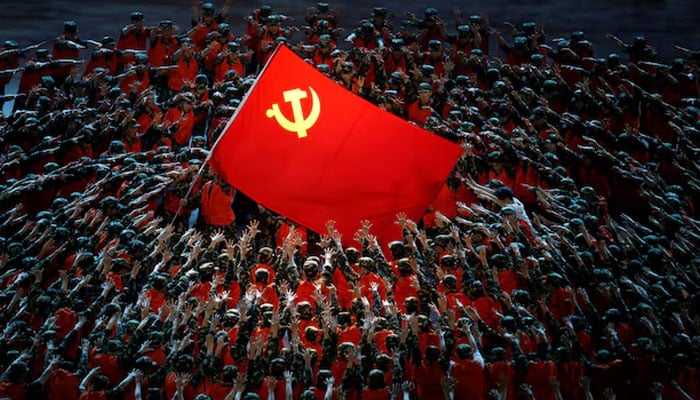
The Communist Party of China (CPC) has entered its second century with pride. It has reason to be proud of its history and achievements. It began with a small number of members dedicated to liberating the people and the country from oppression. The CPC’s ideology and goals attracted people to join the party. It achieved early success and established the Jiangxi Soviet government in 1931. However, the national government of China was unwilling to allow it to exist and launched a multifaceted war against the CPC and the Jiangxi Soviet government. Chiang Kai-shek launched a final bid in 1934 to eliminate the CPC and the government, leading to the Long March.
Long March (1934-1936) is a momentous event in the history of the CPC and China. The Red Army traveled through the most difficult terrain, crossing marshy grasslands, steep mountain terraces, rivers, and plains (crossing 24 rivers and 18 mountain ranges). Simultaneously, it had to survive and repel attacks by the Nationalist army and its supporters. The Nationalist army killed a large number of soldiers of the Red Army, as it had superior weaponry and a large number of troops. In a nutshell, the Nationalist army, natural hazards, and difficult terrain wreaked havoc on the Red Army (only 57000 soldiers survived out of the 206000 who started the march).
However, the Long March left a lasting impact on the CPC rather than reshaping it and its operations. The march infused a spirit of selflessness and readiness to sacrifice everything for ideals and beliefs. Ideals and beliefs became the cornerstone of the CPC, its leadership, and its comrades. The commitment to ideology bred a generation ready to sacrifice to achieve the goal. It made the comrades fearless, facing hardships and uncertainty with courage and dignity. It instilled a spirit of equality and a commitment to serving the people.
After the Long March, the CPC took a new direction, intensifying its efforts to liberate the country and develop the people. The CPC adopted a flexible approach and adjusted policies to ground realities. For example, after the Long March, the CPC forged an alliance with Nationalist forces to fight imperialist Japan. However, it never compromised on its goal. Therefore, after World War II, the CPC resumed its campaign against oppressors and nationalist forces. It waged a protracted struggle against the nationalist oppressors but never lost focus, establishing the PRC in 1949.
From here, another story of courage, the will to fight adversaries, commitment to the people, selfless dedication, and sacrifice. The first task was to address food insecurity and poverty and to revive the economy. The economy was in a dire state, as the Japanese forces and oppressors destroyed economic, agricultural, irrigation, and other factors. It led to higher unemployment and inflation, ultimately increasing poverty. China also faced staunch opposition from the USA and its allies. They refused to recognize China and establish diplomatic relations. They sought to squeeze China’s economic and development opportunities.
However, China had allies such as the USSR, which helped it overcome challenges. Unfortunately, the relationship began to deteriorate in the late 50s and 60s, leading to broader conflicts in the late 1960s. The USSR also refused to help China develop its nuclear program. Simultaneously, China had to fight remnants of feudal and anti-revolutionary forces. China steered the situation through the Three Worlds Theory and the Third Front approach. The Third
Front helped China build new centers of industry and military production, including Sichuan, Guizhou, Shanxi, etc.
On the other hand, Pakistan worked closely with China, helping it connect with the world through the air corridor it provided. Pakistan also assisted China in reclaiming its rightful seat at the UN and on the UN Security Council, and in its rapprochement with the USA. The rapprochement provided an opportunity for China to pursue reform and opening up. Before delving into reforms, it is pertinent to note that China also faced setbacks, including the Great Leap and the Cultural Revolution, which did not yield the desired outcomes. China learned from these setbacks and came back strong with a refined approach to reform.
In 1978, under the leadership of Chairman Deng Xiaoping, China opted for reforms to bring prosperity to its people by integrating into the global economy with Chinese characteristics. China implemented innovative approaches such as dual pricing, township and village enterprises, and land reform (the household responsibility system, which unleashed agricultural potential). CPC-led reforms helped China become the world factory and turned around the country’s fate. Once a fringe economy and a poverty-ridden country, it became the second-largest economy, the biggest trader, and a country with a zero poverty rate.
Under the leadership of President Xi of the CPC, the CPC has led China into a new era of reform, opening, and modernization. China is rapidly becoming a new center of innovation and technology development, and the epicenter of the global economy. It has also emerged as an engine of global growth, with its share of global production rising from 1% in the 1970s to 30% in 2025. It is expected to reach 45% in the next few years. President Xi is also leading the country toward modernization in all respects by 2049. Simultaneously, he is dedicated to presenting a refined model of Socialism with Chinese Characteristics to the world.
However, in the new era under the leadership of President Xi, China, as a responsible emerging power, is equally focused on contributing globally. Therefore, the President has launched global initiatives such as the BRI, GDI, GSI, GCI, and GGI. Through these initiatives and other programs, China is striving to contribute to the enduring peace and prosperity of humanity. President Xi believes it is China’s duty because humanity is interconnected and has a shared future, which underpins his vision of a community with a shared future.
In conclusion, the above discussion makes it clear that the CPC has successfully led from fighting imperialist forces and oppressors to becoming a global power, earning all respect. Thus, we can say that China’s success is the CPC’s success. The CPC achieved this success due to distinct characteristics, including meritocracy, whole-process people’s democracy, people-centric governance, reform in line with ground realities, and strict adherence to socialist values. Lastly, but most importantly, the spirit and values of the Long March played a leading role.