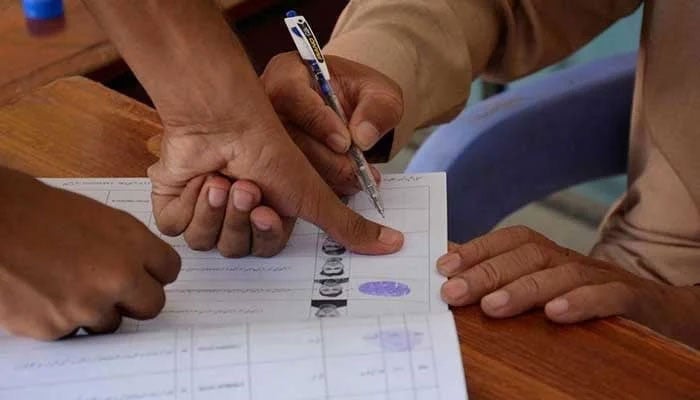
Democracy means the participation of people in the formation of their government and the right to vote is directly connected to this process. Universal suffrage is now the legal norm across the civilised and free world.
There is talk of the 28th Amendment and of raising the voting age from 18 to 25. No official position has been taken on it, but keeping in view the history of recent amendments, such an amendment may be passed overnight. The proposed amendment, if enacted, shall exclude millions of young voters from the decision-making process, the right to form a government, and deprive them of their constitutional and fundamental rights.
This experiment, if undertaken, will definitely be a retrogressive step that will add to the long and unending list of trials and errors made with the political system since the inception of Pakistan, essentially reflecting a distrust of people’s wisdom and their choices. It would also be in direct conflict with the idea of Pakistan, which was based on the will and wisdom of the Muslims of the Subcontinent who decided to have a free homeland where they would enjoy political and religious freedoms.
The constitution of Pakistan, when framed and adopted in 1973, fixed the voting age at 21 under Article 51. There is no discussion on this subject in the lengthy debates on the constitution. The voting age, census, and distribution of seats in the National Assembly that elects the prime minister under Article 91 are interconnected provisions that cannot be examined in isolation.
In 2002, the National Reconstruction Bureau of General (r) Tanveer Naqvi advised policymakers to take three critical and consequential steps to change the political scenario. All these things happened at the same time. They were: one, free and expand the electronic and social media. It was believed that free media would help counter the two major political parties, PPP and PML-N, by educating people through political discussions, debates and narratives. These political parties were cast into the shadows in the aftermath of the 1999 military takeover. They were deprived of their party names and election symbols, among other things. The PML-N also faced dispossession of its party offices and another political party was created from its defectors, leading its leadership into exile, and late Benazir Bhutto went into exile for the second time.
Two, lower the voting age from 21 to 18. It was believed that this move would dismantle the vote-bank politics of these parties, which served an older segment of the population. It was also believed that young, informed voters would outnumber older, ageing voters. Thus, through the Legal Framework Order, 2002 (LFO), the voting age was brought down from 21 to 18 by amending Article 51 of the constitution.
Three, the educational qualification of holding a BA degree was introduced in the election laws as a qualification for candidates to the national and provincial assemblies, the Senate and for office-bearers of local governments, nazims and naib nazims. This led to the obtaining of fake degrees by several traditional politicians from non-existent educational institutions and religious seminaries. Interestingly, a few years later, another Naqvi petitioned the Supreme Court and secured the disqualification of several members of the national and provincial assemblies and nazims, despite the BA degree requirement having already been declared void by the Supreme Court.
Article 21 of the Universal Declaration of Human Rights (1948), to which Pakistan is a signatory, provides that everyone has the right to participate in the process of making government through voting based on adult franchise. In 1971, the voting age was fixed at 18 in the US. In Canada, the voting age has also been 18 since 1971. The same is true in Australia, India and Bangladesh. The voting age of 18 is now almost a universal norm and many countries in Europe and South America are even considering decreasing it further to 16. The history of voting age is, in fact, the history of political consciousness, human dignity and freedom.
From a constitutional viewpoint, the voting age is not merely a constitutional and legal right, as held by the Indian Supreme Court and also cited in Pakistani cases, that can be changed by amending Article 51 of the constitution and a section of the election laws. The voting age and the right to vote are directly connected to human dignity (Article 14) and the right to freedom of political association (Article 17). It is also connected to the state’s socio-ethnic policies and the Principles of Policy set out in the constitution. The distribution of seats in the assemblies and the delimitation process for elections are linked to it. In a federation, where several factors are foundational to cohesion and smooth functioning, the voting age is one such factor that needs careful consideration before any change is made.
Dr Sonja C Grover, an associate editor of the International Journal of Human Rights, published a monograph titled ‘Young People’s Human Rights and the Politics of Voting Age’. It is a comparative study of the laws and constitutions of different countries and deeply examines the factors involved in determining the voting age.
Under Islamic law, the age of legal accountability (mukallaf) is fifteen lunar years. If a person becomes legally accountable for their acts and deeds, as well as their religious obligations, then there is no reason they should not have the corresponding right to participate in the process of making government. Islamic provisions are among the salient features of the constitution.
The age-old saying is that wisdom has nothing to do with age. The state collects taxes from underage persons and taxes can only be levied through law. Therefore, logically, everyone must have the right to elect the members of the national and provincial assemblies, taxation would be imposed without representation.
It is well known to the government and its policymaking circles that young people face hardships and numerous social and economic problems. There is widespread unemployment. There are not enough seats in colleges and universities. Parents are under tremendous stress. The socio-economic gulf between the privileged classes and ordinary people has increased to such a level that unrest, frustration and other psychological pressures are causing significant stress and strain.
Political parties in power and their leadership claim to represent the people of Pakistan. In these circumstances, an increase in the voting age merely to cling to power by less-than-democratic means may ultimately prove counterproductive.
The writer is an advocate of the Supreme Court and formeradditional attorney general for Pakistan. He can be reached at: [email protected]