For 65 years, the Indus Waters Treaty (IWT) of 1960 stood as one of the rare monuments of cooperation between two nations otherwise locked in perpetual rivalry. It survived three wars and decades of diplomatic hostility.
In April 2025, India shattered that record. In the aftermath of the Pahalgam incident in Occupied Jammu and Kashmir, New Delhi announced it would hold the treaty “in abeyance with immediate effect”. What followed has become the most dangerous water dispute in South Asia’s history, a textbook case of water weaponization that threatens the foundations of international treaty law.
The IWT, signed on 19 September 1960 under World Bank mediation and brokered over nearly a decade of negotiations, is one of the most technically precise water agreements ever concluded. It divides the six rivers of the Indus Basin into two categories. The three eastern rivers – the Ravi, Beas and Sutlej – were allocated to India. The three western rivers – Indus, Jhelum, and Chenab – were allocated to Pakistan. The treaty is a binding international agreement that, under customary international law (reflected in the Vienna Convention on the Law of Treaties), cannot be suspended or abrogated by one party’s unilateral declaration.
The language of the treaty on India’s obligations regarding the western rivers is very clear. Article III (2) of the treaty states that ‘India shall be under an obligation to let flow all the waters of the Western Rivers” and shall not permit any interference with those waters. India is therefore legally prohibited from impounding the western rivers beyond defined pondage limits, constructing gated spillways, withholding hydrological and flow data from Pakistan and building storage infrastructure beyond the treaty’s specifications. The constraints on India for the use of western water, detailed in the treaty’s elaborate annexures, were explicitly intended to protect Pakistan as the lower riparian state from upstream manipulation.
The disputes over the Kishanganga (330MW) and Ratle (850MW) hydroelectric projects (violation of the use of water of Jehlum and Chenab) on the western rivers are well documented. Pakistan’s objections centered on excessive pondage capacities, and gated spillway designs, which is an explicit violation of the treaty’s technical annexures by allowing India to artificially regulate the volume and timing of flows into Pakistani territory. These concerns are genuine as during winter months, artificial flow manipulation upstream can cause catastrophic water shortages downstream.
The pattern that emerges is consistent India has been systematically building infrastructure that expands its physical capacity to control the volume, timing and routing of western river flows, flows that sustain the lives and livelihoods of over 200 million Pakistanis. India’s conduct since 2025 is not an isolated reaction to a security crisis. It is the culmination of a long-standing pattern of upstream infrastructure expansion that has repeatedly tested the limits of treaty compliance.
In January 2026, India unilaterally approved the Dulhasti Stage-II Hydroelectric Project on the Chenab River, a 260MW facility involving a 3,685-metre diversion tunnel, horseshoe pondage structures and an underground powerhouse, without prior notification to Pakistan, without data-sharing, and in direct defiance of treaty consultation requirements. This project is one element of a larger post-abeyance strategy explicitly designed to maximise India’s hydropower capacity on Pakistan’s rivers, the Sawalkote project on the Chenab, the Pakal Dul project on the Marusudar tributary of the Chenab and the long-disputed Ratle project have all received expedited clearances and accelerated timelines – whereas, the entire architecture of the IWT rests on the principle that western river waters must be allowed to flow through India into Pakistan unhindered.
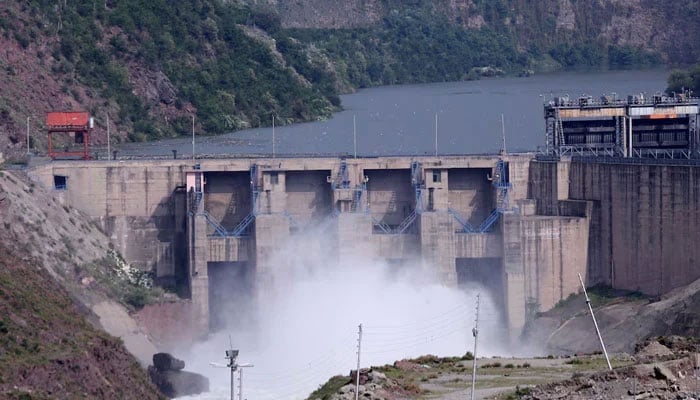
Compounding this threat is India’s plan to carry out sediment flushing operations at the Salal Dam on the Chenab River. Sediment flushing, the process of releasing accumulated silt and sediment from behind a dam in a controlled torrent, can cause sudden, massive downstream surges that devastate agriculture, destroy irrigation infrastructure, contaminate drinking water and trigger flooding. When deployed without advance notice or coordination, it transforms a hydropower facility into an instrument of hydrological warfare. Pakistan has received no prior consultation on these plans, in direct violation of the treaty’s data-sharing and notification requirements under Articles VI and VII (Exchange of Data and Future Cooperation).
The Article IX of Permanent Court of Arbitration (PCA), at the Hague, establishes a graduated dispute-resolution mechanism. In June 2025, following India’s abeyance declaration, the PCA issued a supplemental award explicitly confirming that the treaty contains no provision allowing unilateral suspension. India’s declaration of abeyance, the court found, was simply not contemplated by the treaty’s text and therefore had no legal effect on the treaty’s operation or the court’s jurisdiction.
In August 2025, the PCA issued a further award endorsing Pakistan’s historical position on key technical disputes. In May 2026, the court issued another ruling, however India has boycotted all proceedings, refused to submit written submissions, and dismissed each ruling as illegitimate, a posture that places it in open defiance of binding international adjudication and sets a dangerous precedent for the global rules-based order. Separately, UN Special Rapporteurs have formally communicated to the international community their concern that India’s actions risk violating internationally recognized human rights.
Pakistan’s dependence on the Indus Basin is not a geopolitical abstraction. The Indus system irrigates approximately 80 percent of Pakistan’s arable land. Agriculture supports roughly two-thirds of the country’s population, directly or indirectly. Hydropower from the Indus rivers accounted for 28 per cent of Pakistan’s electricity generation in 2024.
The Indus Basin also recharges the aquifers that supply groundwater to Karachi, Lahore, Faisalabad and dozens of other urban centres. The withholding of hydrological data, which India has suspended along with its treaty obligations, means Pakistan cannot accurately forecast seasonal water availability, plan irrigation schedules or manage flood risks. In a country where a single failed kharif season translates to food insecurity for millions, the political weaponization of upstream data represents a form of institutional violence against civilian populations.
Since water is not merely a resource for Pakistan, it is the condition of national survival, Pakistan’s National Security Committee declared in April 2025 that any attempt to violate, suspend or undermine the IWT would be treated as an act of war, and invoked Pakistan’s right of self-defence under Article 51 of the UN Charter. The government’s position is that these are not technical infractions to be resolved through diplomatic correspondence, they are acts of aggression against a sovereign state conducted through hydraulic means.
The concept of holding a treaty ‘in abeyance’ has no recognised standing in international law. The Vienna Convention on the Law of Treaties, whose core provisions are accepted as legal binding on all states, including India and Pakistan, is explicit. A treaty may be suspended only by agreement of all parties but no such condition was invoked formally by India, and none would be legally sustainable in this context.
The IWT itself states that it ‘shall continue in force until terminated by a duly ratified treaty concluded for that purpose (XII:4)”. It contains no exit clause, no suspension mechanism, and no provision for abeyance. India’s declaration was therefore not a legal act, it was a political statement dressed in legal language, testing the international community’s tolerance for treaty violations.
Pakistan’s position is legally grounded and internationally supported, the IWT is alive, its provisions are binding and India’s unilateral suspension has no legal effect. The PCA has affirmed this three times. UN human rights rapporteurs have endorsed the concern. The international community’s failure to enforce these findings is not a validation of India’s position, it is a failure of the global order itself.
The writer is an associate professor of international relations and head of the departments of international relations and peace and conflict studies at the National University of Modern Languages (NUML), Islamabad.