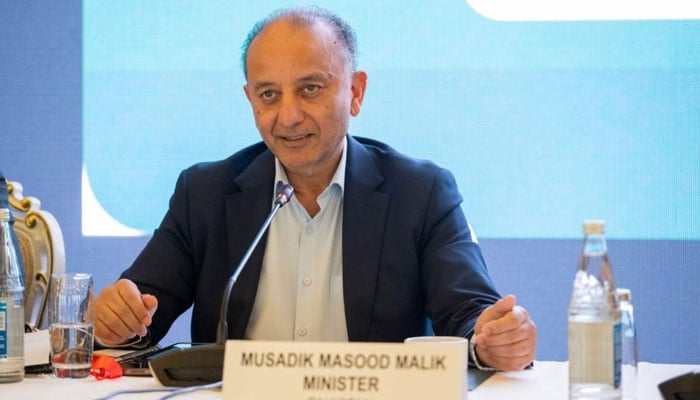
Last Tuesday, the climate change and environmental coordination minister said that India was attempting to politicise shared water resources in violation of long-standing international commitments, including the Indus Waters Treaty. These comments came while he was addressing the fourth international conference on the International Decade for Action on Water for Sustainable Development in Dushanbe, Tajikistan. The minister warned that efforts to undermine international water-sharing agreements could jeopardise the rights of downstream nations. It is apparently not enough for Pakistan to have to grapple with the disruption of two major commodities (oil and gas), given the situation in the Strait of Hormuz. India’s unilateral abeyance of the Indus Waters Treaty following last year’s Pahalgam attack now poses a potential threat to its water as well. However, unlike fuel, there are simply no alternatives to water and, for Pakistan, the waters of the Indus are the lifeblood of its agricultural economy. As such, the climate minister was right to stress that no country should be allowed to use water as a weapon or suspend international agreements unilaterally while depriving other nations of their lawful water rights. For all the disagreements that plague the country’s political landscape, leaders across the political spectrum have warned that attempts to deprive the country of its rightful share under the treaty would have grave consequences for regional peace and stability.
This is an issue on which Pakistan has the backing of the relevant international laws and bodies. Earlier last month, the country welcomed the Court of Arbitration’s recent supplemental award concerning the Ratle and Kishenganga hydropower projects under the Indus Waters Treaty, saying the ruling reinforces key limitations on India’s use of the Western Rivers. However, as the climate minister noted in his remarks, we live in an era in which multilateralism in global affairs counts for less, and cooperative international frameworks are increasingly being replaced by unilateral approaches. Predictably, India has rejected the ruling outright, calling the court “illegally constituted” and insisting that its decision to hold the treaty in abeyance remains in force. That being said, India is not the US or Israel, as much as it may want to be. Its efforts to isolate Pakistan have largely backfired, while India’s own international standing is rapidly sinking. In fact, this whole Indian effort to exploit its upper-riparian position appears to be borne of the fact that it was decisively beaten by Pakistan in last year’s war. Where military measures have failed, India now resorts to threatening Pakistan’s fundamental human rights.
With India seemingly determined to continue using water as a weapon, Pakistan must continue to pursue its case in the relevant international fora and seek ways to maintain its water security. India is far from the only water problem Pakistan faces. Climate change is also exacerbating water stress and recent reports have highlighted deteriorating water quality due to pollution, salinity, odour, etc in the Indus Basin Irrigation System. This is not to downplay the threat posed by India but to stress how the importance of managing the country’s water in a sustainable and efficient manner is only magnified by the Indian threat. And this is not a problem for Pakistan alone to solve. If the international system allows an upper-riparian to bully its neighbour and get away with it, that simply throws another international norm into the bin and sets a dangerous precedent for downstream countries across the world, as the climate minister pointed out. Clean water is a fundamental human right and it cannot be taken away by belligerent neighbours with pretensions to regional hegemony.