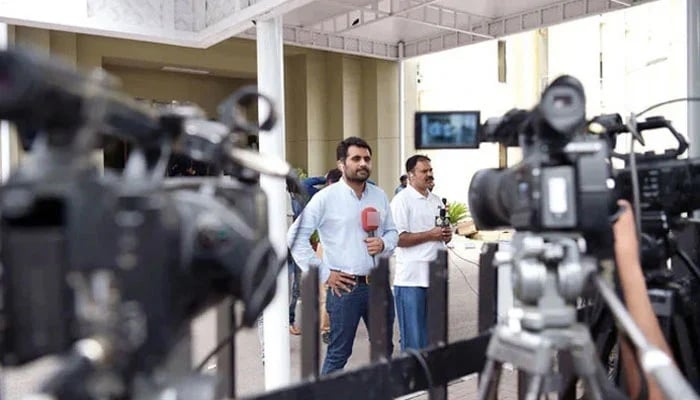
The warning issued this week by more than 600 journalists and media workers gathered in Islamabad should not be dismissed as routine professional dissatisfaction. The fact is that the space for independent journalism in Pakistan is shrinking at an alarming pace. Journalists have rightly condemned the recent amendments to the Prevention of Electronic Crimes Act (Peca) as a “draconian black law”, increasingly being used to regulate, intimidate and silence critical voices rather than protect citizens from genuine online harms. Journalism in Pakistan has never been an easy profession. The country’s political history is replete with examples of censorship, media crackdowns and restrictions on the free flow of information. In the past, such measures were often associated with military rule or periods of overt authoritarianism. Today, however, censorship is increasingly wrapped in the language of legality and regulation. While governments argue that laws such as Peca are necessary to combat misinformation and cybercrime, many journalists view the amendments as part of a broader pattern aimed at discouraging scrutiny and criticism.
This concern does not emerge in a vacuum. Over the past several years, numerous incidents have reinforced perceptions that journalists face undeclared punishment for performing their professional duties. Reporters have allegedly been offloaded from flights, prevented from travelling abroad without explanation and subjected to legal proceedings under cybercrime laws. Media organisations have faced economic pressure through the withholding of government advertising, while journalists continue to operate in an environment where uncertainty and fear have become increasingly common. The consequences extend far beyond individual reporters. Pakistan’s media industry has been struggling with severe financial difficulties for years. News organisations have downsized operations, frozen hiring, delayed salaries and laid off experienced staff. As independent reporting becomes economically unsustainable, investigative and public-interest journalism inevitably suffers. Equally troubling is the erosion of labour rights within the media sector. The concerns raised regarding third-party hiring arrangements and the denial of basic protections such as health insurance, gratuity and EOBI benefits highlight a deeper crisis.
The government must recognise that accountability is not a threat to the state. Attempts to weaken or intimidate the media merely drive it into less accountable spaces. This is particularly important in the digital age. Journalism is evolving rapidly, with digital-only outlets and independent journalists increasingly complementing traditional newspapers and television networks. These new platforms often operate without the institutional protection available to large media houses, making them especially vulnerable to vaguely worded laws and arbitrary enforcement. While regulation of digital spaces may be necessary to address genuine concerns such as disinformation and online abuse, such regulation must be narrowly tailored, transparent and consistent with constitutional guarantees of free expression. Article 19 of the Constitution promises citizens the right to freedom of expression. That promise cannot remain conditional upon political convenience or institutional sensitivities. If the country is serious about strengthening democratic institutions and building public trust, it must stop treating journalism as a problem to be managed and start recognising it as a national asset to be protected.