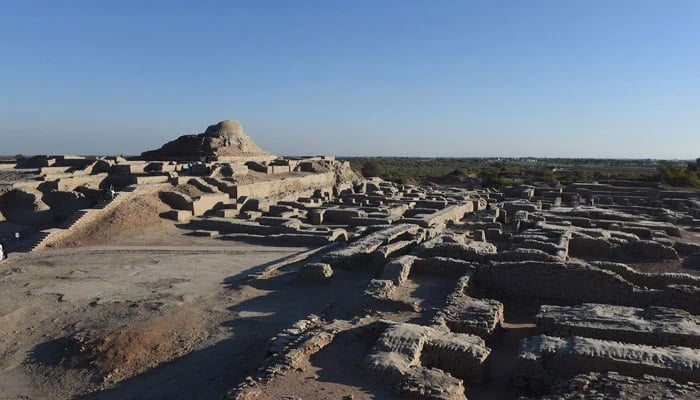
The Sindh government has rejected what it described as an attempt by India’s ministry of culture to lay claim to the ancient civilisation of Mohen-jo-Daro, asserting that any effort to distort the site’s historical identity was unacceptable and contrary to the established historical facts.
Sindh Minister for Culture and Tourism Syed Zulfiqar Ali Shah said that any attempt to misrepresent the history of Mohen-jo-Daro would be firmly opposed.
He stressed that altering historical facts undermined both academic integrity and cultural honesty.
The culture minister stated that Mohen-jo-Daro was an inseparable part of the cultural heritage of Sindh and Pakistan.
He emphasised that claims suggesting exclusive ownership of the Indus Valley civilisation by any single country were inconsistent with historical realities.
Shah noted that Mohen-jo-Daro was one of the world’s most significant archaeological sites and had been recognised as a World Heritage Site by the United Nations Educational, Scientific and Cultural Organisation (Unesco).
He said the city’s historical identity and status were beyond dispute and supported by extensive archaeological evidence.
Referring to renowned artefacts unearthed at the site, including the iconic ‘dancing girl’ statue, the culture minister said these discoveries formed an integral part of Sindh’s cultural legacy and historical heritage.
He further observed that the Indus Valley civilisation existed thousands of years before the emergence of modern nation-states, making attempts to appropriate its legacy for contemporary political purposes historically inaccurate.
The culture minister reiterated that the Sindh government rejected every attempt by India to attribute the heritage of Mohen-jo-Daro exclusively to itself.
He described Mohen-jo-Daro as a symbol of the great civilisation that once flourished on the land that now constituted Pakistan.
Shah warned that any misinterpretation or misrepresentation of Sindh’s historical heritage would not be tolerated, adding that preserving the authenticity of the region’s rich past remained a priority for the provincial government.
As of now, six sites in Pakistan have been included in the World Heritage Sites by Unesco. Of them, two are situated in Sindh — Mohen-jo-Daro and Makli.
Recently, Unesco added three more sites from Sindh in its tentative list for World Heritage. The three sites are the Kot Diji, Naukot and Umerkot forts.
With these additions, the number of heritage sites in Pakistan on the tentative list has increased from 25 to 29.
According to Unesco’s website, a country must prepare an inventory of important natural and cultural heritage sites within its boundaries, known as the Tentative List. “It is an important step since the World Heritage Committee cannot consider a nomination for inscription on the World Heritage List unless the property has already been included on the State Party’s Tentative List,” it says.