ISLAMABAD: Pakistan’s security sources on Monday dismissed an “angled” report by Reuters regarding the deployment of Pakistani troops and fighter jets in Saudi Arabia, saying it misrepresents “the true essence of historic relations and strategic partnership between two brotherly countries.”
Reuters reported Pakistan has deployed 8,000 troops, a squadron of fighter jets and an air defence system to Saudi Arabia under a mutual defence pact, ramping up military cooperation with Riyadh even as Islamabad serves as the main mediator in the Iran war.
The news agency said the deployment the “full scale of which is reported here for the first time”, was confirmed by three security officials and two government sources, all of whom described it as a substantial, combat-capable force intended to support Saudi Arabia’s military if the kingdom comes under further attack.
The news outlet said Pakistan’s military and foreign office and Saudi Arabia’s government media office did not respond to requests for comment on the deployment.
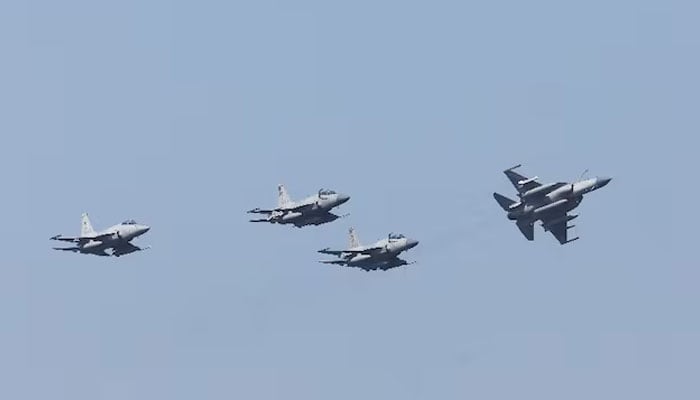
Reuters reported that the full terms of the defence agreement, signed last year, are confidential, but both sides have said it requires Pakistan and Saudi Arabia to come to each other’s defence in the event of an attack. Defence Minister Khawaja Asif has previously implied that it places Saudi Arabia under Pakistan’s nuclear umbrella. According to the sources quoted by Reuters, Pakistan has deployed a full squadron of around 16 aircraft, mostly JF-17 fighters made jointly with China, which were sent to Saudi Arabia in early April. Two of the security officials said Pakistan had also sent two squadrons of drones.
All five sources said the deployment includes around 8,000 troops, with a pledge to send more if needed, as well as a Chinese HQ-9 air defence system. The equipment is operated by Pakistani personnel and financed by Saudi Arabia, they said.
The military and air force personnel deployed during the Iran conflict will primarily have an advisory and training role, according to two of the security officials, who said they had seen exchanges between the two countries and documents on the military assets’ deployment.
The deployment adds to thousands of Pakistani troops with a combat role that were already stationed in the kingdom under previous agreements, all three security officials said.
One of the government sources, who has seen the text of the confidential defence pact, told Reuters it provides for the possibility of up to 80,000 Pakistani troops being deployed to Saudi Arabia, to help secure the kingdom’s borders alongside Saudi forces.
Two of the security officials told Reuters the agreement also involved the deployment of Pakistani warships. The news agency was not able to determine whether any had reached Saudi Arabia.
The scale and composition of the deployment — combat aircraft, air defences and thousands of troops — mean Pakistan has sent far more than a symbolic or advisory mission, the sources said.
Pakistan security sources said, “The recent story by Reuters on deployment of Pakistani military component in KSA is angled and misrepresent the true essence of historic relations and strategic partnership between two brotherly countries.”
The sources said the reporting by Reuters must be “contextualized within the long-standing, transparent, and institutionalized framework of bilateral relations between the Islamic Republic of Pakistan and the Kingdom of Saudi Arabia (KSA). Speculative framing that links these routine and treaty-bound engagements to specific, evolving regional conflicts misrepresents the foundational principles of the Pakistan-KSA strategic partnership.” The sources said. “The friendship between Pakistan and Saudi Arabia is not a reactionary alliance driven by temporary geopolitical shifts. Instead, it is a time-tested, deep-rooted brotherhood bound by shared religious, cultural, social, political, and economic convergences. Decades of mutual trust form the bedrock of this relationship, ensuring that bilateral cooperation remains consistent regardless of the changing regional landscape.”
The security sources reiterated, “For Pakistan, the security of Saudi Arabia is inextricably linked to the sanctity of the Harmain Shareefain (the Holy Mosques in Makkah and Madinah). The people and the armed forces of Pakistan take immense pride in their historic role as protectors of these holy sites. This commitment transcends standard geopolitical agreements; it is a matter of profound faith and pride for entire Pakistani Nation.”
The sources maintained, “Pakistan remains completely committed to the Strategic Mutual Defence Agreement (SMDA) and is fully aware of its institutional obligations regarding the territorial integrity and defence of KSA. Any bilateral deployments, training exercises, or defense cooperation initiatives are conducted strictly within the boundaries of these pre-existing, formal defense frameworks. They are defensive and stabilizing in nature, rather than offensive or provocative.”
They stated, “Pakistan’s official stance has been repeatedly and transparently communicated at the highest levels. As explicitly clarified by the DG ISPR in his press briefing on May 7, the security of Saudi Arabia is of paramount importance to Pakistan. The state of Pakistan has openly reaffirmed that the security of the two Holy Mosques is directly linked to KSA’s stability, and Pakistan will honor its historic pledge to stand by the Kingdom against any threats to its territorial sovereignty. Security sources reiterated”
“The security and stability of Pakistan is of paramount importance to the Kingdom of Saudi Arabia, reflecting a deeply reciprocal and strategic partnership. Saudi Arabia has consistently demonstrated this commitment by providing crucial financial lifelines, energy security assistance, and economic investments during Pakistan’s challenging times. Ultimately, both nations recognize that their security architectures are deeply intertwined, meaning that any threat to Pakistan’s stability directly impacts Saudi Arabia’s strategic and economic interests in the region,” the sources concluded.