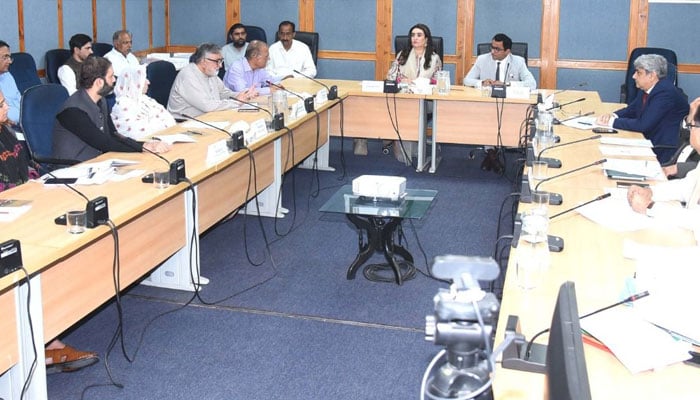
ISLAMABAD: The Senate Standing Committee on Federal Education and Professional Training on Monday approved multiple bills aimed at ensuring 33 per cent women representation in all federal bodies, in line with the Prime Minister’s directive.
The committee endorsed amendments to ensure uniform 33pc women representation across federal boards, statutory bodies, public sector organisations, universities, and allied committees. Officials said the changes were being implemented across multiple laws, including the National Rahmatul-Lil-Aalameen Wa Khatamun Nabiyyin Authority Act, 2022, Area Study Centres Act, 1975, and the National Textile University, Faisalabad (Amendment) Bill, 2025. The National Textile University amendments also aim to ensure women’s representation in governance structures and faculty, alongside broader administrative reforms.
Similarly, amendments to the Centre for Clinical Psychology Centres Act, 1983 incorporate mandatory 33pc women representation and administrative changes vetted by the Ministry of Law and Justice.
The committee also approved renaming and restructuring provisions under the NFC Institute of Engineering and Technology Multan Act, 2012, including renaming it as the Federal Institute of Engineering, Sciences, Technology and Arts (FIESTA), Multan, and changing the pro-chancellorship from the NFC chairman to the Federal Minister for Education.
Members stressed that women’s inclusion in decision-making forums was essential for institutional balance, transparency, and progressive governance. The committee termed the reforms a positive step towards inclusive education governance.
The committee also reviewed welfare measures for visually impaired students, noting that examination rules already provide writer or amanuensis support without fees, with Rs1,000 per paper remuneration for writers. Additional facilities include 45 minutes extra time and large-font papers on request. Officials also briefed that a fully online, paperless degree attestation system is being developed by the Higher Education Commission (HEC), with blockchain-based verification and 24/7 digital applications.
The system, already operational since May 11, 2026, allows online applications and downloadable e-attestation certificates, with only original degrees being processed.
The committee expressed serious concern over recurring Cambridge examination paper leak allegations, including reports of 11 leaked papers in the current cycle. Members said such incidents damage Pakistan’s international image and must be thoroughly investigated. The committee also noted student concerns raised under the “Accountability4Cambridge” movement, calling for transparency, accountability in investigations, and fair compensation mechanisms such as threshold normalisation instead of retakes.