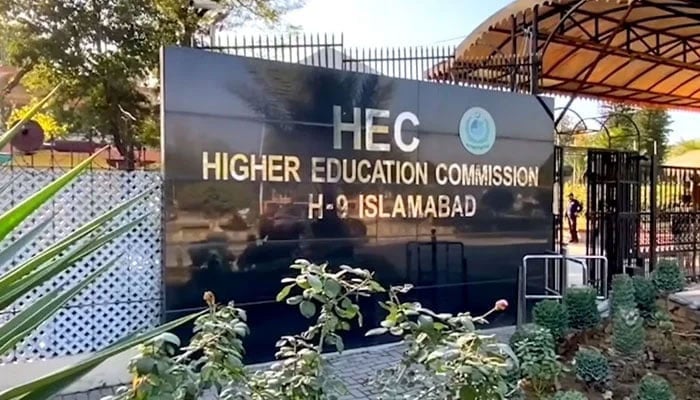
The Higher Education Commission (HEC) has issued a notification introducing a comprehensive policy on dual, double and joint degree programmes aimed at aligning Pakistan’s higher education sector with international standards. The policy has come into immediate effect, and would allow Pakistani universities to launch collaborative academic programmes with local and foreign institutions.
Under the new framework, Pakistani and international universities would be able to jointly offer programmes, enabling students to earn two degrees or a jointly awarded qualification within an integrated period of study.
According to the HEC, the initiative is intended to strengthen international academic linkages, promote student mobility, expand research collaboration, and enhance the global recognition and employability of Pakistani graduates.
The policy states that under a dual degree arrangement, students may obtain two separate degrees in related or distinct disciplines, while double degree programmes would enable partner universities to award separate degrees in the same discipline. In joint degree programmes, two or more institutions would jointly award a single degree carrying the signatures of all the collaborating universities.
HEC Chairman Dr Niaz Ahmad said that such collaborations would only be permitted with internationally recognised foreign universities whose relevant academic programmes hold prominent positions in global rankings.
Partner institutions will be required to sign a formal memorandum of commitment covering fee structures, credit transfer mechanisms, examinations, student mobility, research collaboration, degree issuance and student protection arrangements, he added.
Under the policy, students would also receive a detailed diploma supplement specifying the credits completed at each institution, language of instruction and the nature of the collaborative programme.
Education experts believe the policy would provide Pakistani students access to internationally recognised education without bearing the heavy costs of completing full degree programmes abroad.
Students will be able to benefit from foreign faculty, research facilities and modern curricula during the course of a single programme, improving both academic exposure and professional skills. Experts also note that graduates holding global or jointly awarded degrees would have enhanced opportunities for higher education and employment internationally.
The policy is also being viewed as significant for universities, as it is expected to strengthen research linkages, faculty exchange programmes, collaborative research projects and international rankings of Pakistani institutions. Analysts say the initiative could help attract foreign students to Pakistan, and contribute to the development of a more modern academic and research environment.
According to the HEC, all the collaborative programmes would remain subject to regular monitoring and quality assurance reviews, while universities would be required to submit annual reports on academic standards, research output, student performance and graduate employability. The HEC has warned that action might be taken against the programmes failing to meet the prescribed standards.