Pakistan’s vulnerability to shocks is not incidental, but rather a function of how its economy grows.
This latest tremor (the Iran-Israel-US confrontation) is impacting Pakistan through familiar channels: higher oil prices, pressure on remittances, disrupted trade routes, and jittery investor sentiment. But this is not an isolated episode.
The past five years have seen Pakistan lurch from one disruption to another: the Covid-19 contraction, the 2022 floods that caused roughly $30 billion in damages and losses, the concurrent default crisis, and now the inflationary pressures from international supply chain shocks. The pattern is clear. External shocks are inevitable. What is not inevitable is the economy’s continued exposure to them.
This fragility belies a simple macroeconomic reality: Pakistan grows too slowly, and too narrowly, to build resilience. One of the most significant, and persistently overlooked, reasons is the underutilisation of its female workforce.
According to recent World Bank estimates, female labour force participation (FLFP) in Pakistan hovers around 24 per cent, despite making up nearly half of the country’s population. FLFP is significantly higher in comparable emerging economies: Vietnam 69 per cent, Ethiopia 59 per cent and Bangladesh 39 per cent. Consequently, Pakistan operates below its productive potential, constraining its growth trajectory.
The relationship between labour force participation and economic growth is straightforward. Expanding the labour pool can increase an economy’s capacity to produce goods and services, raising its output. More significantly, higher FLFP can strengthen an economy’s resilience.
First, it expands the economy’s productive base. Pakistan’s growth has remained stuck at 3-4 per cent in recent years. One reason is the reliance on a narrow set of inputs, limited capital, low productivity and a constrained workforce. Increasing FLFP directly relaxes one of these constraints, thereby improving macroeconomic resilience to shocks.
Second, it stabilises households. Dual-income households are better able to absorb income shocks and avoid falling into poverty during downturns. Women’s earnings are also strongly associated with improved household resilience, an effect that becomes particularly important in periods of economic stress.
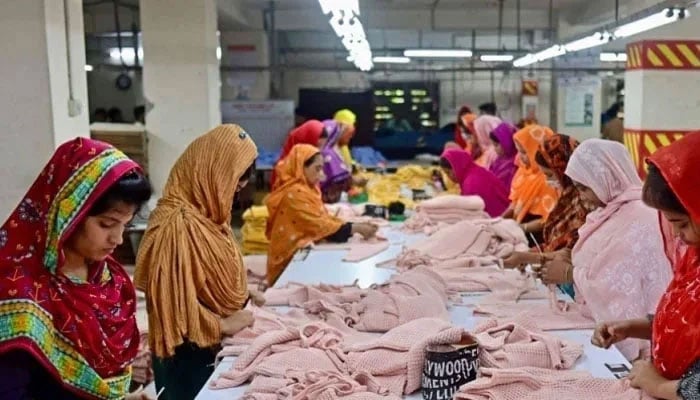
Third, it enhances sectoral competitiveness. Currently, women are concentrated in labour-intensive sectors (agriculture and light manufacturing), which typically drive early-stage industrial growth. Pakistan has not been able to scale these sectors like its regional peers, such as Bangladesh, have. Increased FLFP can provide resources to scale up and enhance diversification across economic sectors.
Fourth, higher participation broadens the tax base. More workers mean more income, more consumption, and ultimately, greater fiscal capacity. This allows the state to respond more effectively to shocks.
The mechanism here is clear: low FLFP constrains economic growth; constrained growth weakens buffers to external shocks, thereby amplifying their effect. The inverse is equally true. Thus, a more inclusive labour market is more than just a social goal; it is an economic stabiliser.
Why, then, has Pakistan remained stuck? The barriers are less about willingness and more about structure. A large share of women’s work remains informal, unpaid or home-based. Practical constraints (mobility, safety, childcare, enforcement of minimum wage and workplace standards) reduce the effective supply of female labour. Skills development systems are poorly aligned with demand. And finally, labour markets are segmented, with limited pathways for women to move into higher-productivity roles.
Policy responses have increasingly emphasised digitisation and access to finance. While both are important, these are partial solutions. Digital inclusion and credit access can facilitate participation at the margins, but they do not, on their own, resolve deeper structural constraints. Without addressing these underlying frictions, such interventions risk expanding low-productivity or informal work rather than driving meaningful growth.
Addressing this requires moving beyond a one-size-fits-all approach to segmented policy solutions.
For unskilled women, the priority is entry. This means formalising and scaling home-based work, integrating more women into agricultural value chains where they are already active, and expanding public works programmes, particularly in climate adaptation and local infrastructure. Interventions such as community-level childcare and safe transport can also significantly increase participation.
For semi-skilled women, the challenge is productivity. Technical and vocational training should be aligned with labour market demand and evolving economic diversification. Firms -- especially in textiles, retail and logistics -- should be incentivised to hire and retain women through time-bound subsidies or tax credits. Building women-inclusive
SME clusters can also help move workers into more productive segments of the economy.
For skilled women, the issue is retention. Pakistan produces a significant number of educated women who then exit the workforce. Flexible work arrangements, employer-supported childcare, and structured re-entry programmes can help prevent this loss of human capital. Targeting high-growth sectors such as IT and professional services can further amplify returns. Incentivising entrepreneurship and growth by offering preferential terms on capital availability can drive gains across segments.
An economy that underutilises half its workforce will remain trapped in low growth, dependent on external financing and vulnerable to every external shock. This is no longer a tolerable equilibrium; it is a systemic risk.
Increasing FLFP is not about equity alone. It is about expanding the economy’s capacity to grow, adapt and withstand shocks. Pakistan’s women are a deeply underutilised economic asset. Unlocking the value of that asset is essential for resilience in an increasingly volatile world.
Maheen Saleem Farooqi is a manager at Tabadlab. Dr Zainab Latif is a senior fellow at Tabadlab.