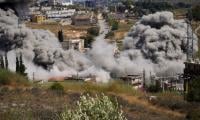
One year ago, India launched Operation Sindoor -- 23 minutes of precision strikes deep inside Pakistan, followed by four days of drone warfare and aerial combat that brought two nuclear-armed states closer to the brink than at any time since 1971.
A US-brokered ceasefire went into effect on May 10, 2025. But India extracted no meaningful concession from Pakistan. What it weaponised instead was something potentially more consequential than airpower: water.
One year on, the Indus Waters Treaty remains suspended. All gates of the Baglihar Dam on the Chenab River remain shut. India’s Ministry of External Affairs, speaking recently, is unmoved: the treaty “stands in abeyance” and will remain so until Pakistan “credibly and irrevocably” abandons its support for cross-border terrorism. No timeline. No process. No negotiation. A unilateral lock on the arterial veins of a nation of 255 million people.
For more than six decades, the 1960 Indus Waters Treaty was the one unbreakable constant in India-Pakistan relations. Wars in 1965, 1971, and 1999. Cross-border terrorism. Nuclear tests. Frozen diplomacy. Yet the rivers -- Indus, Jhelum, and Chenab -- kept flowing to Pakistan under ironclad rules. Those waters irrigate 80 per cent of Pakistan’s farmland, drive roughly a quarter of its GDP and sustain the livelihoods of nearly 40 per cent of its workforce. Predictability was the treaty’s genius in a region where agriculture is not an industry but the fragile spine holding the state together.
That era ended on April 23, 2025. The day after militants slaughtered 26 tourists in Pahalgam’s Baisaran Valley, India placed the entire treaty ‘in abeyance’ without any moral, political, or legal justification. Hydrological data-sharing stopped instantly. Flood forecasts vanished. Permanent Indus Commission meetings were cancelled. New Delhi accelerated hydropower projects on the western rivers it had long been constrained from exploiting.
“Blood and water cannot flow together”, declared Indian Prime Minister Narendra Modi. Indian Home Minister Amit Shah was brutally explicit: the treaty “will never be restored… We will take water that was flowing to Pakistan to Rajasthan. Pakistan will be starved of water that it has been getting unjustifiably”.
With the treaty suspended, the guardrails disappeared overnight. India gained the power to flush reservoirs, adjust releases, and time diversions without notice or consultation. For a downstream economy built on seasonal certainty, the impact was immediate and merciless. Planting cycles collapsed. Yields of wheat, rice, cotton and sugarcane dropped. Food prices spiked in an economy already battered by debt and inflation.
Hydroelectric output -- roughly 30 per cent of Pakistan’s electricity -- turned erratic, hammering industry and blacking out homes. None of this requires a total cutoff. Repeated, small shifts in timing and volume, amplified by Pakistan’s chronically insufficient storage and worsening climate stress, are enough to inflict compounding, cascading pain.
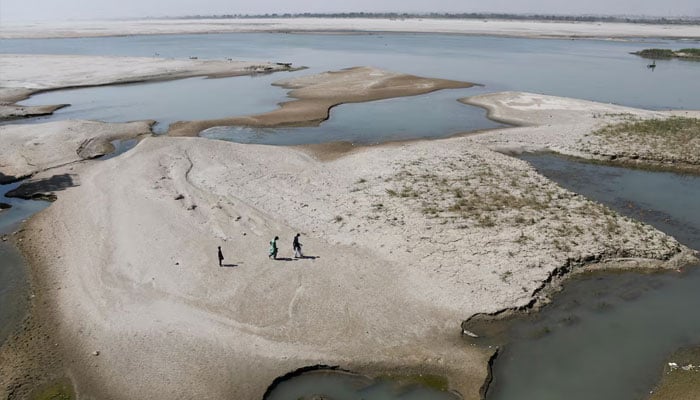
That storage deficit cannot be overstated. Pakistan stores only approximately 30 days of water supply against a recommended benchmark of 1,000 days for a country with its climatic characteristics. It is not merely vulnerable to upstream manipulation -- it is constitutionally exposed to it. The situation is deteriorating: climate change has already caused a net loss of 24.8 per cent in perennial snow and ice cover across the Indus basin between 2001 and 2021. India, meanwhile, is building rapidly.
Occupied Jammu and Kashmir’s installed hydropower capacity of 3,540 MW is expected to rise to 5,164MW -- a 46 per cent increase -- by December 2026 as the Pakal Dul and Kiru projects come online. Concrete is setting. The asymmetry is hardening with every passing month.
Pakistan’s response has been energetic yet revealingly ineffective. It rushed the dispute to the Permanent Court of Arbitration in The Hague, which ruled repeatedly that the treaty permits no unilateral abeyance and that obligations remain legally binding. India dismissed every ruling as ‘illegal and void’, boycotted hearings, and kept building. A Neutral Expert’s April 2026 award on the Kishanganga and Ratle designs largely upheld India’s interpretations but changed nothing on the ground. By the time legal clarity fully arrives, the concrete will have set upstream.
The central question for Islamabad is whether it can leverage its refurbished global relationships to exert meaningful pressure on India. The answer, so far, is no. Years of outreach to Gulf monarchies, Beijing and Western capitals have yielded economic lifelines but no coercive leverage over water. Beijing refuses to risk its balancing act within BRICS and the Shanghai Cooperation Organisation. Gulf monarchies counsel ‘restraint’. Western governments stay conspicuously silent. India even seized World Water Day at the United Nations in March 2026 to advocate for treaty revision, framing it as enlightened modernisation -- repackaging geopolitical coercion as multilateral responsibility. The audacity has gone entirely unanswered.
The consequences are not abstract. The Indus basin is home to 195 million Pakistanis -- more than three in four of the country’s citizens -- living across a river system that covers 65 per cent of Pakistan’s national territory. Disruptions feed food inflation, erode rural incomes, weaken export earnings and fray social stability. Add a pre-existing water quality crisis contaminating supplies for millions, and the picture is dire. This is slow-motion strangulation, not dramatic cutoff -- precisely what makes it so dangerous and so difficult to rally the world against.
The guns of Operation Sindoor fell silent after 88 hours. The water war has no ceasefire. India established a precedent that it will use the pretext of state-sponsored terrorism with conventional military force despite the nuclear dimension and has signalled that such operations remain open-ended. Water is now the extension of that doctrine by other means: persistent, compounding, and calibrated below the threshold that triggers international outrage or Pakistani military response.
What began as a rules-based disagreement has become raw upstream leverage. India treats the treaty as a framework to be discarded when it no longer serves strategic priorities. Pakistan still litigates and lobbies as though the old rules bind both sides equally. The gap between those realities widens with every withheld dataset, every new dam, every ignored court order.
The treaty’s text survives on paper. But the restraint that gave it force has been discarded. Water -- once the last reliable constant between nuclear-armed rivals, the one agreement that outlasted every war -- is now simply another domain of competition, managed, timed and withheld according to strategic need.
The rivers will keep flowing. The question Pakistan confronts -- urgently, without illusion and with no rescue in sight -- is whether it can endure before upstream control over river timing reshapes not merely its fields, but the future of the state itself. This is no longer a story about diplomacy’s limits but about survival.
The writer is former head of Citigroup’s emerging markets investments and author of ‘The Gathering Storm’.