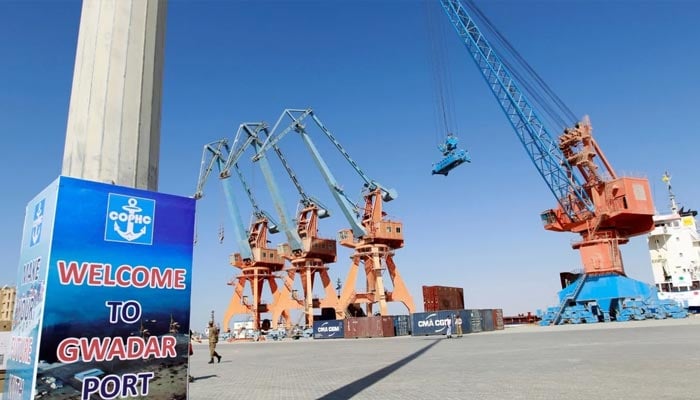
ISLAMABAD: Minister for Maritime Affairs Muhammad Junaid Anwar Chaudhry on Monday announced major reductions in Gwadar Port tariffs as part of efforts to attract global shipping lines, expand regional trade connectivity and strengthen the port’s position as a competitive logistics hub.
In a statement, the minister said the revised policy is designed to significantly increase transit and international transhipment container traffic through Gwadar, while attracting global shipping lines and enhancing overall port activity.
“Under the revised tariff structure, berthing fees for container vessels and ships carrying transit or transhipment cargo have been reduced by 25%. Charges on international transhipment container cargo have been slashed by 40%, while transit container cargo charges have been cut by 31%,” he said.
In a major incentive aimed at improving cargo handling efficiency, the port will also provide one month of free storage for general cargo, compared to the standard five-day allowance at other national ports.
“These incentives take effect immediately, and further adjustments will be reviewed in phases based on operational data and market response,” the minister added, noting that future revisions would be guided by cargo trends, regional competition, and sustainability considerations.
Chaudhry said the measures form part of a broader strategy to transform Gwadar into a competitive, investor-friendly, and modern deep-sea port serving as a strategic gateway for trade with Central Asia, the Middle East, East Africa and beyond.
He said that amid rising demand for low-cost and congestion-free shipping routes, Gwadar is well placed to capture a larger share of regional trade flows. The revised tariff regime, he added, is expected to reduce operational costs for shipping lines, encourage new transhipment and feeder services, and increase cargo throughput.
“This initiative will stimulate economic activity in the country, generate employment opportunities, and expand Pakistan’s logistics and maritime sectors,” Chaudhry said.
Meanwhile, the Chairman of Gwadar Port, Noorul Haq Baloch, has said that significant growth in employment opportunities is expected in Balochistan as the newly introduced tariff structure is set to boost commercial activity.
In a statement, Gwadar Port’s chairman noted that reduced fees and improved facilities will attract both local and international investors, accelerating economic development in the region and creating new job opportunities.
Separately, the maritime affairs minister announced the successful berthing of another cargo vessel at the Gwadar port, highlighting the growing transhipment potential of the Gwadar Port Authority.
In a statement, the minister said that MV Yuan Hang Wei Ye berthed at Gwadar Port at 10:15am on May 11, carrying approximately 34,000 tonnes of cargo comprising around 20,000 pieces.
He noted that the vessel is engaged in transhipment operations and is carrying consignments destined for Abu Dhabi and Kuwait, which will be offloaded at Gwadar.
Chaudhry termed the development a positive sign for the port’s increasing role in regional maritime trade, adding that such operations reflect growing international confidence in Gwadar’s facilities and its strategic position as a transhipment hub.
He reiterated the government’s commitment to further enhancing port infrastructure and services to attract greater volumes of global shipping traffic.