RAWALPINDI: Prime Minister Shehbaz said on Sunday Marka-e-Haq was etched in history as an epic feat of achieving overwhelming dominance over an enemy bent on unprovoked aggression, and the adversary was administered a heavy dose of reality serum to dispel its illusion of invincibility.
In his message on the first anniversary of the victory, he said, “Marka-e-Haq bears testimony that Pakistanis are a peace-loving, yet courageous, resilient and dignified nation who can neither be intimidated nor subdued by any aggressor”.
He said that well-coordinated and synchronised response of Pakistan forces across land, sea, air and cyber domains established Pakistan as an invincible nation. “Marka-e-Haq is a day to bow in gratitude before Allah Almighty for His countless blessings upon us. Today, we commemorate Pakistan’s valiant stand in adversity and the crushing defeat we inflicted on the enemy,” he said adding that the nation pays tribute to its martyrs, their families and the ghazis who stood like a steel wall to defend their homeland.
The PM also paid tribute to the Chief of Army Staff and Chief of Defence Forces Field Marshal Asim Munir for his bold and courageous leadership. “We also pay tribute to Air Chief Marshal Zaheer Ahmed Baber and Admiral Naveed Ashraf for their strategic prudence,” he added.
He pointed out that Pakistan clearly manifested its desire for peace, while re-establishing deterrence and safeguarding its security, sovereignty and territorial integrity. However, he maintained that there should be no doubt that any aggression to undermine Pakistan would be met with an immediate, befitting and full-spectrum response. “We stand determined and vigilant to ensure security along our frontiers. We also remain steadfast in our efforts to root out Fitna al-Khawarij and Fitna al-Hindustan and take the fight against terrorism to its logical conclusion,” he said.
Shehbaz also saluted officers and soldiers of the valiant armed forces who, with unflinching support of the Pakistani nation, inscribed a new chapter in Pakistan-India context.
He mentioned that today Pakistan is recognised as a responsible nation that not only knows how to defend itself, but has also emerged as a guarantor of global peace and stability.
He also noted that Pakistan’s pivotal role as a key mediator during the ongoing US-Iran conflict and our efforts to seek an end to violence, has earned world-wide acknowledgement.
The PM reaffirmed that Pakistan remains committed to its efforts aimed at peaceful resolution of the conflict. “Commemorating the sacrifices of our martyrs during Marka-e-Haq, let us pledge to face our adversaries like a ‘steel wall’ and work selflessly for the destined glory of this great homeland,” he added.
Reiterating Pakistan’s stance on Kashmir, he maintained that no story of Pakistan is complete without Kashmir, which remains the unfinished agenda of the Subcontinent’s partition.
The premier said strategic stability in South Asia without resolution of the Kashmir issue would remain a distant dream, which needed resolution in accordance with the United Nations resolutions and aspirations of the Kashmiri people. “Pakistan shall continue to stand by the fundamental right of freedom and self-determination of Kashmiri people.”
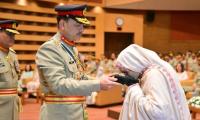
Meanwhile, Field Marshal Asim Munir, Chief of Army Staff (COAS) and Chief of Defence Forces (CDF), Sunday warned India of painful, far-reaching and dangerous consequences of any future misadventure.
“Consequences of any future misadventure if imposed on Pakistan will not be limited but will have far-reaching, dangerous and painful consequences,” he stated while addressing a special ceremony, held here at the GHQ in connection with the first anniversary of Marka-e-Haq. He described the conflict as a decisive battle between two ideologies in which truth prevailed while falsehood faced defeat. “It was not mere a war between two countries rather it was a decisive battle between ideologies in which the truth ultimately prevailed,” he said.
Chief of the Naval Staff Admiral Naveed Ashraf, Chief of the Air Staff Air Chief Marshal Zaheer Ahmed Baber Sidhu and senior officials of the three forces were present at the ceremony.
He said the frustration of the enemy was obvious from its hue and cry and nonesense talk while it suffered heavy human and material losses in Marka-e-Haq, the cost of which it will continue to pay for the times to come. Asim Munir recalled that through Marka-e-Haq, not only the enemy was humiliated more than its expectations but professional capabilities and resolve of Pakistan Army, Pakistan Navy and Pakistan Air Force made the adversary to retreat.
“Under the leadership of the PAF chief, the Shaheens of Pakistan Air Force made the air force of enemy bite the dust and set precedent of unique, result-oriented and long aerial battle,” he said adding that the PAF Shaheens not only shot down fighter jets of the enemy but also destroyed many of its military installations, limiting their aircraft to the ground.
He said that similarly under the leadership of Naval Chief, the Pakistan Navy, due to smart vigilance, kept the warships of the enemy hundreds of miles away from sea boundaries. He recalled that officers and jawans of Pakistan Army on eastern borders, particularly at the Working Boundary and Line of Control, while living up to their traditions, not only foiled aggression of the enemy but also destroyed its military positions and made adversary to wave white flags.
Field Marshal Asim Munir said Pakistan’s Fateh missiles and Pakistan Air Force’s Shaheen units successfully targeted 26 enemy military installations, demonstrating the armed forces’ professional excellence and combat readiness.
He stated that India, overwhelmed by Pakistan’s defence capabilities and national resolve, ultimately appealed to the international community for a ceasefire. He added that India, through the US mediation, later offered reconciliation, which Pakistan accepted in the broader interest of regional peace.
The Chief of Defence Forces said Pakistan’s defence had become “impregnable” against external aggression and reiterated the country’s commitment to maintaining strategic balance and credible deterrence in the region. “Our military strategy is not aimed at aggression but at preserving peace,” he remarked, adding that Pakistan’s armed forces remained fully prepared to defend the country.
FM Asim Munir said the conflict was part of India’s longstanding “expansionist designs” and referred to incidents in 2001, 2008, 2016 and 2019 as “false flag operations” used to create war hysteria and justify pressure on Pakistan.
He said India had attempted to impose conflict through blame campaigns, military intimidation and diplomatic isolation, but Pakistan had repeatedly thwarted such designs. Referring to the May 2025 confrontation and operations Marka-e-Haq and Bunyanum Marsoos, he said Pakistan effectively exposed India’s strategy of diverting attention from its internal failures.
He maintained that India’s ambitions to alter the regional balance of power and establish supremacy had failed. “India perhaps forgot that the people and armed forces of Pakistan can never be intimidated,” he said.
The field marshal also paid tribute to civilians martyred during Marka-e-Haq, including women, elderly citizens and children, as well as officers and soldiers whose bravery, he said, would inspire future generations. He thanked the president, prime minister, federal cabinet and political leadership for their unity, wisdom and support during the conflict.
He said the day was a matter of pride for the entire national leadership, all the government institutions and people like a unit gave a message that there could be no compromise on the national sovereignty, security, geographical boundaries and national pride and unity.
He pointed out that the country’s political leadership and active diplomacy, by conveying Pakistan’s stance at top international fora, also achieved a big diplomatic victory. He said that the country’s media, journalist community and the way the youth through social media and cyber warfare foiled designs of the enemy had no precedence in the past. “This battle was not only won in the battlefield but was won in all departments of society,” he said.
He said that the real strength of a country and the nation was hidden in uniformity of thought of its people and its spirit of patriotism and Marka-e-Haq also demonstrated the same universal strength of the nation. “As clouds of war were hovering over the country, it was witnessed that every thought and individual identity was converted into ‘Pakistaniat’. “Worker, trader, student, young and old and all male and female got united for the defence of the country,” he said.
Field Marshal Asim Munir said the memory of Indian attacks on Pakistani territory remained vivid, recalling how citizens poured onto the streets in defence of the country. He said the unity displayed by the nation, government and armed forces turned Pakistan into a “wall of lead” against the enemy, inspiring the name “Bunyanum Marsoos” from Quranic verses.
He observed that conventional warfare was becoming obsolete, with future conflicts increasingly driven by modern technologies, cyber and electronic warfare, artificial intelligence and space capabilities. Drawing lessons from Marka-e-Haq, he said Pakistan had established a Defence Forces Headquarters to coordinate multidimensional military operations, while expanding its space programme and creating an Army Rocket Force Command.
The field marshal highlighted the induction of Hangor-class submarines into the Pakistan Navy, acquisition of advanced fighter jets for the Pakistan Air Force and development of Fateh missile series as part of preparations for modern warfare. He stressed that military readiness depended not only on advanced weaponry but also on innovative thinking and professional training.
He said Pakistan’s success in Marka-e-Haq had strengthened the country’s diplomatic standing, with the international community recognising Pakistan as an ‘unconquerable force’ and an indispensable regional reality. According to him, Pakistan’s global stature and credibility had risen significantly over the past year, leading to greater international trust in its military capabilities and defence technology.
Field Marshal Asim Munir described the defence agreement with Saudi Arabia as a milestone in Pakistan’s military and diplomatic relations, saying it would further strengthen mutual defence cooperation and regional leadership.
He also said Pakistan’s responsible and balanced diplomacy had enabled it to host historic peace talks between the United States and Iran. He noted that Pakistan’s mediation efforts had earned international praise and enhanced its image as a stabilising force in regional and global affairs.
The field marshal thanked the US and Iranian leadership, particularly Donald Trump, for trusting Pakistan with the diplomatic role. He added that Pakistan would continue sincere efforts to uphold that confidence.
He further said that India, after facing defeat on the military front, had intensified state terrorism. “After failing to defeat Pakistan at the war front, India once again started state terrorism which was continuing not only from India itself but also from Afghanistan,” he said.
FM Asim Munir said Pakistan had consistently urged Afghanistan to prevent its territory from being used by “Fitna Al Khwarij” and “Fitna Al Hindustan,” and to dismantle all militant hideouts operating there. He paid tribute to the people of Balochistan and Khyber Pakhtunkhwa, as well as officers, soldiers and law enforcement personnel, for their sacrifices and bravery in the fight against terrorism. He vowed that Pakistan would defeat terrorism just as it had overcome external aggression, adding that the campaign against militancy would continue until its logical conclusion.
Reaffirming Pakistan’s position on Kashmir, he said the issue remained central to Pakistan’s identity and pledged continued political, diplomatic and moral support for the Kashmiri people. He maintained that demographic changes and new settlements could not alter the ground realities in the disputed territory.
The field marshal also highlighted Pakistan’s diplomatic efforts for ceasefires in Lebanon and Gaza, reiterating support for an independent Palestinian state.
He stressed the need to further strengthen Pakistan’s defence and economy, urging people from all walks of life to contribute to national development with the same unity shown during Marka-e-Haq and Bunyanum Marsoos. He said Pakistan’s armed forces and citizens remained the country’s greatest strength and expressed confidence that the nation would successfully overcome future challenges.
Also, Asif Ali Zardari Sunday said the Pakistani nation and armed forces were fully capable and prepared to defend the country’s territorial integrity and national interests against any challenge.
Addressing a special ceremony at the Pakistan Monument to mark the first anniversary of Marka-e-Haq, the president said the conflict had become one of the most significant chapters in Pakistan’s history.
He said that India launched unprovoked aggression following the false flag Pahalgam incident and carried out air strikes targeting Pakistani civilians and places of worship without justification. He also accused the Indian media of spreading fabricated narratives during the conflict.
President Zardari said the Pakistani nation and armed forces, under the leadership of Field Marshal Asim Munir, delivered a “calibrated yet shocking response” to Indian aggression. He maintained that Pakistan exercised restraint despite possessing the capability to inflict greater damage, reflecting its commitment as a responsible and peace-loving state.
Praising the armed forces, he said the professionalism and bravery displayed by military personnel earned Pakistan international recognition and national pride.
The president particularly lauded the Pakistan Air Force, saying its pilots demonstrated exceptional skill and confidence against a larger adversary. He claimed the air force downed eight enemy aircraft during the conflict, calling it a defining moment of national resolve.
He also commended the Pakistan Navy for maintaining operational readiness and defending the country’s maritime frontiers, forcing the Indian aircraft carrier into a defensive posture.
President Zardari said the victory reflected not only military strength but also national unity, sending a message to the world that Pakistan stood united “like a steel wall”.
Reaffirming Pakistan’s position on Indian Illegally Occupied Jammu and Kashmir, he stressed that the dispute must be resolved in accordance with the United Nations resolutions. He reiterated Pakistan’s continued moral, political and diplomatic support for the Kashmiri people.
The president also criticised India’s move to suspend the Indus Waters Treaty, describing it as “hydro-terrorism” that threatened regional stability and violated international law.
He further called on Afghanistan to prevent its territory from being used for terrorism against Pakistan and neighbouring states.
On the Middle East situation, President Zardari urged an immediate end to the suffering in Gaza and reaffirmed Pakistan’s support for an independent Palestinian state with Al-Quds Al-Sharif as its capital. He said Pakistan had emerged as a regional stabiliser due to the efforts of Prime Minister Shehbaz Sharif and Field Marshal Asim Munir, adding that the country supported a peaceful resolution to the ongoing United States-Iran conflict tensions.
According to the president, Pakistan’s mediation efforts had been internationally appreciated and helped avert a wider regional conflict.
The ceremony was attended by senior civil and military leadership, including Yusuf Raza Gilani, Sardar Ayaz Sadiq, Air Chief Marshal Zaheer Ahmed Baber Sidhu and Admiral Naveed Ashraf, along with diplomats and representatives from various sectors.
Separately, the Pakistan Navy celebrated the first anniversary of Marka-e-Haq with patriotic fervour, reaffirming the armed forces’ resolve to defend the country and honouring the martyrs who sacrificed their lives for the nation.
A dignified ceremony was held at the Pakistan Navy Dockyard to commemorate the occasion. Syed Murad Ali Shah attended the event as the chief guest and laid a wreath at the Shuhada Monument.
In his welcome address, Vice Admiral Muhammad Faisal Abbasi paid tribute to the martyrs and praised the role of Pakistan’s armed forces in safeguarding the country’s sovereignty. A special message from Field Marshal Syed Asim Munir was also read during the ceremony.
Addressing the gathering, Chief Minister Murad Ali Shah lauded the courage, professionalism and sacrifices of the armed forces, stating that Marka-e-Haq had become a symbol of national unity and military excellence.
The ceremony was attended by provincial ministers, senior civil and military officials, members of the business community, dignitaries and a large number of citizens from different walks of life.