Pakistan strongly denounced India at the United Nations Security Council for exporting terrorism, oppressing minorities, and forcibly occupying Jammu and Kashmir, while violating international law and presenting itself as a victim.
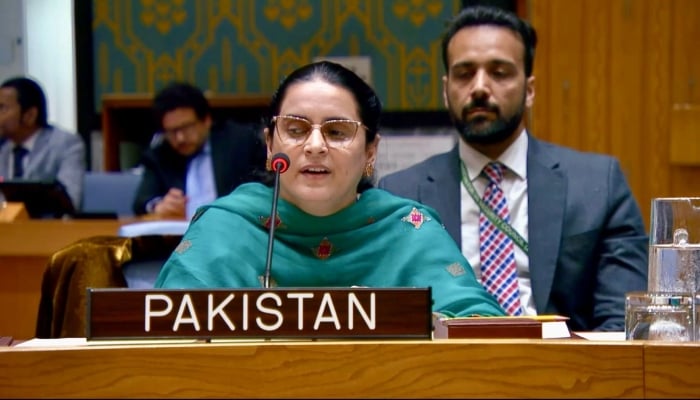
Delivering a right of reply during the UN Security Council’s annual debate on the protection of civilians, Pakistan’s Counsellor Saima Saleem said India “came to this Council wearing the mask of a victim”, adding that the world could see “the face behind that mask”.
During the discussion, India's Permanent Representative to the UN, Harish Parvathaneni, accused Pakistan of "failing to uphold international humanitarian obligations and targeting civilians," according to Times of India.
He also reiterated claims attributed to the Afghan Taliban regarding an alleged attack on a hospital in Kabul earlier this year.
"India’s state-sponsorship of terrorism against Pakistan is not abstract; it has a human cost," Saima said, adding that its terrorist proxies — the TTP, BLA, and Majeed Brigade have killed thousands of civilians, including women and children in mosques, markets, schools, and streets, through networks financed, facilitated, and operated from Afghan soil.
With regard to Afghanistan, she said that based on credible intelligence, Pakistan carried out precise, deliberate, and professional counter-terrorism operations against terrorist hideouts, training camps, ammunition storage sites, and support networks used to plan attacks against civilians, security forces, and infrastructure.
The counsellor said these operations were directed solely against terrorists and their infrastructure, not against civilians in Afghanistan, dismissing the contrary allegations part of a disinformation campaign.
"We can sense India’s disappointment, as its investments in the use of Afghan terrorist franchise against Pakistan are going to waste due to our effective counter-terrorism operations."
Speaking on the atrocities in India Illegally Occupied Jammu and Kashmir, Saima said that India can neither conceal nor deny its occupation the valley, describing it as an internationally recognised dispute on the Council’s agenda.
She said that in IIOJK, civilians are killed, detained, dispossessed and silenced, homes are demolished, freedoms are crushed, and an entire people are denied their right to self-determination.
She added that India’s treatment of its minorities should alarm the conscience of the world, referring to what she described as "state-sponsored Hindutva extremism," where Islamophobia has been normalised as policy and discrimination affects Muslims, Sikhs, Dalits and Christians.
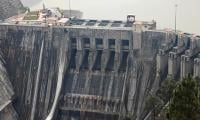
The counsellor also slammed India for weaponising water and New Delhi’s disregard for international law is evident in its holding of the Indus Waters Treaty in abeyance, adding that a state threatening the water and food security of millions of Pakistanis cannot speak of civilian protection.
Saima said that Pakistan stands for peace, dialogue, peaceful settlement of disputes and adherence to international law, and seeks harmonious relations based on mutual respect and sovereign equality, in accordance with the UN Charter and Security Council resolutions.