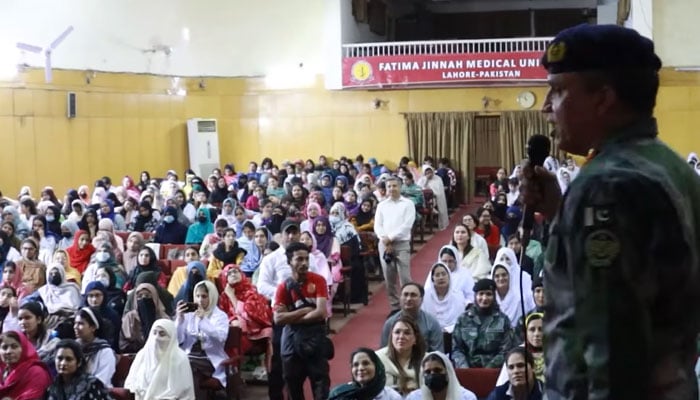
LAHORE: Punjab Counter Narcotics Force (CNF), Director General Brigadier Mazhar Iqbal, visited Kinnaird College for Women University, Lahore, where he met with Principal Dr Iram Anjum and faculty members.
During the meeting, he apprised them of the mandate and objectives of the Punjab Counter Narcotics Force, while underscoring the pivotal role of educational institutions, particularly faculty and administration, in the prevention and eradication of drug abuse.
On the occasion, Brigadier Mazhar Iqbal addressed a seminar titled ‘Youth Against Drugs,’ organised by the Anti-Drug and Tobacco Society of the college, and later joined students in an awareness walk.
Addressing the participants, the CNF DGhighlighted that the Punjab Counter Narcotics Force, working under the Excise, Taxation and Narcotics Control Department, is committed to enforcing anti-narcotics laws and promoting awareness against drug abuse across the province. He emphasised that youth, being the most dynamic segment of society, have a crucial role to play in driving behavioral change and countering the menace of drugs.
Citing data from the Drug Abuse Control Council of Pakistan, he noted that 45 percent of drug addicts in the country belong to Punjab, primarily within the age group of 15 to 34 years, with students constituting a significant proportion, including both male and female.
The CNF DG observed that despite extensive outreach and visits to hundreds of educational institutions, there has been a lack of formal reporting from administrations or students regarding drug sale or usage within campuses. He stressed that the goal of drug-free educational institutions cannot be achieved unless stakeholders demonstrate collective responsibility and proactively report such activities. He clarified that identifying drug dealers would not tarnish an institution’s reputation; rather, failure to address the issue could adversely affect its credibility.
He urged students to remain vigilant and inform parents if they observe any peer falling into drug addiction, emphasising that such reporting is a moral obligation rather than a complaint. He also advised parents to keep a close watch on their children’s social circles as well as their purchasing habits, particularly items bought under the guise of food. He revealed that, during CNF operations, certain food delivery services have also been found involved in drug distribution.
He reiterated that strict legal action is being taken against offenders without any leniency or discrimination, adding that neither wrongful punishment is being inflicted nor any undue recommendations are being entertained. State institutions, he affirmed, are discharging their responsibilities with utmost diligence.
Providing an operational overview, Brigadier Mazhar Iqbal stated that over the past seven months, the CNF has conducted 1,140 operations, resulting in the seizure of 21.7 tons of narcotics worth Rs2.34 billion. He informed that CNF offices have been established across all nine divisions of Punjab, and the force is actively operating throughout the province.
The DG also introduced students to CNF’s official social media platforms and elaborated on the symbolism of the CNF logo. He explained that the circular form represents unity and a comprehensive strategy, while the eagle clutching a snake signifies the enduring struggle between good and evil, reflecting the force’s mission against narcotics. The five white lines and wheat stalks in the logo symbolise Punjab’s five rivers and its rich agricultural heritage.
He briefed the audience on the organisational structure and mission of CNF Punjab, stating that the force is dedicated to combating drug trafficking networks and preventing the cultivation and production of narcotics.
Responding to queries from students and faculty, he shared that the Punjab government is in the process of enacting legislation to prohibit the open sale of intoxicating substances, certain medicines, and nicotine pouches through pharmacies, and that such measures will soon be implemented. He added that, following the 18th Constitutional Amendment, provinces have the authority to undertake independent initiatives for drug control.