ISLAMABAD: Global financial markets came under broad and synchronized pressure on April 28 as a sharp rise in crude oil prices, escalating geopolitical uncertainty, and the United Arab Emirates’ decision to exit the Organization of the Petroleum Exporting Countries (OPEC) and OPEC+ triggered a widespread sell-off across global equities.
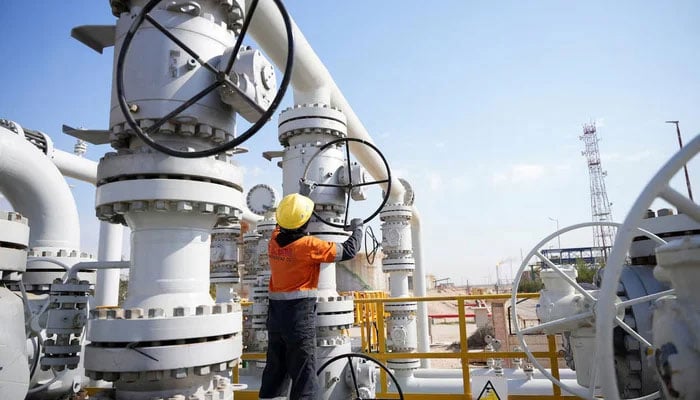
Oil benchmarks surged to multi-month highs, with Brent crude climbing to approximately $110.44 per barrel (+2.04%) and West Texas Intermediate (WTI) rising to around $99.12 (+2.85%). Other benchmarks also recorded strong gains, including Murban crude at $107.22 (+2.91%), while the Indian basket hovered near $110.05 and Arab Light reached $119.80. The rally was primarily driven by escalating supply risks linked to the Iran conflict, disruptions in key Middle Eastern shipping routes, and heightened uncertainty following structural changes in global oil coordination mechanisms.
Equity markets reacted sharply to the energy shock. In the United States, the Dow Jones Industrial Average fell by roughly 600 points (around 1%), while the S&P 500 declined approximately 1.3% and the Nasdaq dropped nearly 1.8%. The sell-off was led by technology and consumer stocks, as investors reassessed inflation risks and the likelihood of prolonged higher interest rates in response to rising energy costs.
European markets also weakened significantly under pressure from higher fuel prices and mounting inflation concerns. DAX in Germany fell by about 2%, marking one of the steepest regional declines, while CAC 40 in France slipped between 1% and 2%. The FTSE 100 in the United Kingdom declined by roughly 0.5% to 1%, partially cushioned by its heavy weighting in energy stocks. Across Europe, rising oil prices have reignited fears of industrial cost inflation and slower economic growth.
Asian markets followed the global downward trend. Japan’s Nikkei 225 declined by around 1% to 1.5%, South Korea’s KOSPI fell between 1% and 1.7%, and major indices in China slipped by about 0.5% to 1%, with losses partially limited by policy support measures. In India, the Sensex dropped approximately 700-900 points (around 1%), while KSE-100 Index in Pakistan experienced volatile intraday declines of 1% to 3%, reflecting the country’s heightened vulnerability to rising oil import costs and macroeconomic pressures.
The UAE’s announcement that it will exit OPEC and OPEC+ from May 1, 2026, has added a major structural dimension to already fragile markets. The decision effectively ends nearly six decades of membership in OPEC and removes one of the group’s key producers, thereby reshaping the long-term dynamics of global oil coordination.
Energy expert Abid Sulehri, CEO of the Sustainable Development Policy Institute (SDPI), noted that the UAE’s decision is driven by a combination of production disagreements, geopolitical tensions and long-term energy transition goals. He explained that a central factor has been a prolonged dispute over production quotas, with the UAE seeking to increase output to between 4 and 5 million barrels per day, compared to its current OPEC+ allocation of around 3 million barrels per day. According to him, this gap widened further amid escalating regional tensions and disruptions in the Strait of Hormuz.
Dr Sulehri also pointed to strained relations among Gulf partners over regional conflicts, including differing approaches to the war in Yemen, as well as broader strategic divergences within the bloc. Another major factor, he said, is the UAE’s long-term climate and energy strategy, including commitments to peak carbon emissions and transition toward net-zero targets, which align more closely with a flexible, market-driven production model.
He added that ongoing disruptions in the Strait of Hormuz mean that there will be no immediate increase in oil supply from the UAE, even after its exit, due to logistical constraints on exports.
However, Dr Sulehri cautioned that the UAE’s departure—following Qatar’s earlier exit from OPEC in 2019—could significantly weaken the influence of OPEC and OPEC+ as coordinated oil-producing alliances. This development may erode supply discipline and introduce greater uncertainty into global oil production decisions.
According to analysts, the move reflects Abu Dhabi’s desire for greater production autonomy, with plans to expand output beyond current quota limits toward capacity levels exceeding 4 million barrels per day in the coming years. The country has long expressed dissatisfaction with OPEC+ production caps and has increasingly positioned itself as a flexible and market-oriented energy supplier.
In the short term, however, the impact on global supply is expected to remain limited, as oil flows are already constrained by geopolitical disruptions and shipping risks in the Strait of Hormuz. Estimates suggest that millions of barrels per day of regional supply are currently affected by precautionary shutdowns and logistical bottlenecks.