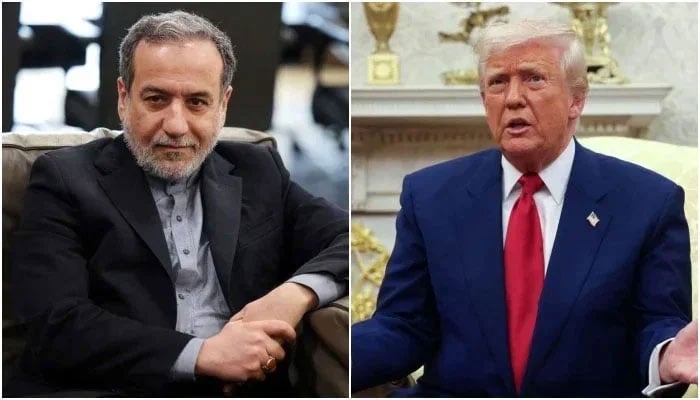
DUBAI/ WASHINGTON: Efforts to end the Iran conflict were at an impasse on Tuesday with US President Donald Trump unhappy at the latest plans from Tehran, which he said had informed the US it was in a “state of collapse” and figuring out its leadership situation.
Iran’s most recent proposal on resolving the two-month war would set aside discussion of its nuclear programme until the conflict was concluded and disputes over shipping resolved.
Trump wants nuclear issues dealt with from the outset, a US official briefed on Trump’s Monday meeting with his advisers said. In a post on Truth Social on Tuesday Trump said: “Iran has just informed us that they are in a ‘State of Collapse’. They want us to ‘Open the Hormuz Strait,’ as soon as possible, as they try to figure out their leadership situation (Which I believe they will be able to do!). Thank you for your attention to this matter!”.
It was not clear from his post how Iran might have communicated that message and there was no immediate response from Tehran to Trump’s latest comments.
Meanwhile, mediators in Pakistan expect a revised Iranian proposal in the next few days after US President Donald Trump indicated that he would not accept an earlier version, CNN reported, citing sources. The sources close to the mediation process said that Iranian Foreign Minister Abbas Araghchi was due back in Tehran on Tuesday after a visit to Russia.
Earlier, an Iranian army spokesperson told state media that the Islamic Republic did not consider the war to be over. Iranian government spokesperson Fatemeh Mohajerani told state media on Tuesday Tehran was using northern, eastern and western trade corridors that did not rely on Gulf ports to neutralise the blockade’s effects.
Iran has blockaded the waterway—a vital conduit for oil and gas shipments—since the start of the US-Israeli offensive two months ago, sending shockwaves through the global economy.
CNN, however, reported that US President Donald Trump was unlikely to accept Iran´s proposal to restore traffic in the strait, as Qatar warned of the possibility of a “frozen conflict” if a definitive resolution is not found.
“We do not want to see a return to hostilities in the region anytime soon. We do not want to see a frozen conflict that ends up being thawed every time there is a political reason,” Qatari foreign ministry spokesman Majed al-Ansari said at a press conference, calling for a “sustainable” peace.
While a ceasefire has held so far, diplomacy aimed at permanently ending the war has proven inconclusive.
Trump met with top security advisors on Monday to discuss the Iranian proposal after Tehran passed “written messages” to Washington via Pakistan spelling out its red lines, including on nuclear issues and Hormuz, Iran´s Fars news agency reported.
The plan would reportedly see Tehran ease its chokehold on the strait and Washington lift its retaliatory blockade on Iranian ports while broader negotiations continue, including over the thorny question of Iran’s nuclear programme.
But CNN, citing two sources familiar with the matter, said Trump had signaled at Monday´s meeting that he was reluctant to take Hormuz off the table without resolving the nuclear question, though it was unclear what his next steps would be.
Iranian defence ministry spokesman Reza Talaei-Nik said on Tuesday that Washington “must abandon its illegal and irrational demands.”
“The United States is no longer in a position to dictate its policy to independent nations,” he said, according to state TV.
Asked about Iran´s proposal, US Secretary of State Marco Rubio told Fox News “it´s better than what we thought they were going to submit,” but questioned whether it was genuine.
“They´re very good negotiators,” he said, adding any eventual deal had to be “one that definitively prevents them from sprinting towards a nuclear weapon.”
Trump faces domestic pressure to find an off-ramp as prices rise, with midterm elections due in November and polls showing the war is unpopular among Americans.
According to a new Reuters/Ipsos poll Trump’s approval rating fell to the lowest level of his current term, as Americans increasingly soured on his handling of the cost of living and an unpopular war with Iran.
The four-day poll completed on Monday showed 34 per cent of Americans approve of Trump’s performance in the White House, down from 36 per cent in a prior Reuters/Ipsos survey, which was conducted from April 15 to 20.
Tehran would need guarantees that Washington and Israel would not attack again if it was to offer security assurances for the Gulf, Iran’s envoy to the UN said.
Trump said that German Chancellor Friedrich Merz does not know what he is talking about regarding Iran, a day after Merz sharply rebuked the US over its handling of the conflict. “The Chancellor of Germany, Friedrich Merz, thinks it’s OK for Iran to have a Nuclear Weapon. He doesn’t know what he’s talking about!” Trump wrote on Truth Social.
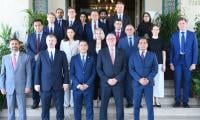
Saudi Arabia, meanwhile, welcomed Gulf leaders and officials on Tuesday to discuss the ongoing crisis in the region. Leaders and officials from across the Gulf region were greeted by Saudi Crown Prince Mohammed bin Salman as they arrived in Jeddah, according to images released by Saudi state media.
“During the summit, a number of topics and issues related to regional and international developments were discussed, as well as the coordination of efforts in response to them,” the Saudi Press Agency reported.
A source close to the government told AFP that “the current political and security situation in the region” was being discussed during the summit.
Qatari Emir Sheikh Tamim bin Hamad Al Thani later said in a message posted on social media that the gathering “embodied the unified Gulf position toward the current situation and what it requires in terms of intensified coordination and consultation”.
An Iranian army spokesman told state TV on Tuesday that “we do not consider the war to be over,” saying Tehran had “no trust in America.” “We have many cards that we have not yet used... new tools and methods of fighting based on the experiences of the past two wars, which will definitely allow us to respond to the enemy more decisively” should the fighting resume, Amir Akraminia said in an interview.
Iran is ready to share its defensive weapons capabilities with “independent countries, especially members of the Shanghai Cooperation Organisation (SCO)”, Deputy Defence Minister Reza Talaei-Nik said during a meeting of SCO defence ministers held in the Kyrgyz capital, Iranian state media reported on Tuesday.
Amid Islamabad’s ongoing mediation between Washington and Tehran in the escalating Middle East conflict, Iran’s Ambassador Reza Amiri Moghadam on Tuesday heaped praise on Pakistani Deputy Prime Minister and Foreign Minister Ishaq Dar and his Foreign Office team, crediting them with quietly steering complex diplomatic engagements and keeping dialogue on track.
In a message on his X handle, Ambassador Moghadam said as trusted harbingers of international harmony, diplomats were the architects of peace, entrusted with navigating the delicate complexities of international relations through the patient craft of dialogue, empathy and understanding.
“I wish to express my sincere and profound appreciation to H.E. Muhammad Ishaq Dar, Honorable Deputy Prime Minister and Foreign Minister, as well as to the veteran, competent and career diplomats of the Ministry of Foreign Affairs of Pakistan, for their tireless endeavors in facilitating, coordinating, and meticulously preparing the arrangements for the delegations and talks, often long before the talks themselves commenced,” he said.
The ambassador added that Mr Dar and his team’s dedicated efforts translated political will and principled determination into the practical avenues and arrangements necessary for any diplomatic process to take shape.
He said that it was diplomacy in its truest sense, not merely words, but the quiet, persistent labour that made dialogue possible and peace attainable. “Their professionalism and commitment deserve deep recognition and gratitude,” he said.
US Marines on Tuesday boarded a commercial ship in the Arabian Sea that was suspected of trying to violate the American blockade of Iranian ports, the US military said.
The M/V Blue Star III was released by US forces “after conducting a search and confirming the ship´s voyage would not include an Iranian port call,” Central Command, which is responsible for American forces in the Middle East, said in a post on X.
A ship fully loaded with liquefied natural gas (LNG) has passed through the Strait of Hormuz for the first time since the Middle East war virtually closed the route in early March, marine tracking firm Kpler said.
Panama-flagged tanker Idemitsu Maru, carrying 2 million barrels of Saudi oil, crossed the Strait of Hormuz, LSEG shipping data showed on Tuesday, becoming the first Japan-linked crude tanker to do so since the Iran war began.
Iran’s top security body has approved a temporary scheme for businesses to access the global internet with fewer restrictions, a government spokesperson told Iranian media on Tuesday, after the authorities had imposed a blackout since the start of the war against the U.S. and Israel. “The Supreme National Security Council approved the ‘Internet Pro’ scheme to preserve businesses during times of crisis,” said government spokesperson Fatemeh Mohajerani.
Iran shared on Tuesday a breakdown of the death toll from a deadly strike on an Iranian school on the first day of the Middle East war, state media reported. Seventy-three boys and 47 girls were killed in the February 28 strike on an Iranian elementary school in Minab, state broadcaster IRIB and local media reported. Twenty-six teachers, seven parents, a school bus driver, and a pharmacy technician at the clinic next to the school were also killed, IRIB said in a Telegram post. This puts the death toll at 155 instead of more than 175 reported earlier.
Italian Prime Minister Giorgia Meloni said her current priority was to restrain inflationary pressures on prices, especially energy, given the impact from the US-Israeli war against Iran.
The head of Israel´s Mossad has praised the spy agency´s “groundbreaking” operations in the war against Iran and Hezbollah, saying it acquired intelligence “from the heart of the enemy´s secrets”.
Violence has continued on the war’s Lebanese front, despite a recently extended ceasefire between Israel and Iran-backed Hezbollah, which drew Lebanon into the Middle East war by firing rockets at Israel. Israel responded with strikes and a ground invasion.
Israel’s military on Tuesday warned residents of more than a dozen villages and towns in southern Lebanon to immediately evacuate, saying Hezbollah’s “violation of the ceasefire” was compelling it to act.
Despite its occupation of a swath of territory along the border, Israeli Foreign Minister Gideon Saar said his country “has no territorial ambitions in Lebanon.”
A Russian super-yacht trapped in the Gulf by the Middle East war carried stranded Filipino seafarers out through the perilous Strait of Hormuz, the Philippines government said Tuesday. On board the yacht and a bulk cargo ship that also passed that day “were 36 Filipino seafarers, bringing the total Filipino crew of vessels out of the Strait to close to 1,200”, it added.
Iran Foreign Minister Abbas Araqchi said on Tuesday he welcomed Russia’s support for diplomacy and praised the strength of ties between the two countries, after meeting with President Vladimir Putin on Monday, saying recent events had demonstrated the depth of their strategic partnership.
British police were Tuesday investigating a suspected arson attack on a London memorial wall that currently commemorates Iranians killed in anti-government protests in Iran.
Sweden´s government warned of a potential jet fuel shortage in the Scandinavian country due to supply disruptions caused by the Middle East war and the closure of the Strait of Hormuz.
Eurozone consumers have sharply increased their expectations for inflation, a European Central Central Bank survey showed Tuesday, after the Middle East war sent energy costs surging.
Thailand´s economic growth and tourist arrivals are forecast to drop this year as the Middle East war roils global energy prices, the finance ministry said Tuesday.
Some US defence material deliveries to Europe are being delayed because of the war in the Middle East, Finland’s President Alexander Stubb said on Tuesday.
US intelligence agencies are studying how Iran would respond if President Donald Trump were to declare a unilateral victory in the two-month-old war that has killed thousands and become a political liability for the White House, two US officials and a person familiar with the matter said.
The intelligence community is analyzing the question along with others at the request of senior administration officials. The goal is to understand the implications of Trump potentially pulling back from a conflict that some officials and advisers worry could contribute to deep Republican losses at the midterm elections later this year, according to the sources.
The sources spoke on the condition of anonymity in order to discuss sensitive intelligence matters. It is not clear when the intelligence community would complete its work, but it has previously analyzed the likely reaction of Iran’s leaders to a US declaration of victory.
In the days following the initial bombing campaign in February, intelligence agencies assessed that if Trump were to declare victory and the US drew down its forces in the region, Iran would likely view it as a win, one of the sources said.
If Trump instead said the US had won but maintained a heavy troop presence, Iran would likely see it as a negotiating tactic, but not one that would necessarily lead to the end of the war, the source said.
The CIA and the Office of the Director of National Intelligence declined to comment.
White House spokeswoman Anna Kelly said the US is still engaging with the Iranians on negotiations and would “not be rushed into making a bad deal.”
“The president will only enter into an agreement that puts US national security first, and he has been clear that Iran can never possess a nuclear weapon,” she said.