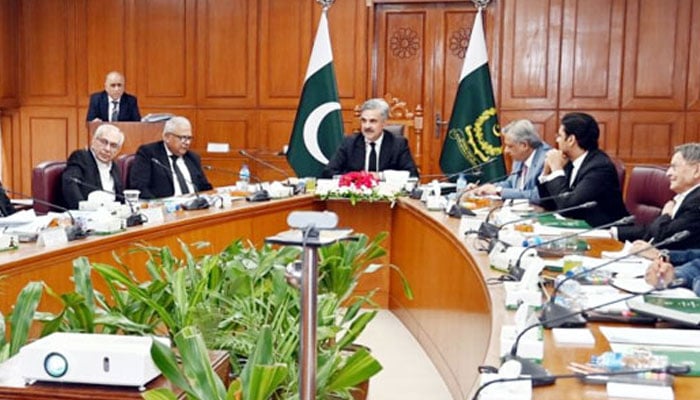
ISLAMABAD/ PESHAWAR: The long lingering issue of transfer of Islamabad High Court (IHC) judges was finally settled on Tuesday when the Judicial Commission of Pakistan (JCP) approved the transfer of three judges to other high courts.
The commission met here at the Supreme Court, with various compositions, to consider proposals concerning the transfer of IHC judges to other high courts under Article 200 of the Constitution.
Chief Justice of Pakistan (CJP) and JCP Chairman Yahya Afridi chaired the commission meeting.
The meeting was attended by Justice Aminuddin Khan, Justice Munib Akhtar, Justice Aamer Farooq, Justice Syed Hassan Azhar Rizvi, Law Minister Azam Nazir Tarar, Attorney General Mansoor Usman Awan, representative from Pakistan Bar Council Ahsen Bhoon, Farooq H Naek, Barrister Ali Zafar and Barrister Gohar Ali Khan.
The meeting was convened by the JCP secretary in exercise of powers conferred by clause (22) of Article 175A of the Constitution, as the commission chairman, while giving reason therefore, declined to convene the meeting on the requisition by one third of the total members.
In terms of the first proviso to Clause (1) of Article 200 read with Article 175A of the Constitution, the respective chief justices of high courts concerned participated as members of the commission to consider each proposed transfer.
After detailed deliberations, the commission approved by majority the transfer of Justice Mohsin Akhtar Kiani to the Lahore High Court (LHC), Justice Babar Sattar to the Peshawar High Court (PHC) and Justice Saman Rafat Imtiaz to the Sindh High Court.
Likewise, the members who had requisitioned the meetings for the transfer of Justice Arbab M. Tahir from the Islamabad High Court to the Balochistan High Court, and of Justice Khadim Hussain Soomro from the same court to the Sindh High Court, withdrew the respective proposals.
The commission further decided by majority that any vacancy arising as a result of transfer of a judge from a high court shall be filled through transfer only, and such vacancy shall not, in any manner, be treated as a vacancy for initial appointment, says a press release.
Minister of State for Law Barrister Aqeel Malik has said that decisions taken by the Judicial Commission of Pakistan (JCP) are in accordance with the Constitution and law, and that no member of the commission is subordinate to another.
Speaking on Geo News programme Aaj Shahzeb Khanzada Kay Saath, Malik said the authority to transfer judges rests with the JCP, not the executive, adding that the issue of judges’ rotation had also been demanded by bar councils.
He said the written position of Justice Babar Sattar had been placed before the commission, noting that the Constitution allows the commission to hear a judge if it considers it appropriate, but such a hearing is not mandatory.
Referring to Articles 200 and 175A of the Constitution, the minister said the commission comprises seven senior judges, including two chief justices, and representatives from both the government and the opposition, and that decisions are taken by majority. He rejected the perception that judicial transfers amount to punishment, saying the Constitution provides for such measures, adding that the transfers are aimed strengthening federal system.
Malik said that if the Chief Justice of Pakistan had not been in favour of convening the meeting, he would not have attended it, adding that a “wrong impression” was being created about the proceedings.
Commenting on individual cases, he said Justice Saman Rafat Imtiaz, who belongs to Sindh, was being transferred back to her home province, and added that rotation of judges was necessary to avoid groupings.
He also said the government had never expected judges to deliver decisions in its favour and respected judicial independence.
Mumtaz Alvi adds: In a related development, PTI Chairman Barrister Gohar Ali Khan on Tuesday said transferring judges without hearing their views was an attack on the judiciary.
Speaking to the media along with Barrister Ali Zafar outside the Supreme Court, he said the Judicial Commission approved the transfer of judges by majority.
Such transfers go against the concept of an independent judiciary, Gohar said, adding that the number of judges in all high courts was already complete and that transferring judges was tantamount to dividing the judiciary.
He contended that rules should have been formulated before transferring judges, noting that the decision to make rules after the 26th Amendment was taken in the first Judicial Commission meeting.
He insisted that transferring judges was not the job of any individual. “When judges take oath, it is stated in the Constitution that they will not be transferred without their consent; transferring judges without hearing their position is an attack on the judiciary.”
He further said the PTI founder Imran Khan was brought to hospital at night for an injection, stressing that the matter of the founder chairman’s health should be taken seriously. “The party founder and his spouse, Bushra Bibi, should be treated by their personal doctors; the best treatment is the fundamental right of both,” he underlined.
Expressing his views on the transfer of judges, PTI parliamentary leader in the Senate Senator Barrister Syed Ali Zafar recalled that five judges had written a letter to the Supreme Court. He said the agenda for the transfer of Justice Arbab and Justice Khadim was withdrawn in the commission, adding that there must be a valid reason for transferring judges.
Senator Ali Zafar said it was a sad day for the independent judiciary, as the Constitution did not allow judges to be transferred maliciously. He emphasised that the PTI’s position was that judges could not be transferred without reason and that such transfers could be used as a form of punishment.
In another related development, the Tehreek Tahaffuz Aiyeen-e-Pakistan (TTAP) criticised the Judicial Commission meeting to bring the transfer of Islamabad High Court (IHC) judges on the agenda, calling it a serious blow to the independence of judiciary.
In a statement, Akhunzada Hussain, the opposition alliance spokesman, contended that this matter was a negation of the principle of separation of powers (trichotomy of power) and an attempt to subordinate independent judges to the whims of the government.
The independence of the judiciary, he underlined, was a fundamental pillar of the 1973 Constitution and a fundamental component of the system and achievement of justice in any society. He said the transfers had exposed the real objectives of recent constitutional amendments.
Meanwhile, Akhunzada condemned the act of taking Imran Khan to PIMS for medical examination in the absence of his personal doctors and family members.
Peshawar Bureau adds: In yet another development, the Khyber Pakhtunkhwa Bar Council has expressed reservations about the transfer of judges to the Peshawar High Court from other high courts, demanding a reciprocal arrangement to ensure a balance and provincial representation. The concerns were raised during a meeting of the council’s executive committee, chaired by Executive Chairman Malik Imad Azam, Advocate. The committee discussed various matters, with a particular focus on the issue of judicial transfers to the Peshawar High Court. The council urged the Judicial Commission of Pakistan to ensure that if a judge was transferred to the Peshawar High Court from another high court, a judge from Peshawar should be appointed in exchange to another high court. The meeting also called for immediate appointment of judges from Khyber Pakhtunkhwa to the Islamabad High Court in accordance with the Constitution of Pakistan, so that the province’s representation was ensured. The bar council warned that any violation of the Constitution would prompt the body to devise a strategy for a protest.