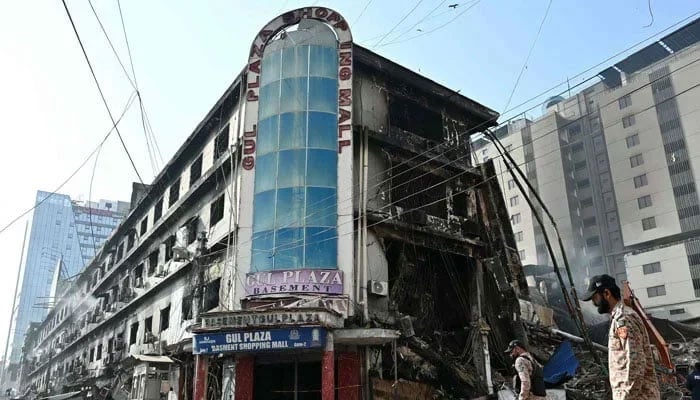
Last year in December, barely minutes before its closure, a shopping plaza in Karachi caught fire, trapping tens of people inside, including shoppers, shop owners and helpers. The apocalyptic tragedy led to the death of over 70 people. For Pakistan, that incident should have became a wakeup call for authorities to pay attention to workplace safety and comes to mind immediately when one thinks of ‘World Day for Safety and Health at Work’ that is observed annually on April 28. The Gul Plaza tragedy highlights structural failures and low market compliance with safety standards. According to the ILO, nearly three million workers die every year due to work-related accidents and diseases, an increase of more than 5.0 per cent compared to 2015. Most buildings in Pakistan (including corporate houses) are not equipped with fire safety equipment. There are no fire exits, and in an emergency people often find themselves extremely clueless.
Had the Gul Plaza building been installed with fire sprinklers, glow-in-the-dark floor lights leading people to exits and easy-to-open windows to provide proper ventilation to smoke, the people who lost their lives might still be alive. But the truth is that city authorities in Pakistan rarely monitor buildings and related infrastructure. The problem doesn’t end here. Labourers and workers at mining sites, for example, also put their lives in danger when they enter narrow mines. This month alone, seven labourers were killed and three others sustained injuries during mining in Nangabad in Rustam area after ballast stones fell on a mining site. The labourers working at the site were trapped under the stones. An analysis of surface mining accidents in Punjab between 2004 and 2018 recorded 377 deaths in 361 accidents, with inadequate personal protective equipment and primitive mining practices cited as primary causes. Over the years, in Balochistan, gas explosions at coal mines have led to many deaths.
Successive governments have failed to develop a long-term plan to resolve the area’s issues and ensure safe working conditions for thousands of workers. Workers’ union leaders routinely complain about the lack of safety protocols, but their pleas go unanswered. The same is true for sanitation workers. According to reports, around 100 sanitation workers die each year in Pakistan in the line of duty. Anaerobic decomposition in sewers leads to poisonous gases that can cause illness and death by asphyxiation. These examples tell how vast the problem is and how much the country needs a plan to tackle it. Besides the obvious physical risks, workers in our country also go through mental stress. According to the ILO, a healthy psychosocial working environment depends on how work is designed, organised and managed, as well as on workplace practices that shape daily conditions. Factors such as workload, working hours, role clarity, autonomy, support and fairness strongly affect employees’ health, safety and performance. When these factors are negative, they become psychosocial hazards that must be managed alongside physical and chemical risks. While our policymakers have allowed market players to run their businesses as they please, it is essential to have a workplace safety and health programme that respects workers’ health rights. A healthy and safe workplace can lead the nation towards progress and prosperity.