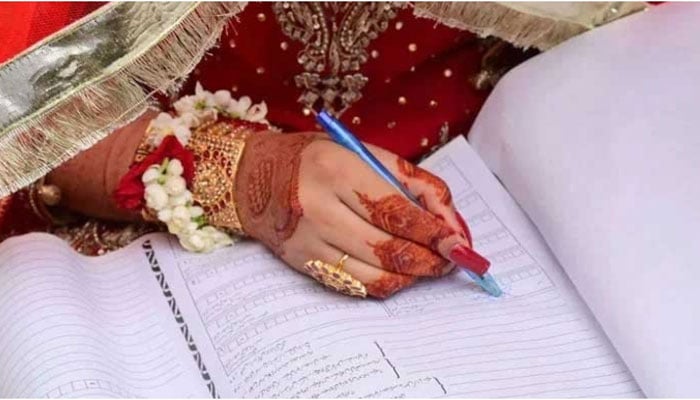
The passage of the Punjab Child Marriage Restraint Bill 2026 should ideally be a moment of uncomplicated progress. To be fair, in legal terms, it is. By making marriage below 18 a cognisable offence and introducing prison terms for those who facilitate it, the Punjab Assembly has aligned itself with a growing, if uneven, national consensus: that childhood is not negotiable. Yet if Pakistan’s legislative history on child marriage teaches anything, it is this: the distance between law and lived reality remains vast. Punjab is not the first mover here. The Sindh Child Marriage Restraint Act 2013 broke ground over a decade ago. More recently, the Islamabad Capital Territory Child Marriage Restraint Act 2025 and the Balochistan Child Marriage Prohibition Bill 2024 followed suit. On paper, then, much of Pakistan now recognises 18 as the minimum age of marriage. But paper victories have not translated into social transformation. According to Unicef estimates, Pakistan is home to over 19 million child brides, with one in six girls married before adulthood. This is essentially a system in which poverty, patriarchy and weak state enforcement converge to normalise what should be unthinkable.
The consequences are well documented. Early marriage truncates education, locking girls out of economic opportunity before they have even entered it. It exposes them to serious health risks, particularly during early pregnancy. And it perpetuates cycles of dependency and vulnerability that extend beyond individuals to entire communities. Punjab’s law, therefore, is necessary but the deeper challenge lies in enforcement. And here the state’s record is sobering. Even in Sindh, where legislation has existed since 2013, implementation has been inconsistent at best. Studies by the UNFPA and the Population Council have pointed to increases in child marriage in certain periods despite the legal framework being in place. The lesson is clear: legislation without enforcement risks becoming symbolic. So why exactly is enforcement so elusive? Part of the answer lies in resistance from politico-religious actors. For example, right-wing groups and politicians have openly challenged such laws, framing them as incompatible with their interpretations of religion.
But ideology is only one piece of the puzzle. Material conditions matter just as much. Poverty continues to drive child marriage across Pakistan, particularly in rural and climate-vulnerable regions. Marrying off daughters becomes, in these contexts, a coping mechanism, however devastating its consequences. Post-disaster assessments by Unicef have found correlations between climate shocks and spikes in child marriage. This complicates the policy response. Enforcement alone cannot address a practice that is, in part, economically rational for families with few alternatives. What, then, would a serious response look like? First, the state must treat implementation as a governance priority, not an afterthought. This means training police and local officials to register and prosecute cases, establishing monitoring mechanisms and ensuring that penalties are not merely theoretical. Second, there must be sustained public engagement. Awareness campaigns are essential to shift social norms and communicate the legal and health consequences of child marriage. Third, economic interventions are indispensable. Conditional cash transfers, education stipends for girls and targeted support for climate-affected families can alter the cost-benefit calculations that currently incentivise early marriage. Without addressing poverty, legal reform will continue to run up against structural limits. Finally, the state must be willing to confront regressive narratives directly. This does not mean suppressing debate, but it does require clarity: child marriage is a rights violation. Punjab’s new law is a step in the right direction. But we have to be clear that without enforcement, economic support and political will to challenge entrenched interests, it risks joining a familiar pattern: progressive statutes, regressive realities.