_akhbar.jpg)
The lack of agreement in Islamabad during the US-Iran meetings held over the last weekend was disappointing but not unexpected, given their widely divergent positions on contentious issues, the 47-year-long history of enmity between the two countries and the resulting lack of mutual trust.
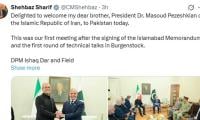
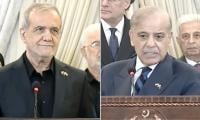
It goes to the credit of the mediation by the Pakistani leadership that this high level meeting took place in an attempt to give diplomacy a chance to resolve the issues at the core of the conflict that had been raging since February 28 when the US and Israel lunched surprise air attacks on Iran even when there were reports of some progress in the indirect talks at Geneva.
Those surprise attacks were the outcome of a serious miscalculation by President Trump and his close advisers, who mistakenly believed that the resultant decapitation of the Iranian top leadership would paralyse the Iranian governmental machinery and embolden the Iranian opposition to replace the Islamic Republic in Iran with a pro-US and pro-Israel government of the type that had ruled Iran before the Islamic revolution of 1979.
The additional objective was to destroy further Iran’s nuclear facilities and degrade its missile capabilities. While the attacks did succeed in inflicting heavy damage on Iran’s nuclear and missile facilities and its civilian infrastructure, they, contrary to American expectations, also served to unify the Iranian people in the face of the US and Israeli acts of aggression against Iran’s sovereignty and territorial integrity.
Iran responded to the American and Israeli attacks with great courage, relying mostly on its missile and drone capabilities to damage targets in Israel and American military bases and other assets in the Gulf, raising the spectre of a regional conflict. Fortunately, the GCC countries exercised restraint and refrained from retaliatory attacks against Iran while protesting against it diplomatically.
Iran, in an attempt to pile on pressure on regional countries and the rest of the world, partially closed the Strait of Hormuz in early March, through which 20 per cent of the world’s oil and gas supplies, as well as other commodities, pass daily. The disruption of oil and gas shipments and supply chains generated adverse ripple effects on the global economy.
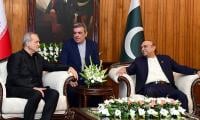
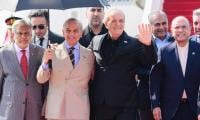
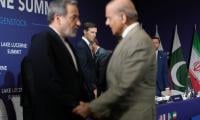
It was against this background and amid the danger of further intensification of the conflict that the US, in response to efforts by Prime Minister Shehbaz Sharif, announced on April 7 a ceasefire for two weeks to give diplomacy a chance to resolve contentious issues with Iran. The failure of the high-level Iran-US talks at Islamabad on April 11-12 has clouded the prospects of a peace settlement between the two countries even though US Vice President J.D. Vance before his departure from Islamabad on April 12 announced that the US side had left with the Iranian delegation, which had been led by Speaker of the Iranian Majlis, Muhammad Bagher Ghalibaf, America’s final proposal for the resolution of the outstanding issues.
Tensions between Iran and the US have, however, risen with President Trump’s order to the US Navy to impose a blockade on the Strait of Hormuz, primarily to bar ships and tankers from heading to Iranian ports or departing from them. It remains to be seen whether better sense will prevail on all sides, leading to restraint and continued serious efforts by the US and Iran to resolve the outstanding issues between them. Some reports are coming in now that talks will be continuing between the two.
These developments need to be examined against the backdrop of China’s growing challenge to American global supremacy. The preceding century witnessed the ascendancy of America’s power and the moral appeal of its democratic institutions grounded in a rules-based order. The US reached the zenith of its power in the wake of the Soviet Union’s disintegration, emerging as the sole superpower, towering over the globe like a Colossus. Unfortunately, instead of exercising its enormous power with a moral compass, the US repeatedly committed gross violations of international law and the UN Charter, undermining the foundations of the so-called rules-based order.
President Trump has taken the process of blatant violation of the UN Charter to new heights by launching surprise attacks on Iran in league with Israel without any provocation on the part of Tehran. The lame and varying excuses given by President Trump to justify these attacks lacked any credibility. Since there was no danger of an imminent attack by Iran, the US attack on it could not be justified as an act of self-defence under Article 51 of the UN Charter.
The US attacks on Iran in June last year and again this year have brought home once again the loss of moral purpose in the conduct of its foreign policy. This is a serious development, alongside the slowing of its economic growth. In the modern era, overall economic power, especially industrial and technological strength, has played a determining role in the rise and fall of great powers as elaborated by Paul Kennedy in his seminal book, ‘The Rise and Fall of the Great Powers’. Thus, as the economic and technological power of China grows relative to the US, it will pose a potent challenge to the US’s global supremacy.
China has achieved dramatic economic and technological progress over the past four decades. According to the IMF, China surpassed the US in purchasing power parity terms in 2014. Even in nominal dollar terms, it has become the second-largest economy in the world, with a GDP amounting to $19.4 trillion as against $30.6 trillion for the US in 2025. Given its faster GDP growth rate, China may overtake the US economy, even in nominal dollar terms, by about 2040. China’s rapidly growing economic and technological power will also enable it to build its military power quickly.
According to reliable reports, China is doing precisely that by rapidly increasing its resource allocation to the development of its military might. According to some projections, China would emerge as the world’s most powerful economic and military power by 2050, enabling it to expand its presence and influence worldwide at the expense of the US.
Against this background, the loss of moral purpose in US foreign policy, as evidenced by the disregard for international law and the UN Charter by the US under President Trump, has serious implications for US global leadership.
The loss of moral purpose in the US foreign policy will hasten its relative decline vis-a-vis China. Great powers often lead through legitimacy, and their immoral behaviour allows competitors to successfully challenge their leadership. Therefore, the totally illegal and unjustified US attacks on Iran this year may signal the beginning of the end of US global domination.
The writer is a retired ambassador and author of ‘Pakistan and a World in Disorder – A Grand Strategy for the Twenty-First Century’. He can be reached at: [email protected]