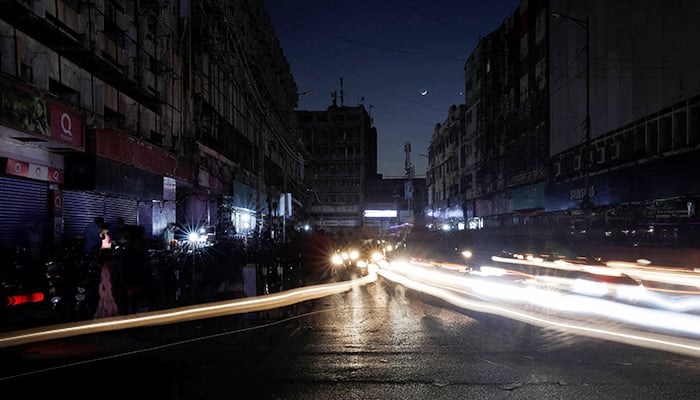
ISLAMABAD: The federal government has announced power outages exceeding two hours during peak hours across the country, except Karachi and Hyderabad, and cautioned that electricity tariffs are likely to rise, urging the public to prepare for the increase.
The major move comes as the world grapples with an energy crisis following Iran’s closure of the Strait of Hormuz in retaliation for US-Israel strikes, sending governments scrambling to conserve power.
In a statement, the Power Division’s spokesperson said that in light of the situation, the government has decided that from 5pm to 1am (peak hours), electricity supply will be suspended for nearly 2:30 hours daily.
The rationale, the spokesperson explained, was that the government aims to minimise the use of expensive fuel and prevent the possible increase in electricity prices.
The spokesperson added that at present, the “biggest challenge” the government faces is during peak hours, where there is a significant increase in electricity demand, particularly because these days, the production of hydel power plants has decreased substantially.
“If expensive fuel is relied upon to meet these requirements, it can lead to a considerable increase in electricity prices,” the spokesperson said, further explaining the reason behind the loadshedding.
Explaining further, the spokesperson added that the situation is continuously being monitored and Prime Minister Shehbaz Sharif has given Power Division the task that “there should not be a huge increase in electricity price” and “if due to furnace oil use some increase in price also happens, then measures must be taken to [minimise the possible increase]”.
The spokesperson noted that despite the ongoing crisis, from July to February, the power tariff has gone down by Re0.71 per unit on average.
“The basic reasons for this significant decrease include reforms brought into the system, various relief packages, strict implementation of merit order, better and timely planning, and running the system effectively in accordance with modern requirements.”
Given the PM’s instructions to ensure power tariff remains low, the Power Division’s spokesperson said 80 MMCFD local gas has been provided to power plants, due to which not only Re0.80 per unit increase in electricity price has been prevented, but extra load management has also been stopped.
The purpose of the over two-hour peak hour load management is to “prevent” approximately Rs3 per unit increase in electricity price, the Power Division said.
“Despite limiting furnace oil use, we have to be ready for approximately 1.5 rupees per unit increase, which, if these measures were not taken, would have caused 5 to 6 rupees per unit increase,” the statement mentioned.
The Power Division added that instructions have been issued to DISCOs that timings of electricity shutdown of every feeder should be shared with consumers at every level, so that they are aware of their electricity timings.
Apart from this schedule, it added, “no” electricity shutdown should happen. “Where, due to any local fault, an electricity shutdown is required, the relevant offices will inform consumers about it.”
The Power Division added: “It is clear that this action is not load shedding or load management, but is part of the government’s ‘Peak Relief Strategy’ for reducing possible increase in price during peak hours.”
A spokesperson for the Power Division, however, clarified that K-Electric and Hyderabad Electric Supply Company (Hesco) have been exempted from load management under peak hours relief strategy.
The decision was made in the backdrop of low-cost electricity being supplied to the power distribution companies, the spokesperson added.
The two power distribution companies are not significantly affected by power plants operating on furnace oil, the spokesperson said, adding that there is ample supply of electricity generated from sources other than furnace oil in the southern region.
The spokesperson further said that cheap electricity in the south region is supplied only to these two power distribution companies, ensuring that consumers are not subjected to unnecessary inconvenience.