For most of us who grew up in the 1990s and 2000s, television wasn’t just a preferred pastime; it was a portal to a global culture. Accessible at the click of a button on a plastic-covered remote control, the pan-regional and international channels aired on our box-like TV sets offered a form of escapism. As foreign faces flickered across the ‘idiot box’, we were drawn beyond the confines of our national boundaries and gained front-row seats to a broader cultural exchange.
In hindsight, this may have been a slow yet potent form of cultural imperialism, though nostalgia has softened my memory of it. What I do recall is the heady mix of thrill and confusion as Indian and American cultural influences blended together in the TV lounge of an idyllic Karachi home. Like an eager sponge, my young mind absorbed dubbed reruns of American sitcoms such as The Nanny and Who’s the Boss?, never once questioning how the unmistakably glamorous Fran Drescher spoke eloquent Hindi.
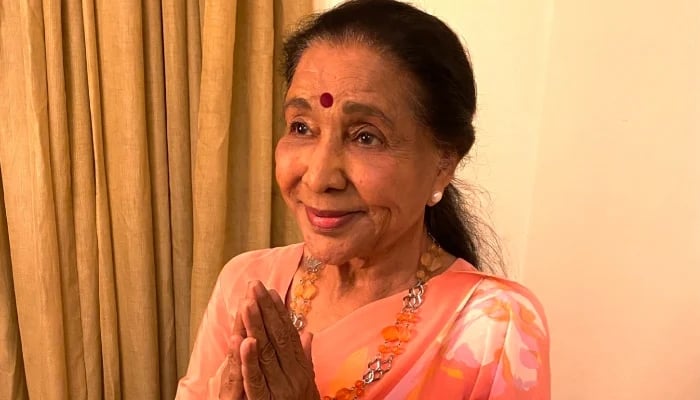
It was through these cross-cultural televised broadcasts that I discovered the allure of Asha Bhosle. Not through her timeless melodies of yore, but the music video of a soulful new track that was all the rage in 1997.
Imbued with blue-tinted hues and atmospheric lighting in a stylish lounge, the video of Raat Shabnami unfurls as a dreamscape suspended between imagination and reality. Beyond its portrayal of a young couple --Milind Soman, the brooding ‘90s heartthrob, paired with the elegant Helen Brodie -- the video also features Asha Bhosle as a mythical, if not grandmotherly, presence. Throughout the song, she acts as a metaphorical Cupid, orchestrating a chain of magical coincidences to guide the lovers towards their proverbial happily-ever-after.
My six-year-old mind, already sceptical of unexplained supernatural forces after being traumatised by the weekly staples of The X-Files and Zee Horror Show, wasn’t rattled by the sari-clad Bhosle. She didn’t even seem like an anachronism amid the song’s exuberant IndiPop vibe. Instead, she emerged as an indispensable force who quietly elevated the performance with her presence.
I didn’t know it then, but Bhosle spent much of the mid-1990s collaborating with other musicians to revive her old songs, especially those she recorded with her late husband R D Burman. Sceptics would have viewed this as a desperate attempt to remain relevant in a rapidly evolving music scene. Even if that were the case, Bhosle may have provided artists with a useful template for preventing their melodies from fading into oblivion. At its core, these revivals were her gift to the future -- a reminder that music isn’t handcuffed to a particular generation but flows freely through time.
As I grew older and learnt how to navigate the complexities of televised globalisation, Bhosle’s songs lingered in the air, like a balm easing the weight of difficult days. Raat Shabnami faded into a childhood memory and was gradually replaced by new notes from the legendary songstress’s oeuvre, which continue to swirl through my mind like soothing lullabies for the burdens of adult life. Even now, Aage Bhi Jane Na Tu from the 1965 multi-starrer Waqt remains my talisman, a constant reminder of the futility of dwelling on the past and the future when the present is what truly matters.
From the dewy, moonswept night of a childhood melody, I often find myself repeatedly drawn to the haunting beauty of Raat Akeli Hai. The lyrics evoke a darker and more desolate night, where oil lamps have long been extinguished, and a woman beckons her beloved to whisper sweet nothings into her ears. Though wildly transgressive, the song is not as controversial as the catchy hippie anthem Dum Maro Dum or the suggestive sighs that punctuate Piya Tu Ab Tau Aaja.
Be that as it may, Bhosle's musical career didn’t just rely on artistic rebellion. Many songs, such as In Ankhon Ki Masti, Dil Cheez Kya Hai and Nigahein Milane Ko Jee Chahta Hai, have strong classical foundations and carry an air of conformity. Straddling both extremes with effortless panache, Bhosle’s eight-decade-long career has been a masterclass in versatility, culminating in a legacy that is diverse and deeply rewarding.
For many artists, versatility is often a happy accident stumbled upon without conscious design. In Bhosle’s case, however, versatility was a deliberate choice and perhaps the only means through which she distinguished herself from her older sister, the iconic Lata Mangeshkar. Growing up with siblings, I can relate to the quiet struggle to assert one's own potential and how it can turn into a battleground. Bhosle, though, was never graceless in her attempts to carve out her own identity and consistently rebuffed rumours of a feud with Lata. After a long and arduous struggle, Bhosle stepped out of her sister’s shadow and stood in her own spotlight.
For years, I had seen Bhosle as a singer open to collaborations with foreign musicians, including Boy George, Robbie Williams and the British boy band Code Red. That’s why I was astonished to discover that she had acted in a film titled Mai, which I happened to watch on a flight from Dubai to London. Bhosle skilfully portrayed an aging widow afflicted with Alzheimer's who is abandoned by her son and then looked after by her daughter. It was only after watching this film that I was reminded of Bhosle’s age. All her musical ventures and collaborations had made her seem beyond the limits of age, as though time itself had frozen in reverence of her immense talent.
Now, as the news of Bhosle's demise makes headlines across the world, I see Mai as a quiet prelude to the reality of her mortality.
If the lyrics of Aage Bhi Jane Na Tu are anything to go by, we must adopt a simple mantra: jo bhi hai bas yehi ek pal bai (whatever is there, it’s in this moment). Yet, mercifully -- and in cold defiance of the song’s logic -- memory is the doorway I will always open to revisit that first televised performance I watched of an ageless, almost evergreen phenomenon: the inimitable Asha Bhosle.
The writer is an acclaimed novelist. He can be reached at: [email protected]