For decades, US policy in the Middle East has been anchored in its partnership with Israel.
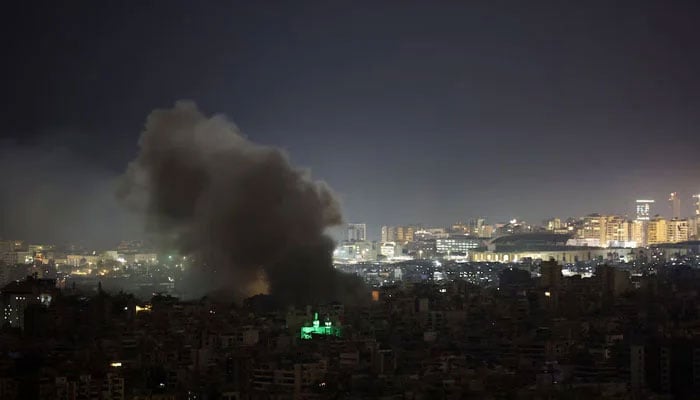
Israel’s genocide in Gaza, replicated in southern Lebanon, has now expanded into direct war with Iran, a conflict Washington chose to join on a logic that does not withstand scrutiny.
In June 2025, the US struck Iran’s nuclear facilities at Natanz, Fordow and Isfahan. The strikes were presented as decisive and limited, intended to restore deterrence and avoid a wider war. They did neither. Instead, they marked the beginning of direct confrontation with Iran.
That confrontation resumed in February 2026 through coordinated US and Israeli operations across Iranian territory and continued into early March, when US strikes hit Kharg Island, a critical node in Iran’s oil export infrastructure. What was framed as a contained response had become an expanding war.
The reasoning behind that escalation is where the contradiction becomes impossible to ignore. Israel pushed towards war with Iran. Senior US officials understood that Israeli strikes would trigger retaliation against American bases across the region. US Secretary of State Marco Rubio acknowledged as much, making clear that the consequences were anticipated in advance.
Instead of restraining Israel, Washington adopted the logic that, because Israeli actions would expose US forces to retaliation, the US had to join the war itself. This was escalation driven by fear of consequences rather than control over them. There was no strategy in play, and the logic collapsed almost immediately.
The war expanded, US forces were exposed to risk across the region and key European allies refused to support a broader confrontation with Iran. Their position reflected a simple calculation: the risks outweighed any strategic benefit.
Israel raised the stakes again by striking the South Pars gas field, one of the most critical shared energy assets between Iran and Qatar, with global economic implications.
President Donald Trump then publicly distanced Washington from the strike, stating that the US was not involved and warning Iran not to retaliate against US or Qatari assets. The message was not subtle. The US had participated in the broader war, anticipated escalation and was now asking to be excluded from the consequences of further Israeli action.
European governments have already drawn their own conclusions by showing no willingness to support an expanded war with Iran. This reinforces the reality that there is no unified Western position. What exists instead is a trajectory driven by Israeli decisions, with the US increasingly reacting rather than directing.
The rhetoric from Israeli leadership reflects that shift. Prime Minister Benjamin Netanyahu has invoked figures such as Genghis Khan as models of ruthless effectiveness, framing power in terms of domination rather than restraint. The assertion that even Jesus Christ (peace on him) would not prevail against such brutality is a statement of belief. It reflects a worldview in which moral limits are irrelevant and force determines outcomes. That logic is visible in Gaza, in Lebanon and now in the expansion of conflict into Iran.
For the US, the contradiction is becoming harder to sustain. Domestically, opposition to another Middle Eastern war is significant. Public figures such as Tucker Carlson and Joe Kent have questioned the rationale for escalation, reflecting a broader shift towards prioritising domestic stability over foreign entanglements. At the same time, US actions continue to expose American forces and infrastructure to retaliation in a conflict whose direction is not being set in Washington.
A recalibration of US policy is both possible and necessary. European allies, already reluctant to escalate, would support efforts to stabilise the situation and reduce the risk of a wider war. Restraint in this context is the reassertion of control over policy and outcomes and should not be viewed as retreat.
But Washington will not change course on its own.
Regional and allied powers have the capacity to influence the direction of this conflict. The Gulf states, Pakistan and key European governments are not peripheral actors. Their current posture of caution does not match the scale of human suffering and escalation underway.
A coordinated and enforceable position is required, not only to deter further escalation, but to contain it. Clear red lines must be established around the targeting of civilian populations, the destruction of infrastructure and the expansion of conflict into additional theatres. Diplomatic pressure must be aligned, economic leverage must be used and security cooperation cannot remain insulated from the consequences of continued escalation.
Deterrence alone is no longer sufficient. The pattern of actions in Gaza, now replicated in southern Lebanon and extended into Iran, raises the question of accountability.
The international system has faced moments like this before. After World War II, the response was not limited to containment. It included establishing accountability for actions that crossed accepted boundaries, regardless of who carried them out. That principle cannot be selectively applied without losing its meaning.
If the international community is willing to impose consequences in some cases but not others, then it is not enforcing a system of rules. It is reinforcing a system of exceptions. Containing escalation is necessary, but holding those responsible accountable is unavoidable. Without both, the current trajectory will accelerate. The consequences are no longer regional; they are already global.
The writer is a non-resident fellow at the Consortium for Asia Pacific & Eurasian Studies. He tweets/posts @umarwrites