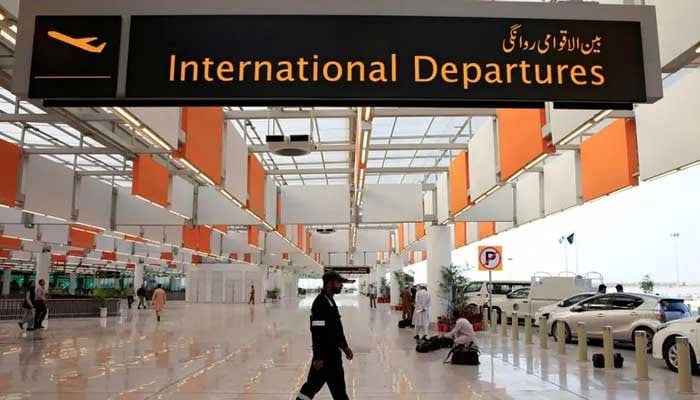
The first interaction of any investor or visitor with any country is through its airports. These are not just infrastructure but declarations of the state’s capacity and its citizens’ behaviour. Airports and airlines are the backbone of global mobility, driving investments, trade and tourism. They are also considered engines of economic growth as foreign direct investment in any country heavily relies on their infrastructure of airports and airlines.
In Pakistan’s case, that interaction mostly communicates hostility, mistrust, suspicion and institutional disarray rather than confidence, efficiency and welcome. The ultimate result is not just inconvenience but an economic and reputational liability for the country.
Globally, around nine billion passengers travel annually. China leads with over 1.5 billion, followed by the US at around 900 million, India, nearly 260 million and Japan, about 205 million.
Pakistan’s 10 major airports (Karachi, Lahore, Islamabad, Sialkot, Quetta, Peshawar, Multan, Faisalabad, Gwadar, Sukkur) handle roughly 55 million travellers annually, compared to around 90 million at Dubai International Airport and more than 70 million at Heathrow Airport. In New Delhi, the Indira Gandhi International Airport has exceeded 70 million commuters, reflecting rapid aviation growth. The divergence is not in the scale but in the system performance at these airports. At airports where the system operates competitively, departure processing takes 45–75 minutes, whereas in Pakistan, it routinely takes more than 4 hours.
There is a structural inefficiency: with roughly 480 weekly international flights from Pakistan carrying 105,000 seats, control of this capacity is increasingly external. Gulf carriers – Saudi, Qatar, Etihad, Gulf, Emirates – collectively account for the majority of Pakistan’s international seat capacity, operating multiple flights daily across Pakistan’s 10 major airports. They move millions of Pakistani passengers annually, mostly driven by labour migration, diaspora travel, and religious traffic. More than 65 per cent Pakistani travel to and from Gulf countries.
Pakistan’s current airport system has multiple imbalances: for instance, Pakistan generates strong demand through its population and diaspora; GCC foreign carriers dominate operational control of that demand; and finally, the most important, the economic value – revenue, service standards and network effects etc, is captured externally, while we are left with the residual layer of infrastructure strain, administrative friction, and taxation.
Qatar Airlines alone carries more than 50 million passengers annually, and that is effectively more than Pakistan’s entire aviation capacity. The majority of airports in the GCC have integrated efficiency into the passenger experience and Hamad International Airport is the global benchmark. India pursued a different trajectory, leveraging public–private partnerships to modernise its hubs (Mumbai, Bangalore, Delhi) and aligning infrastructure growth with intensifying demand. Despite similar geographic advantages, Pakistan has not translated demand into system capacity or competitiveness.
Primarily, institutional design is failing the Pakistan aviation sector. The regulator, the Civil Aviation Authority in Pakistan, also functions simultaneously as operator, landlord, and commercial entity. This concentration of authority is a major impediment towards progress. This conflict of interest promotes control and rent extraction rather than efficiency and service delivery. We can certainly learn from the US Federal Aviation Administration (FAA) entity, as it separates regulations from operations, thus enabling accountability, specialisation and performance discipline.
The consequences are visible across Pakistani airports, as a traveller departing Pakistan confronts multiple, often redundant checkpoints – security, documentation, scanning, anti-narcotics, foreign currency scrutiny, immigration and recurring gate-level checks etc – repeatedly operating without integrated data systems, so-called vigilance has become procedural inflation. In a competent, professional and advanced aviation ecosystem, the security apparatus is intelligence-led, identifying risk before arrival at the airport, enabling continuous movement for the majority and targeted intervention where needed.
The CAA compounds the inefficiency, as air travel in Pakistan is burdened by multi-layered taxation, including federal excise duties, embarkation charges, airport fees and fuel surcharges. On international segments, especially to the Gulf, these charges can constitute 40 per cent of the total ticket cost, thus representing a disproportionate burden. The system monetises friction rather than facilitating growth.
The PIA crisis has also reinforced this structural imbalance. Now privatised, PIA – once a global pioneer – now faces persistent financial losses, operational inefficiencies, and diminished credibility. PIA’s contraction has surrendered market share to GCC airlines, diminishing Pakistan’s capacity to structure its own aviation ecosystem. Strong airports and strong national airlines are closely linked – the corrosion of one will accelerate the deterioration of the other. Yet the highest cost was imposed due to a safety failure. European regulators’ restrictions further led to billions of dollars in lost revenue and permanent reputational damage. Safety in the aviation sector alone is the foundation upon which the entire system rests.
The current aviation environment in Pakistan has overlapping agencies that derive relevance from the multiplicity of checks; discretionary authority facilitates rent-seeking; and the amalgamation of powers protects institutional autonomy. Therefore, attempts to reform the aviation sector must disrupt these symmetries and must be structural, sequenced, and economically grounded.
The CAA must be restructured into three autonomous bodies: a regulator entity that exclusively deals with safety and compliance; corporatised airport operating companies, which can potentially be structured through public–private partnerships; and an independent air navigation service provider. This separation of roles will certainly align incentives and strengthen accountability.
There is also a need to redesign the passenger movement process, revitalising it through digital integration, including online check-in, off-airport baggage processing, biometric verification and unified data platforms across law enforcement agencies at the airport. This reform will eliminate redundancy and streamline procedures at our airports.
Professional management and merit-based recruitment principles must also be upheld, drawing on expertise in operations, safety systems, and commercial management. And continuous training, certification, and international benchmarking should be mandatory. Accountability and transparency are the preconditions for improvement. Through independent oversight mechanisms, real-time complaint systems, publicly reported performance metrics, and public dashboards, processing times, passenger satisfaction, safety indicators and public dashboards must be institutionalised.
Commercial transformation is very important in the aviation industry. An airport can be transformed into an economic platform, as globally, over 40 per cent of total airport income comes from non-aeronautical revenues. At London Heathrow, Passenger spending averaging around GBP20 per traveller. Even a modest increase of $10-15 per passenger across Pakistan’s system could generate $500 million annually, transforming airports into revenue-generating assets rather than fiscal burdens for taxpayers.
And finally, the legal reforms, exit control lists (ECL), and other travel restrictions and enforcement mechanisms must operate within transparent, rules-based frameworks, with clear avenues for appeal. The conjecture of facilitation must replace the assumption of suspicion.
Reform implementation should be phased: at the first stage, there should be immediate restructuring of redundant security checks and retraining of the frontline workforce; medium-term focus should be on the deployment of digital systems and institutional separation; and finally, long-term development of Pakistan as a regional aviation connector between South Asia, Central Asia, the Middle East and Europe.
We can certainly learn from global success stories: Dubai International Airport shows how governance clarity and service excellence can create global hubs; Hamad International Airport exemplifies the amalgamation of design, technology and efficiency; Heathrow Airport proves the power of regulatory separation and commercial discipline; and can gradually improve customer service standards.
Airports are not just terminals but a physical expression of how a state manages its authority, risk, and time. Pakistan’s challenge is operational, as we possess demand, geography and human capital. We have allowed others to carry our passengers, define our standards and capture our aviation value – but this trajectory can be reversed.
With institutional alignment, we can certainly transform from a procedural state to a passenger state. Our aviation ecosystem currently reflects disintegration, inefficiency and external dependence. At the same time, it is also giving us the opportunity for transformation – from control to competence, from opacity to transparency, from fragmentation to coherence. Pakistan must now decide whether it intends to compete or concede.
The writer is a political economist, public policy commentator and advocate for principled leadership and regional cooperation across the Muslim world.