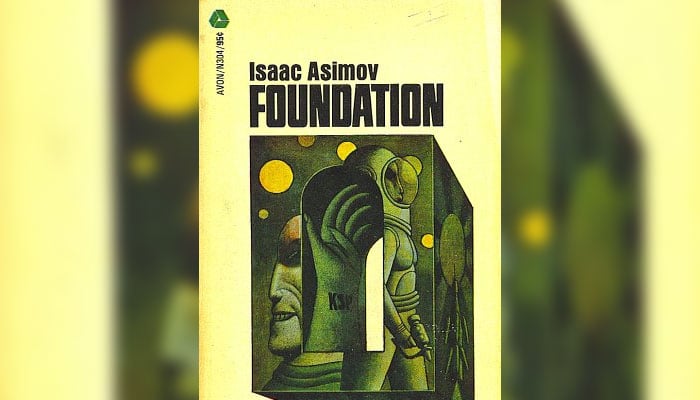
In the science fiction novel ‘Foundation’ (1951), Isaac Asimov introduces psychohistory as a revolutionary science capable of predicting the collective behaviour of large populations. It is done through mathematical probability. Psychohistory appears to be a literary or narrative device designed by Asimov to advance the story. However, it serves as a model of governance that renders political authority scientifically foreseeable. Through psychohistory, Asimov transforms governance from a disputed arena of ideology and democratic negotiation into a dimension of rational calculation and technocratic management. He brings forth a speculative idea where power is no longer debated but foreseen.
In ‘Foundation’, psychohistory, conceived by one of the key characters, Hari Seldon, is developed on two assumptions. First, human behaviour on a large scale follows predictable statistical patterns, and second, individuals are irrelevant compared to mass movements or actions taking place in the cosmos. This framework removes the irregularity of singular actors and promotes aggregate behaviour. Governance, therefore, becomes about managing historical paths rather than persuasion. The fall of the Galactic Empire in ‘Foundation’ is not a political failure but a statistical certainty. Seldon’s Plan does not avoid collapse; it shortens the dark age from 30,000 years to 1000. In doing so, Asimov shifts political authority from elected leadership to scientific foresight.
This shift replaces democracy with technocracy. In the Foundation’s early years, political leaders made strategic decisions during moments known as ‘Seldon Crises’. However, these crises are not thoughtless conflicts. They are mathematically projected turning points fixed within Seldon’s predictive model. The leadership of the Foundation operates within the boundaries of certainty. Their role is not to shape history but to recognise the path that is determined by psychohistory. Leaders, therefore, become supervisors rather than actors of change.
Asimov reinforces this technocratic vision through the creation of the Second Foundation (1953), a secretive group of mental scientists who safeguard the Plan. Unlike the political structures of the First Foundation, the Second Foundation administers invisibly, influencing events to maintain historical stability. Knowledge, instead of consent, becomes the source of sovereignty. Authority rests with those who understand the equations of history. In this system, power is not based on the people’s choice, but on the belief that those in charge have superior knowledge. Asimov does not present this system as flawless. The emergence of the Mule, a mutant capable of disrupting the emotional balance of populations, introduces a threatening force into psychohistory’s framework. The Mule represents the inconsistent individual who resists statistical modelling and reveals the instability of governance.
Written during the early cold war, Asimov’s ‘Foundation’ series reflects contemporary belief in systems analysis, bureaucratic management and large-scale forecasting. It was a time when governments in the West relied on scientific advisors and strategic models to manage nuclear risk and geopolitical instability. Psychohistory can be seen as an imaginative extension of this technocratic confidence.
‘Foundation’ also foreshadows modern concerns about algorithmic governance. In an age defined by predictive analytics, AI, and data-driven policymaking, psychohistory seems prophetic. The concept that human societies can be modelled, forecasted and guided through mathematical systems parallels contemporary debates about the role of algorithms in shaping political decisions. Asimov’s fictional science presents ethical questions. If history can be predicted, should it be managed? This may cause serious concerns for those managing predictability, as they may be compelled to alter the future.
The writer is a science fiction author and a columnist.