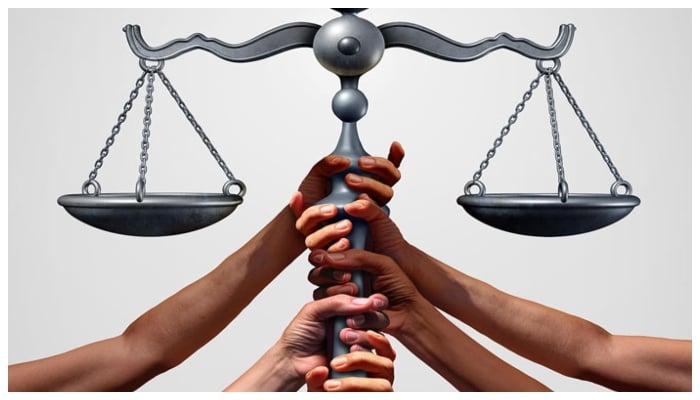
Every year on February 20, the international community observes the World Day of Social Justice. Recognised by the UN, the day emphasises the dire need to promote fairness, equality and human dignity, as well as efforts to tackle several critical issues such as poverty, marginalisation, inequality, unemployment, human rights and social protections.
For many, it is an international observance marked by statements, conferences and policy discussions. However, being a minority non-Muslim parliamentary leader of Pakistan, the day is all about strengthening my tireless struggle to ensure belonging, opportunity and equal respect under the same green and white flag in accordance with the constitution of Pakistan.
According to Quaid-e-Azam, Pakistan was envisioned as a homeland where all citizens, regardless of faith, could live with dignity and security. In his August 11, 1947 speech, the promise of equality and social justice was not limited to one community. It was meant for all. Unfortunately, Pakistan still continues to grapple with structural inequalities that affect not only religious minorities but also women, the poor and marginalised regions.
For minority communities, social justice begins with equal access and equitable opportunities, particularly in education, employment, security and political representation. It means feeling safe to worship freely. It means being judged by competence, not faith. It means that our patriotism is never questioned because of religious affiliation.
Similarly, the constitution of Pakistan guarantees equal rights to all citizens. In principle, no one should face discrimination based on religion, ethnicity, gender or background. In practice, however, social attitudes and economic disparities sometimes create invisible barriers. It is important to acknowledge that inequality in Pakistan is not limited to religious identity only. Poverty cuts across communities. Inflation affects every person alike. Rising prices burden every household. However, for many marginalised families, economic challenges are compounded by limited access to quality education and professional opportunities. Informal discrimination may not always be visible, but it can restrict the ability to perform positively in society.
Education, in my view, remains the strongest tool for breaking cycles of exclusion. That’s why the most important struggle is to ensure a hate-free school curriculum. I believe that teaching to show respect for all religions and diversity does more for world peace than any slogan ever could.
Constitutionally, political representation of minorities in parliament exists through reserved seats. While this is a positive step, representation should not be symbolic but should be used to build confidence and trust. There should be proactive participation in legislative and decision-making processes for ensuring equal voice in shaping state policies.
Social justice is also not a favour granted by the majority to the minority. It is a universal obligation for unity and stability. When every citizen feels valued without any bias, the nation grows stronger. It is also about our behaviours. In my personal experience, casual prejudice, stereotypes or social exclusion, even when unintended, can create feelings of alienation.
World Day of Social Justice invites us to move beyond tolerance toward mutual respect. Diversity should not be seen as a threat but as a strength. Pakistan’s cultural richness, from temples to churches, gurdwaras to masjids, reflects a rich shared civilisational heritage.
As a patriotic minority Pakistani citizen, I always seek inclusion. I do not ask for privilege; I ask for equality. The future of Pakistan depends on cohesion – and cohesion depends on fairness. On this World Day of Social Justice, I reflect not with bitterness but with hope. In my view, the path towards fairness may be gradual, but it is achievable through sincere commitment, institutional reform and collective goodwill.
The writer is a member of the National Assembly and patron-in-chief of the Pakistan Hindu Council. He tweets/posts @RVankwani