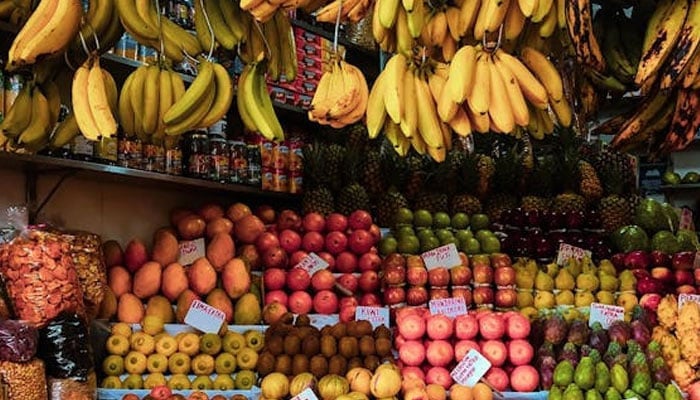
LAHORE : Number of fruit rates were registered upwards trajectory before the start of Ramazan as the producers stopped the supplies from orchards which pushed up the rates of these fruits.
Its annual practice that the producers, middlemen manipulate the supplies ahead of the Ramazan to gain windfall profits while the government and the authorities concerned are unable to control this practice. This year, banana and guava supplies were already affected as the intake of both fruits are increased in the holy month of the Ramazan. The supplies are affected from the orchards as the producers stopped harvesting them for a shorter span which was started almost 10 days ago.
This holding the crops has already pushed the rates of both items sharply upwards and presently only B or C category quality of both fruits are being sold in the market.
Live chicken prices were sharply reduced by Rs40 per kg on the official list and fixed at Rs309–323 per kg, yet the commodity was largely unavailable at these prices across most localities. Chicken meat followed the same trajectory: despite a Rs58 per kg cut to an official rate of Rs468 per kg, consumers paid between Rs500 and Rs550 per kg, while boneless chicken continued to sell at exceptionally high rates, hovering close to Rs800 per kg and above in many neighbourhoods.
For families already grappling with food inflation, the nominal price cuts offered little practical relief. Vegetable markets reflected a similar disconnect between official rates and selling prices. Soft-skin new potatoes were officially fixed at Rs20–22 per kg, but retailers charged Rs30–40 per kg. Tomato prices fixed at Rs82–90, but market rates remained sharply higher, ranging from Rs120 to Rs160 per kg.
Onion prices were fixed at Rs55–60, though they continued to sell between Rs80 and Rs100 per kg.
Local garlic prices rose to Rs210–220 per kg, but retailed at Rs280–300 per kg. Chinese garlic remained gained to Rs505–530 per kg and retailed near Rs600-700 per kg.
Thai ginger also gained to Rs285–300 per kg, sold between Rs400 and Rs450 per kg. Farm cucumbers fixed at Rs42–45, but were sold at Rs70–100 per kg.
Pumpkin gained to Rs114–120 per kg, but continued to sell between Rs200 and Rs250 per kg. Green chilies gained to Rs133–140 per kg and retailed at Rs180–200 per kg. Capsicum also gained to Rs138–140 per kg, selling at Rs180–220 per kg.
Pea prices reduced to Rs38–40 per kg and sold at Rs60–100 per kg.
Fruit prices showed mixed trends. Apple prices were officially fixed between Rs250 and Rs420 per kg, but sold at Rs350–600 depending on quality.
Banana A-category price was surged to Rs20–230 per dozen, though retail prices ranged from Rs300 to Rs350 per dozen and B-category rate at Rs125-140 per dozen, sold at Rs200-250 per dozen.
Guava prices fixed Rs138–145, selling between Rs200 and Rs250 per kg. Dates prices were fixed at Rs410–495, but ranged Rs800to Rs2,000 per kg. Papaya prices gained to Rs325–340 and sold at Rs350–450 per kg. Grapefruit remained fixed at Rs28–30 per piece and sold at Rs40–50 per piece, while musami prices fixed at Rs172–180 per dozen but sold at Rs200–250 per dozen.
Citrus fruit prices were fixed between Rs220 and Rs335 per dozen, but retailed at Rs300–450 per dozen.
Kandhari pomegranates were fixed at Rs601–630 per kg and sold at around Rs800 per kg, while danedar pomegranates were fixed at Rs772–810 per kg but retailed between Rs1,000 and Rs1,400 per kg.
Melon was fixed at Rs180-240 per kg, sold at Rs250-300 per kg. Strawberry price was not fixed, but sold at Rs800-1000 per kg.