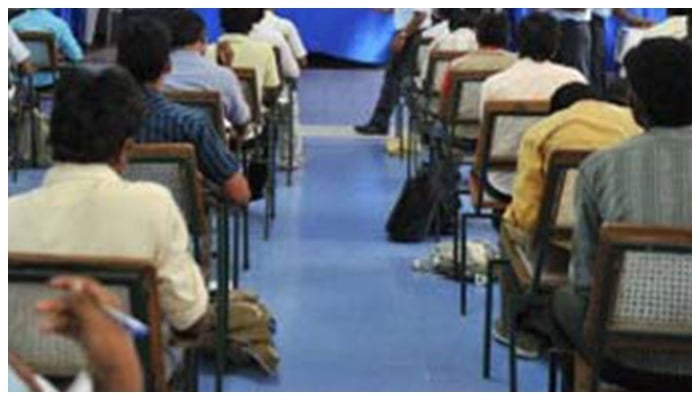
Every year, around this time, I find myself back in a classroom with 100 or so 17–19-year-olds. Medical students. Bright, opinionated, funny, occasionally exhausting. I’ve been doing this for nearly a decade now and it remains one of the few things that reliably recentres me. [I know, I know: I talk about this far too much, but will make no apologies]. Call it a focus group, call it an annual study: all I know is that I am quite convinced I learn more from these classes than they do. These students are also Pakistan’s meme generation that laughed its way through crisis after crisis, including a war last year, using humour as shield, coping mechanism or maybe just the only language left when fear becomes too familiar.
Last week, something small but telling happened mid-class. I can’t remember what we were discussing that day. It could have been politics, media, identity or technology. I do remember having a lot of social media noise rattling around in my head – much of it around Basant and watching people be unconditionally happy – when I suddenly asked: what gives you joy, outside of social media? The room went quiet. That rarely happens. My students usually have opinions ready to go. They like their discussions ‘spicy’ – their favourite word, as in: “Ma’am, debate spicy nahin thee”. But this question seemed to throw them a bit. There was hesitation, a sense that joy was not an easy thing to offer up.
I had a fleeting (and entirely unscientific) thought in that moment, which I am now doubling down on until proven otherwise: joy, for many young people today – certainly in Pakistan – feels like something that needs explaining. Something that needs to be justified. As if happiness, unless placed carefully within a context of struggle, productivity or purpose, is slightly embarrassing. Can we then say that for this generation, talking about ideas comes easily, but talking about themselves does not? Ironic, isn’t it, for a lot that documents almost every aspect of its life. And yet, when it comes to joy without a filter, without an audience, without a narrative – that inward turn feels heavier.
And perhaps that makes sense. Pakistan is not an easy place in which to feel light. It is a country weighed down by inequality, economic stress, political instability and a near-constant awareness of how bad things are for so many. Any thinking human being pauses before joy, reflects on privilege, questions whether happiness is deserved. That guilt is understandable. It may even be necessary. But that is not the joy I was asking about. Not joy as a function of money or class or insulation from hardship. But fleeting and ordinary joy. The kind that exists in moments – admiring the sky, laughing with friends, loving one’s family, celebrating Eid or Christmas or any other event, feeling festive without apology. Knowing that life is hard for many should not mean judging yourself for taking a minute to breathe.
But then again, this generation grew up in a post-Covid world, came of age watching a literal genocide unfold live on their screens, lives in a country addicted to political theatrics and is constantly warned about machines replacing human labour. Uncertainty is not an occasional visitor for these kids, but their very own OST. These are the children of parents that carry some seriously messed-up political trauma and baggage.
There is, of course, data to back this up. A 2025 Harvard-backed survey reported by Fortune found that many young adults today struggle with a lack of direction and meaning, with researchers noting bluntly that “young people are not doing as well as they used to be”. More than half the respondents said they did not know what they wanted to do with their lives, a confusion closely linked to declining mental health. A Forbes piece from last year echoed this sense of quiet exhaustion. Experts pointed to a perfect storm of pressures unique to Gen Z: economic precarity, constant comparison on social media, burnout arriving far too early and the feeling of carrying adult anxieties without adult control.
Back in the classroom, one of my students said that joy is something experienced offline. It is not meant to be performed. It is personal, unfiltered, separate from the online self. I understand that. I also wonder what that means for grief. If joy is private and offline, where does ‘real’ sadness go? If you step away from the filters, the outrage, the memes and the performance, are you prepared to sit with your raw self? Another student, Anam, described joy as the feeling you have when you are a child and how adulthood is really just a long attempt to find your way back to it. I found that unexpectedly moving in its simplicity. But it’s not that simple when it comes to the social media effect (a more detailed write-up due on that). For my student Hasanuddin, the “constant chase for a dopamine high has left us unable to value it when we experience it”. He feels his generation has forgotten that “there cannot be high highs without low lows”.
This is not a lament for a lost generation. Nor is it one of those tired ‘kids these days’ takes. The students I teach are thoughtful, kind and painfully aware of the world they have inherited. If anything worries me, it is not their seriousness but their cynicism and how rarely we speak to them without performing for them. We talk endlessly about Gen Z. We market to them, parody their slang and panic about their attention spans. But we don’t ask how they are doing and then sit still long enough to hear the answer.
To be fair, every generation has believed the one after it to be strange, mysterious or inaccessible. Maybe that is the only point of this column: not to diagnose a generation or romanticise it but to suggest that if joy feels harder to name right now, perhaps the least we can do is ask about it and not rush to explain it away. And maybe try to make the world gentler. And, yes, I blame us all: the politician that won’t stop their hypocrisy; the elite that won’t stop their plunder even as this planet literally dies; the parent that won’t stop imposing whatever borrowed political trauma they have; the media that exploits the cynicism of an 18-year-old; and the teacher that thinks talking down to a young person is how it’s done.
The writer heads the op-ed desk in this newspaper and teaches college and university students. She says stuff on X @zburki and can be reached at: [email protected]