Is Basant the spring that comes after winter? I know that there are allusions in this statement that may not make much sense. But I am so tempted to quote Shelley: “If Winter comes, can Spring be far behind?”
Clearly, this famous last line of ‘Ode to the West Wind’ symbolises hope and the promise of renewal after a period of gloom and hardship. Winter, here, is a metaphor for a difficult time and spring celebrates life and its possibilities. This is what weather means in places where winters are long and very cold.
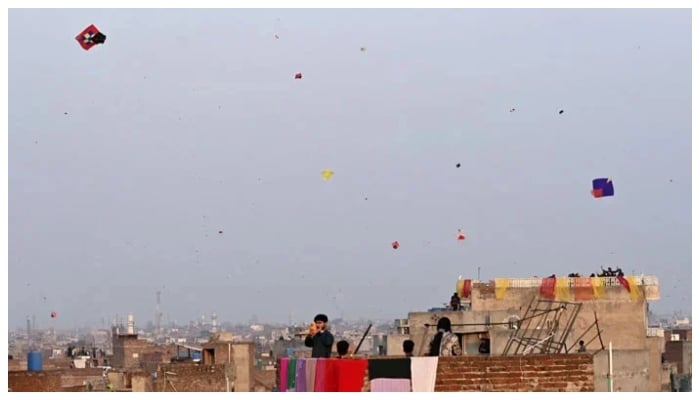
Still, spring universally is the season of joy. Plants and leaves begin to grow again. Flowers bloom. Hence, spring has for centuries been celebrated with festivals in many cultures. That is what Basant is, as it had for long been celebrated in Lahore. Last weekend, Basant returned to Lahore after an absence of nearly two decades. And it came back with, as they say, a bang.
It would be worthwhile, I think, to look at the particular circumstances in which the provincial government took the decision to revive a hallowed tradition and went ahead to set the stage for it on a big scale. It became a good example of an effective execution of a large project. Punjab Chief Minister Maryam Nawaz deserves credit for this achievement. To put it simply: she did it.
But to return to the thought I have expressed at the outset, what does this wonderful celebration of Basant in Lahore really mean? What kind of cultural or political messages sprout from those fleeting moments of glory? Would the impulse that prompted the decision to celebrate Basant be invested in more initiatives in the same direction?
Before we address these questions, we need to understand why Basant was banned in 2007. The major reason cited was that the sharp string used by kite flyers would cut the throats of motorcyclists coming in the way, resulting in fatalities. In any case, not just Basant but kite flying itself was banned, though violations continued to be reported.
At the same time, there have been orthodox and obscurantist elements who argued that Basant was a Hindu festival and should not be allowed in the Islamic Republic. Kite flying was also frowned upon by them because it seemed so frivolous and also dangerous, because kite runners, as well as flyers, could fall from roofs or run into obstacles. At some level, religious people do not much approve of people being playfully jovial and having fun.
Anyhow, Basant and kite-flying remained banned for all these years. Almost an entire generation that grew up in Lahore and the surrounding areas over the past twenty years was denied the culturally enriching experience of participating in the festival. I was not in Lahore last week, but I have had the Basant experience long years ago and would testify that no other event can match the involvement it creates at the popular level.
During Basant's long absence, I often grieved about it in this space, wondering why it could not be revived with whatever administrative controls were needed. I have often wondered if the ban on Basant was one more manifestation of Pakistan’s deprivations in the domain of social and human development. Now that Basant has passed, the ban on kite flying remains in place. Hence, ambivalence about the administration's real intent persists.
It so happens that a suicide bombing in an Imambargah in Islamabad at the time of the Friday prayers overlapped the beginning of Basant in Lahore. More than 30 persons lost their lives and scores were hurt. This was a major terrorist attack and did cast its shadow on the celebrations in Lahore, which included the literary festival. Some official Basant ceremonies were cancelled.
Come to think of it, these are the two poles of the Pakistani society: violent extremism and intolerance in the name of religion on one side and the struggle for peace, social harmony and cultural renewal on the other. The choices that the establishment had made in the past gave rise to violent extremism. We are not sure about the choices that are being made now. But Basant has come as a breath of fresh air.
Accounts of how it was celebrated are heartwarming. Rightly, the international media took notice of the great passion with which it was observed. Observers also noted the political implications of the Basant becoming a distraction from a popular agitation planned by Imran Khan’s party on Sunday, on the second anniversary of the disputed elections. Once again, the PTI’s purported legions failed to storm the citadel of power.
Basant is derived from Vasant, the Sanskrit word for spring. In Pakistan, it has traditionally been restricted to Lahore and a number of other cities in Punjab. But spring festivals like Nawroz in Iran and other Central Asian countries and the New Year in China, which in 2026 begins on February 17, are massive national celebrations that involve many, many millions of citizens.
I have fond memories of watching Iran’s Nawroz celebrations one year after the Islamic revolution in 1979. I was covering the first Majlis elections. Nawroz begins on the spring/summer equinox around March 20 and I recall that after the revolution, the 47th anniversary of which was observed on Thursday, some religious leaders had opposed the pagan rituals of Nowruz. But traditional culture always prevails in living societies.
There is nothing like Nowruz in the Iranian calendar and it continues for nearly two weeks. I cannot forget those bonfires on Tehran’s streets and people jumping over them. This was the ritual of Chaharshanbe Suri, or Red Wednesday, performed on the eve of the last Wednesday before Nowruz. It is an ancient Persian festival of fire symbolising purification and renewal.
All festivals have their extensive rituals, including the meals that are eaten and the dresses that are worn. We know that Basant is so much more than flying kites from the rooftops. Like other festivals, it inspires a sense of community. And God knows we need it badly.
The writer is a senior journalist. He can be reached at: [email protected]