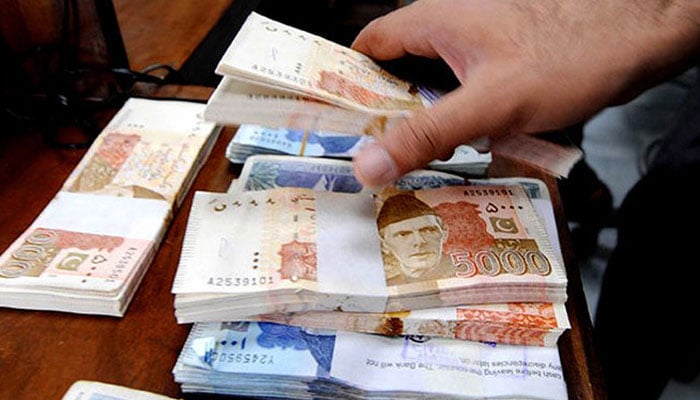
The latest numbers from the State Bank of Pakistan should alarm anyone paying attention to where this country is headed. Private sector credit – the money businesses borrow to expand operations, upgrade equipment, and create jobs – has fallen off a cliff. We’re talking about a 79 per cent drop compared to last year.
Let me break down what that means in actual terms. In the first half of last year, businesses borrowed Rs1.87 trillion from banks. This year? A mere Rs395 billion. That’s nearly Rs1.5 trillion in lost investment – money that would have built factories, created jobs and driven growth.
This isn’t some abstract financial metric. It translates directly into fewer opportunities, underutilised capacity and an economy that’s essentially treading water. And here’s the kicker: despite the State Bank slashing interest rates to encourage borrowing, businesses aren’t biting. We’ve stumbled into what economists call a stagnation trap: where making money cheaper no longer sparks growth.
Start with the most obvious problem: consumers are tapped out. Consider what the average Pakistani family has endured over the past two years. Food prices have spiked 30-40 per cent at various points. Electricity and gas bills have doubled, tripled, even quadrupled in some cases. Whatever income gains people made have been eaten alive by inflation. Real purchasing power – what your rupees can actually buy – has shrunk.
Put yourself in a business owner’s shoes. Why would you borrow money to ramp up production when your potential customers are struggling to afford necessities? If a middle-class household is maxing out its budget on food, rent, and keeping the lights on, they’re not shopping for new appliances or clothes. So businesses hunker down rather than expand.
Then layer on the uncertainty. Political instability that never seems to end. IMF programmes that inevitably bring fresh tax hikes and utility price shocks. The constant threat of currency devaluation making your import costs explode overnight. Try making a five-year business plan in that environment. Most business owners would rather pay down existing debt and sit on cash than take on new risks.
The other half of this equation is the banks themselves. Pakistani banks still carry scars from previous waves of bad loans. They’ve learned their lesson or think they have. Why lend to businesses when you can buy government securities instead? Risk-free returns, no hassle, no loan officers to pay, no recoveries to chase. Government debt has become the path of least resistance. The result? Money circles endlessly between banks and government borrowing instead of flowing to the factories, farms and startups that could actually create growth.
Here’s something that doesn’t get enough attention: rate cuts can actually make borrowing 'feel' more expensive, depending on inflation. Think about it this way. When interest rates were 18 per cent but inflation was running at 20 per cent, you were effectively borrowing at negative real rates. Now rates have dropped to 17 per cent, but if inflation has cooled to 15 per cent, your real borrowing cost has actually gone up. The headlines trumpet 'rate cuts', but business owners looking at their bottom lines see a different picture entirely.
Even if loans were dirt cheap, Pakistan’s broader business environment remains fundamentally broken. We have some of the highest electricity tariffs in the region – and that’s when the power actually flows. Factories regularly deal with outages that kill productivity. Import restrictions trap raw materials and machinery at ports for weeks or months. Policy changes come out of nowhere, throwing cost calculations into chaos. The expanding tax net increases compliance costs, even if the long-term goal makes sense.
How does a factory compete when it can’t count on uninterrupted power, can’t get inputs reliably, and can’t predict what its cost structure will look like next quarter? In that context, a low interest rate is beside the point. This is what makes it a trap. The central bank can cut rates all it wants. But it can’t force businesses to borrow money they don’t need, and it can’t force banks to lend to clients they see as risky. Economists have a phrase for this: pushing on a string. You can push harder, but nothing moves.
Lower interest rates aren’t enough. Not even close. Pakistan needs policy stability so businesses can plan beyond the next quarter. Energy costs need to come down and power supply needs to become reliable. Import rules need to be clear and consistent. Tax reforms should be gradual and predictable, not shock therapy. And households need support to restore their purchasing power – because without demand, nothing else matters.
When people can spend again, and businesses can plan with some confidence that the rules won’t change mid-game, investment will return. Not before.
So what does all this economic stagnation mean for the average Pakistani trying to make ends meet? For starters, don’t expect your salary to catch up with prices anytime soon. When businesses aren’t investing and the economy isn’t growing, there’s no pressure to raise wages. Your employer isn’t expanding, isn’t hiring, and certainly isn’t handing out raises beyond token cost-of-living adjustments that don’t come close to covering actual inflation.
Job security becomes shakier. Companies operating on thin margins and uncertain prospects start looking at headcount as the easiest cost to cut. Fresh graduates find themselves competing for fewer and fewer positions, often accepting jobs well below their qualifications just to get a foot in the door. Then there’s the slow erosion of quality in everything around you. That pothole on your street stays unrepaired longer. Public services deteriorate as tax revenues stagnate and the government focuses on just servicing debt. Schools and hospitals that were barely adequate become worse. Infrastructure projects get shelved indefinitely.
Your savings, if you have any, lose value even in the bank. While the official inflation rate might be cooling, the prices of things you actually buy – food, transport, utilities – remain stubbornly high. And forget about big purchases like a car or property. With stagnant incomes and uncertainty everywhere, these become pipe dreams rather than realistic goals.
Perhaps worst of all, you’re stuck. Moving up feels impossible when the entire economy is stuck in place. The middle-class life your parents achieved seems increasingly out of reach, and the gap between those with overseas income or inherited wealth and everyone else just keeps widening.
But here’s what gets lost in all the financial jargon: real people are paying the price for this stagnation. Poverty rates have climbed sharply. According to recent estimates, nearly 40 per cent of Pakistanis now live below the poverty line – up from around 22 per cent just a few years ago. That’s tens of millions of people pushed into deprivation while we debate monetary policy.
The social indicators tell an even grimmer story. Malnutrition among children under five has worsened, with stunting rates hovering around 40 per cent – one of the highest in the world. School dropout rates are rising as families pull kids out to work or simply can’t afford fees and supplies anymore. Healthcare access has deteriorated as out-of-pocket costs skyrocket beyond what ordinary families can manage.
Unemployment, particularly among young people, continues to climb. Pakistan is producing hundreds of thousands of graduates each year who face an economy that can’t absorb them. The brain drain accelerates as those who can leave do leave, taking their skills and potential to countries that can actually offer them a future.
Until we break out of this stagnation trap, all the rate cuts in the world won’t change these realities. We’ll keep limping along with idle factories, risk-averse banks, an economy going nowhere, and a generation of Pakistanis whose potential is being squandered while we figure out – or fail to figure out – how to make this country work again.
The writer tweets/posts @FarrukhJAbbasi