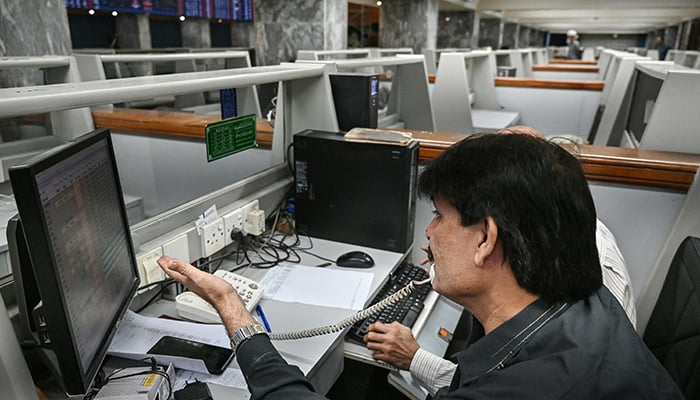
The Pakistan Stock Exchange (PSX) opened the week deep in the red on Monday, with the benchmark index plunging over 9,000 points as investors panicked amid the escalating war in the Middle East.
The KSE-100 Index settled at 146,480.14 points, down 11,015.96 points, or 6.99%, from the previous close of 157,496.1, marking its second-highest single-day decline.
The record fall this year remains the 16,089-point plunge recorded earlier in 2026, and the three largest single-day declines in the index’s history have all occurred in 2026
The index traded between an intraday high of 150,174.09 (down 7,322.01 points, or 4.65%) and a low of 144,119.43 (down 13,376.67 points, or 8.49%).
The benchmark index declined by 10,566 points or 6.3% last week due to the US-Israel vs Iran war.
"The pressure is obvious due to war premium and 100 plus oil prices derailing macro stability with no signs of ceasefire. All eyes on SBP today," said AAH Soomro, an independent investment and economic analyst.
Following the massive decline of 9,780.15 points, or 6.21%, to 147,715.95 at the start of the session, trading was halted.
Trading was briefly halted under PSX risk-management rules after a sharp drop, with the exchange’s notice stating that the halt was triggered due to a 5% decrease in the KSE-30 Index, suspending all equity-based markets.
It also noted that outstanding orders were cancelled automatically and set out the re-opening schedule (Market Halt Time 09:22:15am; Pre-Open 10:22:15am; Open 10:27:15am).
Analysts expect cautious trading this week as markets assess the impact of regional tensions, inflation trends and interest rate direction. The index currently trades at a price-to-earnings ratio of about 8.1 times and offers a dividend yield of around 6.3%, which analysts view as attractive at current levels.
According to AHL Research, the KSE-100 index performance over the week will depend largely on geopolitical developments and the outcome of the Monetary Policy Committee (MPC) meeting today.
The research house noted that the market trades at relatively attractive valuations compared with its historical levels. It identified several sectors where fundamentals remain supportive despite recent volatility.
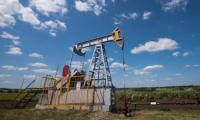
Other Asian stock markets plunged Monday as oil prices soared 30% on fears about supplies from the Middle East as the US-Israeli war against Iran continued into a second week with no sign of letting up.
Investors, already spooked by concerns over extended tech valuations and the huge spending on AI, ran for the hills as crude rocketed to its highest level since the Russian invasion of Ukraine in 2022.
Fears grew that the Middle East conflict could last for some time after US President Donald Trump said only the "unconditional surrender" of Iran would end the war.
He added at the weekend that the spike in prices was a "small price to pay" to eliminate Iran’s nuclear threat, reiterating the White House’s insistence that the rise is temporary.
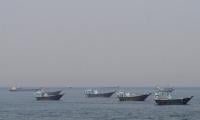
Both main contracts, which had surged more than a quarter last week, spiked as Iran carried out retaliatory strikes against crude-producing Gulf nations.
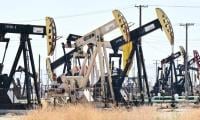
West Texas Intermediate, the main US oil benchmark, jumped as much as 30% to hit a high of $118.88 per barrel, while Brent spiked 28% to as much as $118.73.
Since the beginning of the war, WTI is up more than 75% and Brent more than 60%.
— Additional input from AFP