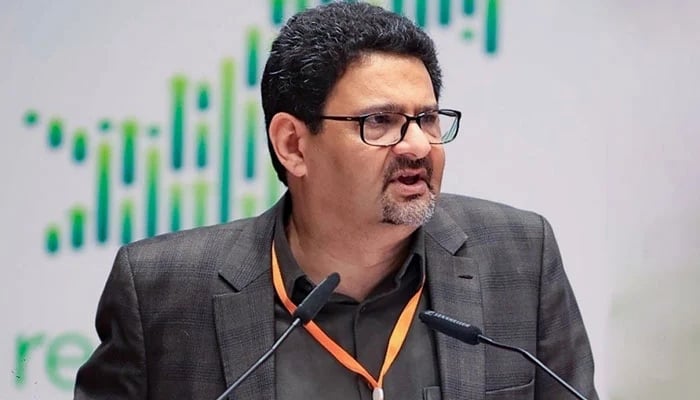
Former finance minister Miftah Ismail has criticised the PML-N-led government for allegedly allowing oil companies to earn up to Rs70 in additional profit in the latest revision of petroleum product prices.
In a post on X, Miftah, who served as the finance czar during Prime Minister Shehbaz Sharif's previous tenure, said that the government raised the prices, but in doing so, it also gave Rs35 per litre extra profit to oil companies on petrol and Rs70 per litre on diesel.
The federal government raised petrol and diesel prices by Rs55 per litre as surging global oil prices, fuelled by the US‑Israel war with Iran, put pressure on domestic energy costs.
Effective from March 6, the new price of petrol is Rs321.17 per litre from Rs266.17; whereas, the diesel rate is Rs335.86 per litre from Rs280.86 after the review.
Explaining it further, the Awam Pakistan Party (APP) leader said that the government decided to increase petrol and diesel prices by Rs55 per litre each, which is both the highest single increase ever and the highest price level for both petrol and diesel. "And it will, of course, bring in a huge increase in inflation."
Miftah said that in Pakistan, petrol and diesel prices are set every 15 days. The last price increase came on February 28 for the period of March 1-15, which is set according to the prices in Singapore’s Platt index.
The government, he explained, took the average Platt price for petrol and diesel from February 15-28 and added petroleum levy and other incidentals and came up with a price.
"It does it because the inventory cost of petrol and diesel in Pakistan sold by oil companies in the first fortnight of March is based on international prices that existed before Feb 28 when companies bought the products from international markets."
Now, because of the heavy increase in international oil prices, he said, there was an expectation in the local market of a large increase in prices for the period of March 15-31. So consumers started filling their tanks, and petrol pumps and oil companies also started hoarding in the expectation of price increases and windfall profits.
"The government felt compelled to increase prices now to stave off a shortage," he stressed.
The other option, Miftah said, would have been to credibly announce that they would reduce the petroleum levy from March 15 onwards so that the final consumer price would not increase.
This would also have staved off hoarding, but fiscal prudence and the International Monetary Fund (IMF) wouldn't have allowed this.
"A final option would have been better monitoring of oil companies and petrol pumps, but the government doesn't have faith in its own monitoring apparatus. So the government decided to raise prices."
However, he said, instead of just increasing the petroleum levy by Rs55 per litre for this week and committing to reduce it back to the original rate from March 15, so that the expectation about a price increase on March 15 ended, it raised the prices for oil companies and gave them windfall profits.
"This is beyond comprehension."
The government raised the petroleum levy by Rs20 per litre on petrol and gave Rs35 extra profit to oil companies, but in the case of diesel, it reduced the levy by Rs20 per litre and gave the oil companies extra profit of Rs70 per litre, he revealed.
"This is really just giving huge profits to oil companies at the cost of consumers and [the] government." The oil companies had already bought the petrol and diesel being sold today before February 28 at lower prices, he added.
Miftah said that their costs plus profits were already being covered by the prices set originally for March 1-15. "There was absolutely no reason to increase their prices and allow them excessive profits. This is just taking advantage of a crisis and allowing them excessive profits."
He explained that this was similar to last year's allowing of sugar millers to export sugar and increase sugar mills’ profit at the cost of the public.
"This time, the government allowed excessive profit to oil companies. It's always [the] large companies over the people. To stave off shortages, it should have either increased [the] petroleum levy for a week or done better monitoring of oil companies and petrol pumps. But it chose to do a favour to oil companies."
He said that the second point he wanted to make was about joint sacrifice. "Due to this war, the price of oil has risen, and the increase in [the] cost of petrol and other things is inevitable." If not now, he said, prices had to increase by March 15.
Miftah said that the government has again asked the people to tighten their belt and sacrifice. Pakistani people have already gotten poorer by 12% over the last 6 years, he stressed.
"But what about the government's own belt-tightening? How about cutting fuel allowance of senior bureaucrats by 10%."
"How about asking ministers (who have unlimited fuel allowance) to also pay just 10% of their own fuel. This would suggest some shared sacrifice. But when the government only asks people to sacrifice, and continues its spendthrift ways, it just shows it's own [apathy]."