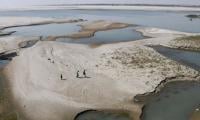
Pakistan witnessed two episodes of severe floods in 2022 and 2025, causing billions of losses and damages along with loss of life.
Given the horrors of these past floods, is there data available to help predict the risk of floods or droughts in 2026? To answer this question, we can rely on the Pakistan Meteorological Department (PMD) Climate Outlook of January 2026. This data provides preliminary indications of increased drought and flood risk due to temperature and rainfall anomalies observed in December 2025, compared to the normal period of 1990 to 2020.
Starting with the northern regions of Pakistan, such as Gilgit Baltistan, Azad Jammu & Kashmir, and Khyber Pakhtunkhwa (KP), the rainfall departures are -25.9 per cent, -39.7 per cent and -39.7 per cent, with temperature anomalies of 2.3 oC, 0.1 °C, and 1.5 oC, respectively. This reflects lower snowfall or winter precipitation and higher temperatures in December 2025 compared to the normal period. Higher temperature rates lead to rapid ice melting in April to June, which may cause early downstream runoff and intensify the monsoon season. This also increases the chances of flooding in central and southern regions.
Considering climate indicators for central regions of Pakistan – Punjab and Balochistan – there are -73.2 per cent and -11 per cent rainfall departures, and temperature anomalies of 0.9 oC and 1.2 oC, respectively. These indicate expected extreme dryness and agricultural drought if monsoon rainfall is normal or below normal.
On the other hand, if monsoon rain is normal or above normal, it can increase the risk of compound flooding. Given the temperature anomalies, there is a higher risk of flooding in the central region as well. Finally, contrasting indicators are found in Sindh, the southern region of Pakistan: a positive 71.7 per cent rainfall departure and a temperature anomaly of 0.7 oC.
The excessive rainfall implies recharged groundwater. If monsoon rainfall is normal or below normal, as in the central region of Punjab and Balochistan, it would lead to drought, but it may not be severe. However, with the existing temperature anomaly, there is a higher chance of slightly above-normal monsoon rainfall, which can lead to urban flooding in mega-cities such as Karachi.
At the national level, Pakistan has a -34.8 rainfall departure and 1.2 C in December 2025, which can lead to above-normal monsoon rainfall. These factors point again to catastrophic flooding this year if not properly managed. To reduce such climate risk, it is crucial to implement the following tasks to protect Pakistan’s economy from another consecutive flood brunt.
First, timely weather alerts and water flow information from PMD were communicated to the national and provincial disaster management authorities and the public. Second, rehabilitation of embankments, barrages, bridges, and nullahs or drains, especially those that have experienced past flood damage.
Third, channelling floodwaters to recharge wells in semi-arid and arid regions. Fourth, creating sponge cities to absorb, filter and store water via green roofs, permeable pavements, and parks. Fifth, political will and coordination among provinces for effective preparation and post-disaster recovery.
Undeniably, there is a cost to taking action to reduce climate risk, but the cost of inaction is far greater.
The writer is an assistant professor at the Institute of Business Administration (IBA), Karachi.