In most economies, work is the ultimate shield against crisis. When prices rise and incomes are squeezed, households respond by working more – adding earners, extending hours, diversifying livelihoods.
This is the classic ‘added worker effect’ taught in labour economics. Pakistan’s latest household and labour data, however, tells a different story: work itself has stopped working.
According to the HIES 2024–25, the national average number of earners per household has fallen from 1.86 to 1.72 between 2018–19 and 2024–25. The decline is evident in both urban (from 1.75 to 1.62) and rural (from 1.92 to 1.78) areas. Punjab shows the sharpest decline – from 1.63 to 1.34 earners per household. This is not a marginal shift. It is a macroeconomic signal.
The message is clear: households are poorer, yet unable to mobilise more labour. Labour may be available, willing and even desperate – but the economy is failing to convert it into paid work.
The consumption data reinforces this alarm. Per capita monthly quantities of essential food items have declined since 2018–19. Wheat and wheat flour consumption fell from 7.00 kg to 6.59 kg per person. Rice declined from 1.06 kg to 0.86 kg. Pulses – an affordable protein source – fell from 0.35 kg to 0.26 kg. Milk consumption dropped from 6.85 litres to 6.15 litres, while cooking oil declined from 0.32 litres to 0.28 litres.
In plain terms, households are eating less of what sustains nutrition and resilience. Yet instead of adding earners to cushion this shock, the earner base is shrinking. This combination – declining real consumption alongside fewer earners – should unsettle any serious policymaker. It points to a labour market that is not merely weak, but structurally blocked.
If Pakistan’s household economy were flexible and adaptive, income sources would diversify under stress. Instead, income composition remains rigid and increasingly dependent on narrow channels and transfers. In 2024–25, wages and salaries account for 42.00 per cent of total household income (41.68 per cent in 2018–19). Other non-agricultural activities contribute 16.25 per cent (15.91 per cent earlier). In rural areas, crop production contributes 11.73 per cent and livestock 11.94 per cent, leaving rural households heavily exposed to climate shocks.
More telling, however, are the coping mechanisms. The share of foreign remittances rose from 4.96 per cent to 7.77 per cent. Gifts and assistance, including cash transfers, increased from 2.12 per cent to 4.57 per cent, while domestic remittances rose to 3.77 per cent. These flows are vital buffers – but when they grow alongside falling earners and shrinking food consumption, they resemble distress insurance rather than opportunity.
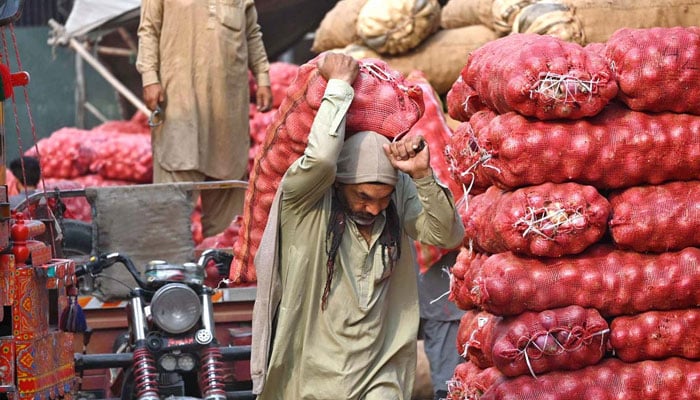
Employment structure adds another layer of concern. The share of employees increased from 54.80 per cent to 60.10 per cent, while self-employment fell from 24.70 per cent to 21.75 per cent, and contributing family workers declined from 17.39 per cent to 13.53 per cent. This means fewer households can generate employment internally through family enterprises or small businesses – the traditional shock absorbers in developing economies. More people are pushed towards wage employment, but wage jobs are not expanding fast enough to absorb them.
The Labour Force Survey 2024–25 confirms this broader dysfunction. Overall labour force participation stands at about 46.3 per cent, with an employment-to-population ratio of 43.0 per cent and unemployment around 7.1 per cent. The gender gap is stark: refined participation is 68.7 per cent for men versus 22.7 per cent for women, with urban female participation particularly low. People are willing to work, but the economy is not generating sufficient, productive opportunities.
Why are earners declining when households are clearly under stress? Because Pakistan is not facing a normal cyclical downturn. It is confronting a multi-shock economy where the binding constraint is labour demand and the cost of doing business. Over the past five years, Pakistan has endured repeated spikes in inflation, energy price shocks, import compression, policy uncertainty and severe climate events, including floods that disrupted agriculture, livestock and informal work. In such an environment, the ‘natural’ household response – sending more earners – fails because the market response (job creation) does not arrive.
The distributional implications are severe. Although average household incomes have risen, gains are skewed. Income growth since 2018–19 was 119.25 per cent for the top quintile, compared with 80.45 per cent for the bottom quintile, widening inequality. When jobs are scarce, inequality becomes not only unjust but also macroeconomically destabilising: poorer households cut back on nutrition, withdraw children from education and reduce mobility, thereby locking in low productivity for years to come.
This contradiction matters. Declining household earnings are not merely a labour statistic; they signal that Pakistan’s crisis has shifted from inflation to livelihoods. Stabilisation without jobs is not recovery; it is merely a pause before the next rupture.
Pakistan does not need another grand vision document. It needs a jobs-and-entry shock that makes it easier to create firms than to close them, easier to hire than to comply, and easier to compete than to lobby. One bold step can signal this shift: make business registration a same-day default – an 18-minute digital process – through a single national window that links registration, tax identity, Social Security and licensing. The objective is not convenience, but scale.
When firm entry becomes frictionless and predictable, competition rises, informality becomes less rational and job creation can restart – especially for youth and women currently priced out of opportunity. PIDE Policy Viewpoint titled ‘A Digital Solution for Simplified Business Registration in Pakistan’ provides a complete solution to register a business in 18 minutes.
The data from HIES and LFS delivers an uncomfortable truth: Pakistan’s households are no longer coping by working more, but by consuming less. When work stops working, the problem is not effort but the economy. If policymakers continue to celebrate macro calm while ignoring this signal, the next crisis will not emerge from markets. It will emerge from homes.
The writer is a professor of economics at the Pakistan Institute of Development Economics (PIDE). He can be reached at: [email protected]