Early this week, at the inauguration of a children’s ICU in Larkana (December 28), Bilawal Bhutto gave voice to the widespread public dissatisfaction with the direction of the economy.
That sentiment contrasts sharply with the repeated reassurances from senior government officials that, regardless of the numbers, the economy is headed in the 'right direction’. Yet, that direction is unclear. Bilawal did not clarify it either. So let us look more closely at what this ‘direction’ amounts to, judging by the priorities and pronouncements of those currently in charge, and ask whether it aligns with the economic and political duties assigned to the state by our constitution.
First, there is the planning minister’s ‘new’ roadmap, announced last week, to reach a $63 billion export target over the next four years. To us, the people of Pakistan, it reads as yet another promise of revival deferred.
The grand economist, Keynes, warned against precisely this habit of deferral as policy. Economists, he cautioned, “set themselves too easy, too useless a task if, in tempestuous seasons, they can only promise that once the storm has passed, the ocean will be flat again”.
Nor does the short run inspire confidence. Responsibility, therefore, rests squarely with the finance minister. Yet he insists that creating jobs is not his job, and investing to expand production is not his business either. In other words, this is austerity and growth materialising on its own, via state withdrawal and hope. The outcome is no mystery: an economy stuck in low gear by design, nowhere near takeoff – ‘uraan’ in name only.
Withdrawal and hope masquerading as a ‘hard state’ are no answer for a country starved of jobs and investment, burdened by low literacy, hunger and widespread economic distress. Simply letting things rip is not governance but abdication.
Austerity in such settings redistributes national wealth upward and towards the coercive state, crowding out growth and corroding democratic consent. This, then, is the focus here: the direction of the government’s economic policy, who it serves and its political consequences.
In practice, two overused policy instruments, under the finance minister’s stewardship, drive that redistribution: rupee devaluation and high interest rates. Both have proved blunt tools, failing to spur exports, investment or productivity, yet delivering large, policy-created rents to a few.
Consider first the effect of rupee devaluation. Five years ago, when the exchange rate stood at Rs158 per dollar, exporters earned $28 billion (about Rs4.4 trillion). Today, the same $28 billion translates into roughly Rs7.9 trillion due to the weaker rupee, representing a windfall of Rs3.5 trillion to exporters in a single year, independent of any increase in productivity or investment effort.
Meanwhile, government domestic debt has surged beyond Rs54 trillion (over Rs6.6 trillion added in the past year alone). Yet this borrowing is not financing growth. Instead, it underwrites a redistribution of national wealth to private banks, which hold about Rs35 trillion of this debt (over three-fifths of their assets).
Two years ago, the government paid interest rates as high as 22 per cent; even today, rates hover around 10 per cent. This translates into over Rs3 trillion per year in risk-free interest payments to banks – a transfer from the public purse sustained through extractive loops created by the state itself.
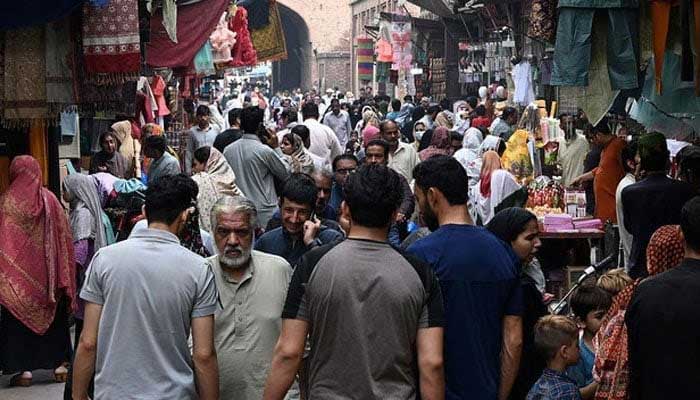
At this point, a natural question arises: who pays for these effortless, colossal windfalls? The answer is deeply unsettling. It is we, the people, who pay through depressed wages, elevated prices, eroding public services and lost opportunity. One in five persons is undernourished; two in five children under five are chronically malnourished; and at least 25 million school-age children are out of school. These are distress signals from a country eating its future. Add to this a crippling, self-inflicted burden of our low ranking on the Global Peace Index, and the reasons for being stuck in low gear become clearer still.
An economy that is inattentive to its people’s needs cannot advance under austerity policies that systematically redistribute national wealth upward. These policies are not unique to Pakistan. They have been analysed and warned against in books such as Pinochet’s ‘Economists and The Capital Order’, which tell us the political direction countries take when austerity substitutes for economic strategy. Both trace a common direction: growth is hollowed out, financial power concentrates, inequality rises, society fractures, and democracy erodes – easing the path to fascism.
In Pinochet’s Chile, these outcomes were managed through repression. We are not Pinochet’s Chile (yet), and the contexts differ. But the logic is strikingly similar: when opportunity narrows, consent weakens, and when consent weakens, governance turns to coercion.
The authors present this direction as a warning. Yet it is precisely the one implied by our current economic policy. It is the wrong direction – one that does not align with the constitution’s Preamble, which commits the state to the full observance of the principles of democracy, freedom, equality, tolerance and social justice.
The alternative is not a matter of policy preference, but of the state’s economic duties, as set out in Articles 38(a) and 38(b) of our constitution: to provide citizens with opportunities for work and an adequate livelihood and to prevent the concentration of wealth. That must be the only rightful direction.
The writer is a freelance contributor. He can be reached at: [email protected]