I asked Anas bin Malik (R.A): “Who collected the Qur’an at the time of the Prophet (S.A.W) ?

BITS ‘N’ PIECES
Narrated Qatada (R.A):
I asked Anas bin Malik (R.A): “Who collected the Qur’an at the time of the Prophet (S.A.W) ?” He replied, “Four, all of whom were from the Ansar: Ubai bin Ka’b (R.A), Mu’adh bin Jabal (R.A), Zaid bin Thabit (R.A) and Abu Zaid (R.A).”
Sahih Bukhari, Volume 6, Book 61, Number 525
Victor Glover became the first person of colour, Christina Koch the first woman and Jeremy Hansen the first non American astronaut to travel on a lunar mission.
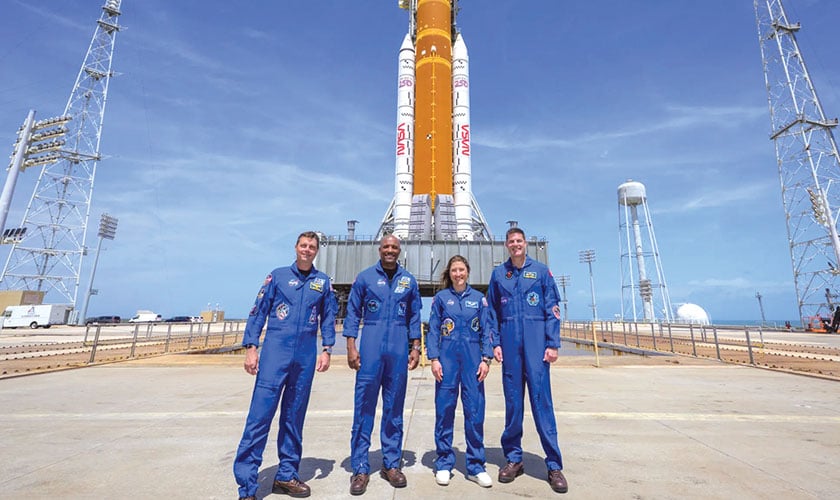
Artemis II was a United States spaceflight mission that sent four astronauts on a journey around the Moon. It launched from Kennedy Space Center on 1 April 2026 and lasted about ten days. The crew included NASA astronauts Reid Wiseman, Victor Glover and Christina Koch, along with Canadian astronaut Jeremy Hansen.
This mission marked the first crewed flight of NASA’s Orion spacecraft, the capsule designed to carry astronauts to the Moon and beyond, and the second launch of the Space Launch System rocket. It was also the first time humans travelled beyond low Earth orbit since Apollo 17. The mission followed the success of Artemis I in 2022 and was a key step in NASA’s Artemis programme, which aims to return humans to the Moon.
During the mission, Orion entered a high Earth orbit before being propelled towards the Moon. The spacecraft travelled on a free return trajectory, looping around the far side of the Moon and naturally heading back to Earth without requiring major propulsion for the return journey. At its farthest point, the crew travelled more than 400,000 kilometres from Earth, setting a new record for the greatest distance reached by humans in space.
The mission also tested several critical systems. Astronauts evaluated life support, navigation and manual flight controls, ensuring the spacecraft can safely carry humans on future deep space missions. The European Service Module, developed by the European Space Agency, provided power, oxygen, water and propulsion throughout the flight.
Artemis II was not a landing mission but a test flight designed to prepare for future lunar exploration. It demonstrated that astronauts can safely travel to the Moon and back using modern spacecraft. The mission also gathered valuable data on human health in deep space, including the effects of radiation, isolation and long duration travel.
This historic mission carried symbolic importance as well. Victor Glover became the first person of colour, Christina Koch the first woman and Jeremy Hansen the first non American astronaut to travel on a lunar mission.
Artemis II represented a major milestone in space exploration, paving the way for future missions that aim to land astronauts on the lunar surface and eventually send humans to Mars.