As Pakistan and China mark 75 years of diplomatic relations and an enduring friendship, it is worth reflecting on the deeper, human dimensions of this relationship -- those that extend well beyond formal statements, official communiqués and strategic interests.
PAK-CHINA COOPERATION
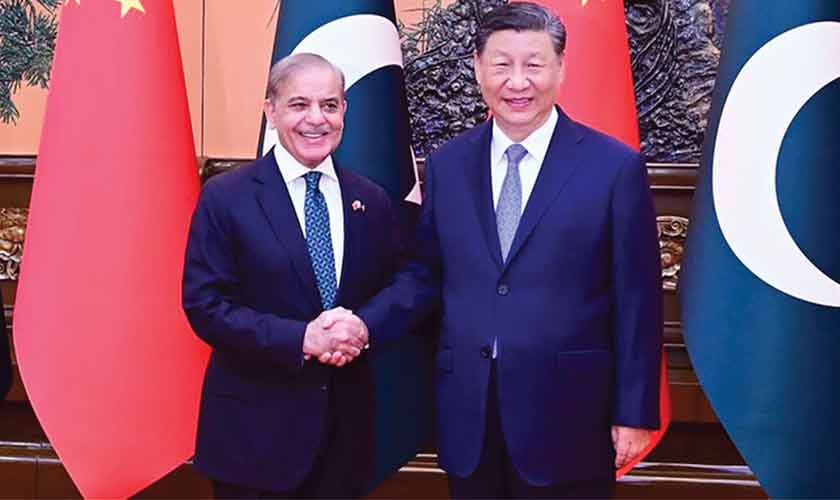
As Pakistan and China mark 75 years of diplomatic relations and an enduring friendship, it is worth reflecting on the deeper, human dimensions of this relationship -- those that extend well beyond formal statements, official communiqués and strategic interests.
Few international partnerships can claim the depth of personal association, institutional memory and emotional connect that characterise Pakistan–China ties. One such remarkable chapter is linked to former Chinese president Jiang Zemin, whose long-standing association with Pakistan and personal bonds with Pakistanis have since become part of the shared history of the two nations.
President Jiang’s connection with Pakistan predates his rise to the highest office in China. In 1976, as head of a high-level Chinese delegation from the then First Ministry of Machine-Building Industry, he visited Pakistan and laid superstructure of the Foundry & Forge Works at the Heavy Mechanical Complex (HMC), Taxila. Stationed there for nearly two months; he was closely involved in major technical and administrative decisions for the commissioning of the facility. This early engagement laid the groundwork for long-term industrial cooperation and gave him an intimate familiarity with Pakistan’s engineering sector and its people.
However, the roots of Pakistan–China friendship go back even further. Many today may not be aware that Chinese Premier Zhou Enlai paid his first visit to Pakistan in December 1956, touring Karachi, Lahore, Peshawar and other major cities. The visit witnessed unprecedented public enthusiasm, with massive crowds turning out to welcome him -- an event remembered for decades. This historic visit proved to be a turning point, firmly establishing the foundations of an all-weather friendship that has continued to grow stronger with time.
During that visit, Premier Zhou Enlai also toured Batala Engineering Company Limited (BECO), now Pakistan Engineering Company (PECO), then a leading industrial enterprise located in Badami Bagh, Lahore. He showed keen interest in Pakistan-manufactured machinery and equipment, some of which was already being exported. Subsequently, China placed order for BECO machine tools, underscoring early confidence in Pakistan’s industrial capabilities.
I recall former Chinese president Jiang Zemin’s state visit to Pakistan in December 1996, during which he invited his former colleagues from Taxila to an exclusive dinner. This deeply personal gesture symbolised the warmth and continuity of Pakistan–China relations. Beyond symbolism, the visit further strengthened economic, financial, technological and industrial cooperation -- cooperation that remains a cornerstone of bilateral relations today. Over the decades, China has extended substantial financial and technical assistance to Pakistan, contributing significantly to the establishment of a capital goods industry with versatile manufacturing capabilities.
Pakistan enjoys the unique distinction of having hosted a future Chinese president at a formative stage of his career. During his stay from March to April 1976, Jiang Zemin developed close fraternal relations not only with senior Pakistani engineers but also with factory workers at HMC. A professional electrical engineer by training, he left a lasting impression through his discipline, foresight and humility. Under his leadership, the Foundry & Forge Works project was completed on schedule and without cost overruns—an achievement rare for a project of such scale. The facility was inaugurated by then prime minister Zulfikar Ali Bhutto later that year.
As the two countries celebrate 75 years of diplomatic relations, it is this deep reservoir of goodwill and mutual respect that continues to sustain the partnership, ensuring that Pakistan–China cooperation remains resilient, enduring and truly beyond diplomacy
During his stay, Jiang Zemin also visited industrial units in Lahore and Karachi, including Pakistan Steel Mills, and learned Urdu while living in the HMC housing colony -- an extraordinary personal effort that further endeared him to Pakistanis. He later returned to China to assume charge as Minister for the Electronics Industry, embarking on a political journey that would eventually lead him to the presidency.
Many of Jiang Zemin’s former Pakistani colleagues were pleasantly surprised when, despite retirements and relocations, they received invitations for an informal dinner with him at Aiwan-e-Sadr, Islamabad, on December 1, 1996. During this meeting, the Chinese president reiterated his government’s commitment to continued economic and technological assistance to Pakistan, particularly in heavy engineering sector, and reaffirmed cooperation despite Western restrictions. The following day, four bilateral agreements were signed, including one on the promotion of economic and technical cooperation.
During a long career associated with Chinese-assisted industrial projects, the writer also developed close personal relations with several Chinese diplomats posted in Islamabad. Beyond official engagements, these relationships often extended to family interactions, reflecting the rare warmth of people-to-people ties. Two ambassadors, in particular, served Pakistan for extended periods and came to regard the country as their second home.
Ambassador Lu Shulin (January 1999–April 2002), during a visit to the Heavy Electrical Complex (HEC) at Hattar Industrial Estate, fondly recalled his earlier posting as counsellor and revisited a tree he had planted years earlier -- a living symbol of Pakistan–China friendship. A student of Urdu at the University of Karachi, Ambassador Lu has recently authored two books dedicated to bilateral friendship, titled 'Garlands of Love' and 'You and Us', the latter also available in Urdu. His contribution to strengthening political, economic and industrial cooperation remains widely acknowledged.
Ambassador Zhang Chunxiang, associated with Pakistan for over 23 years, began his connection with the country as a young engineer during the construction of the Karakoram Highway (KKH). Later serving as counsellor and then ambassador (April 2002–February 2007), his exceptionally long tenure reflected both trust and effectiveness. Fluent in Urdu and deeply familiar with Pakistan, he played a key role in advancing economic cooperation and infrastructure development. His personal kindness, including facilitating a family visit to China after the writer’s retirement, exemplified the human dimension of diplomacy.
Equally memorable was my association with Mr Fu Guangtin, Chinese Economic and Commercial Counsellor during the 1990s. Serving as a vital bridge in bilateral trade relations, he witnessed Pakistan–China trade grow manifold to $717 million in 1999. Even after his retirement and appointment as vice president of the state-owned China International Engineering Consulting Corporation in Beijing, personal ties remained intact.
These personal memories and institutional milestones together illustrate that Pakistan-China relations are not merely the product of strategic alignment or economic necessity. They are built on decades of trust, shared experiences and genuine human connections -- between engineers and workers, diplomats and families, leaders and ordinary citizens. As the two countries celebrate 75 years of diplomatic relations, it is this deep reservoir of goodwill and mutual respect that continues to sustain the partnership, ensuring that Pakistan-China cooperation remains resilient, enduring and truly beyond diplomacy.
The writer is a retired chairman of the State Engineering Corporation.