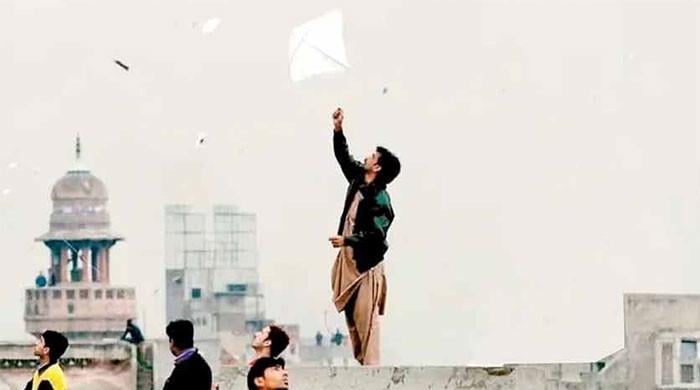
For three days, Lahore looked up again. And in doing so, it confronted its past, its politics and its appetite for joy.

For nearly two decades, Basant in Lahore existed purely as a memory. It lived in stories told by parents. In faded rooftop photographs. In the vocabulary of gudda, pinnah, bo kata, words younger Lahoris understood but never inhabited a space it referred to in the real. Now that Basant 2026 has come and gone, there is no looming question about how the provincial capital could host this kaleidoscopic festival. This spring festival’s enormous success across Lahore brought hope and the spirit of the kind of country Pakistan is trying to be.
The word Basant comes from the Sanskrit “Vasant”, meaning spring. It marks mustard fields turning yellow across Punjab’s agricultural belt. It predates Partition.
It predates Pakistan. One origin story traces it to the 13th-century Sufi saint Hazrat Nizamuddin Auliya and his disciple Amir Khusro, who is said to have dressed in yellow and sung to lift his master’s spirits. But it was under Maharaja Ranjit Singh in the 19th century that Basant became inseparable from Lahore.
Pre-Partition, Hindus, Muslims and Sikhs flew kites across undivided Punjab. By the 1990s, the festival had transformed into spectacle with kite-flyers living in revelry. Organised kite-flying gharanas emerged. Havelis opened their rooftops. Diplomats and international visitors arrived. At its peak, Basant was not only celebration. It was cultural export. Then came the fatalities linked to chemical and metallic string. A ban followed and for more than twenty years, the sky was empty.

The Basant Festival that returned in 2026 was not nostalgic freedom. It was regulated revival. Under the Punjab Regulation of Kite Flying Act 2025:
This could be para- para-paradise
* Only cotton string (maximum nine threads) permitted
* Strict kite size limits
* QR codes for manufacturers and sellers
* Fines up to Rs5 million
* Prison terms up to seven years
* Charkhis banned
* Red, Yellow and Green risk zones
* Drone surveillance
* Mandatory safety wires on motorcycles

More than 600 registered vendors were authorised to sell kites and string. During the three days, approximately 900,000 vehicles entered Lahore. Around 1.4 million passengers used public transport. Over 600,000 travelled free on the Orange Line. Buses, rickshaws and app-based rides were subsidised. Two hundred mobile clinics and 21 field hospitals were deployed. It uplifted Lahore’s economy but more than that, it gave people something to celebrate.
This could be para- para-paradise Crucially, the festival concluded without major reported fatalities.
For supporters, this proved that Basant could be celebrated responsibly. For critics, it remained a pilot project wrapped in political messaging. Either way, the scale was undeniable.
Before the kites filled the sky, the markets had already filled with yellow. Kite prices doubled. Pinnay rose from Rs7,000 to nearly Rs12,000. Rooftops in the Walled City rented from Rs50,000 into the hundreds of thousands. Some premium packages crossed Rs300,000. Hotels reached capacity. Designers reported spikes in yellow outfit orders. Mehndi sales rose. Food vendors thrived. Sound system providers reported record demand. For three days, Basant was not just heritage. It was industry.
If commerce drove momentum, celebrities drove visibility. Basant ’26 pulled in stars like Atif Aslam, Aima Baig, Ali Zafar, Saba Qamar, Fawad Khan, Maya Ali, Ayeza Khan, Shoaib Malik, Mohib Mirza, Sajal Aly, Saboor Aly and many more. It can easily be said that more stars came out to support this festival of spring, colours and kites than an award ceremony. Even cricketers and digital influencers travelled, many from the city by the sea to be present in Lahore. Social media feeds filled with rooftop selfies, kites against winter sun and carefully worded captions urging safety.
Diplomatic participation added another layer. Acting US Ambassador Natalie Baker attended the Delhi Gate event alongside senior provincial officials. International media covered the spectacle. The message was clear: Basant was back while projecting soft power.

From the Walled city to the backdrop of the majestic Badshahi Mosque to the narrow lanes, the spirt of Basant was everywhere. But visibility also brought scrutiny.
This could be para- para-paradise The festival coincided with national tragedy: a deadly attack on an imambargah in Islamabad. Online, criticism mounted. Some argued public celebration after a deadly attack was tone-deaf and a day of mourning should have been announced.
Hashtags questioning celebrity responsibility trended. Screenshots circulated.
But, the backlash did not erase the joy on rooftops. In hindsight it was a complicated situation. It exposed a tension that runs deeper than Basant: in a country that oscillates between grief and resilience far too often, when is celebration appropriate? And do public figures carry a different moral calculus? Basant became a cultural event and a social debate simultaneously.
Perhaps the most enduring image of Basant 2026 is not fireworks, QR codes or celebrity rooftops. It is older hands guiding younger ones. For parents who once flew kites every spring, passing on this joyous kite-flying to their children was about passing on tradition.
For Gen Z, the festival shifted from inherited nostalgia to lived memory. For a brief moment, Lahore felt less fractured and through its colours and beauty, Pakistan. Neighbours crossed rooftops again. The city looked upward, together.
It is unclear whether Basant will return to Lahore or other parts of Punjab next year. Questions remain about leftover stock, enforcement beyond Lahore and whether Basant will become an annual festival or remain an experimental pilot project. Whether political calculation or cultural conviction drove the revival may ultimately matter less than what it achieved. For three days, Lahore remembered itself.
Basant did not return unchanged. It came with surveillance, zoning, QR codes and carefully managed optics. It came with celebrity amplification and social media backlash. But it also came with something intact.
The instinct to look up. Because Basant was never only about cutting someone else’s kite. It was about reclaiming the sky and in the end, the people certainly did.