The House of Amir Adnan unveils Darbar Spring/Summer ‘26 as much more than a seasonal presentation.
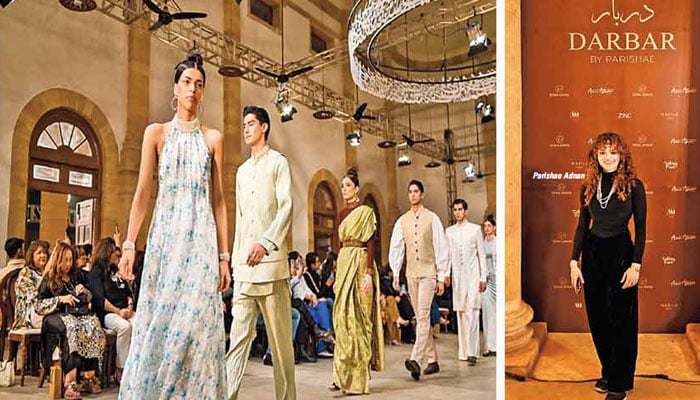
In countries like Pakistan, fashion’s monetary impact extends far beyond the runway, supporting artisanal commu-nities, manufacturing networks and urban employment while shaping consumer behaviour and cultural confidence. When a legacy fashion house amends how it designs, produces and sells its work, the implications reach far beyond a single season.
Through the Darbar Spring/ Summer 2026 collection, the House of Amir Adnan introduced one of the most significant operational shifts seen in Pakis-tani fashion in recent years.
Held on January 18 on an unusually cold winter evening, what unfolded was more than a richly layered creative showcase. Industry professionals would have recognised that the true transformation lay beneath the surface. Under the leadership of CEO Parishae Adnan, the brand formally unveiled a runway-to-retail operating model that brings select looks into retail circulation immediately following the show. This move collapses the traditionally prolonged gap between creative presentation and commercial availability, signalling a decisive move towards modernised fashion systems.
What sets this development apart is not its adoption of a global trend but its contextual execution. In an industry long shaped by speculative seasonal cycles, delayed deliveries and excess production, this approach reflects a deeper commitment to structural reform. Rather than positioning the runway as a purely aspirational exercise, the House of Amir Adnan has integrated show planning directly into supply chain logistics, inventory forecasting and retail timelines.
This level of coordination requires internal discipline, cross-departmental alignment and a willingness to prioritise long term sustainability over short term spectacle.
“Our focus is on building a system where creative direction, production planning and retail timelines are in conversation with one another. Reducing lead times and bringing runway closer to retail allows us to respond more intelligently to demand, manage inventory with greater precision and create collections that are both culturally relevant and commercially viable,” said Parishae Adnan.
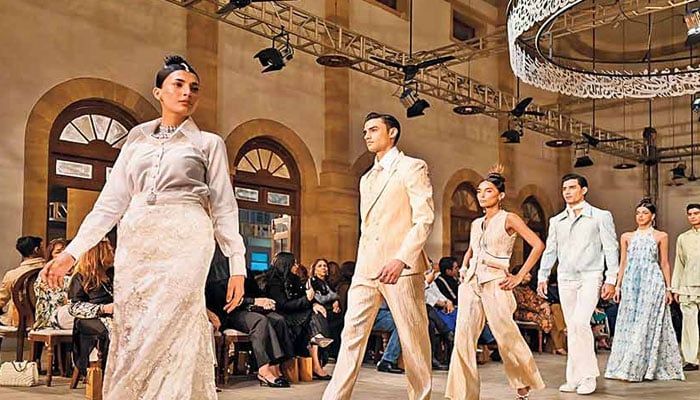
The Darbar SS26 collection itself functioned as a carefully constructed narrative rather than a series of disconnected looks. Structured in three distinct movements, it explored the ideas of inheritance, tension and authority through material, silh-ouette and pacing. The opening segment embraced restraint, presenting hand-loomed bro-cades, fluid silks and sheer organzas rendered in softened pastel hues. These garments conveyed elegance shaped by continuity rather than nostalgia, suggesting lineage as an evolving force rather than a fixed aes-thetic.
As the collection progressed, surface complexity and density increased. Intricate hand embroi-dery and richly textured fabrics introduced a sense of pressure and friction, reflecting the weight of responsibility that accom-panies legacy. This middle phase acknowledged the labour-inten-sive processes that support South Asian luxury while subtly questioning how value is assi-gned within fashion systems. By allowing craftsmanship to assert itself without excess embe-llishment, the collection main-tained visual discipline while deepening conceptual tension.
The finale shifted decisively into assertion. Sharply tailored silhouettes in velvets, brocades, deep maroons and golds con-veyed confidence through stru-cture and control. Rather than relying on overt opulence, auth-ority was communicated through cut, proportion and composure. This progression mirrored the brand’s broader narrative of consolidation and command, both creatively and operationally. The intellectual framework of Darbar extended beyond clo-thing into performance and space.
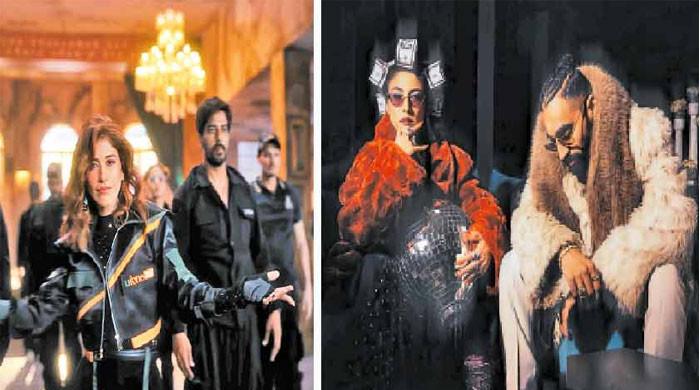
The evening opened with a custom-written rap by Daniya Kanwal that set the conceptual tone with deliberate clarity. Her performance interrogated hier-archy, fashion as currency and the systems that determine visibility and remembrance.
Rather than serving as a decorative opening, the spoken narrative functioned as a pro-vocation, directly addressing the audience and implicating them within the power structures being examined. This integration of performance as critique mar-ked a confident departure from conventional show openers.
“The rap I wrote for this performance interrogates social hierarchy, fashion as currency and the invisible power dynamics that shape who is seen, valued and remembered.
It speaks directly to the room, to the attendees themselves, asking what legacy really means and who gets to inherit it. For me, this performance isn’t just an opening. It’s a disruption, a mirr-or held up to fashion’s grandest stage,” shared Daniya Kanwal post-show.
“Darbar marks a shift in how we think about fashion as a business,” said Parishae Adnan.
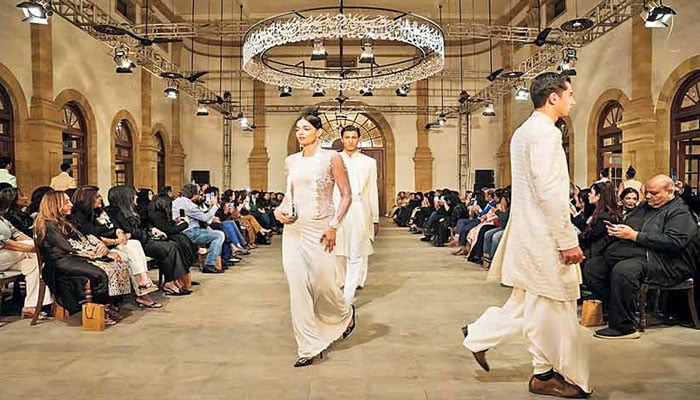
Equally significant was the choice of venue. Khaliq-dina Hall, one of Karachi’s most historically resonant civic spaces, brought an additional layer of meaning to the showcase. Built in 1906 and designed by Iraqi-Jewish architect Moses Somake, the Palladian stru-cture has long served as a site of public discourse and resistance. Most notably, it housed the 1921 Trial of Sedition during British colo-nial rule. By situating Darbar within this setting, the House of Amir Adnan aligned fash-ion with memory, resilience and civic identity. The architecture did not merely frame the collection but reinforced its engagement with power and continuity.
From a production pers-pective, the showcase demonstrated a high degree of cohesion and intent. Show direction by Almitra Maval-vala, cinematography by Ayesha Noor Kurd and sound design by Omer Saeed supported clarity rather than competition for attention. Casting management by ZINC, styling by Tabesh Kho-ja and grooming by NGENTS and NABILA reinforced the collection’s emphasis on identity in every form.
The seamless coordi-nation across creative, technical and operational teams suggested a mature organisational framework capable of executing a complex vision. Each ele-ment contributed to a show-case that felt deliberate, controlled and strategically aligned. Ultimately, Darbar represents more than a seasonal collection. It has set a benchmark for how heritage brands can evolve without erasure.
In a world that feels increasingly unstable, Pari-shae Adnan as a designer sought a provocative yet balanced aesthetic, chann-elling it into a singular cohesive vision.
This was not a celebration of misery but an appreciation of the dignity inherent in functional clothing.