Print Story
X




Pakistan’s hunger for resurgence collides with Australia’s bold new era in a high-stakes ODI battle built for fearless cricket

There are cricket series that arrive with noise, and then there are series that arrive with meaning. Pakistan’s three-match ODI series against Australia belongs firmly in the second category.
The series that began at the Rawalpindi Cricket Stadium, is far more than another bilateral assignment. It is a meeting between two teams standing at different stages of transition but chasing the same destination; stability, identity, and momentum ahead of the 2027 ICC Cricket World Cup.
For Rawalpindi itself, the occasion carried historical weight. Nearly 28 years have passed since Pakistan and Australia last played an ODI at that venue in 1998. That long gap gave the opening match a special emotional and symbolic significance.
Cricket has evolved dramatically since then, but Australia’s reputation for ruthless professionalism and Pakistan’s unpredictability remain constants of this rivalry. This time, however, the dynamics feel different.
Pakistan entered the series with questions to answer but also with an opportunity to establish authority at home. Australia arrived as world champions, yet with a squad that clearly reflects transition and long-term planning rather than immediate domination.
That combination could make this one of the most fascinating ODI contests Pakistan as hosted in recent years.
Pakistan’s biggest challenge over the last two years has not been talent, it has been consistency. Individually, the side possesses enough match-winners to defeat any team in the world. Collectively, however, Pakistan has too often drifted between brilliance and disorder. This series offers an ideal platform to reset that narrative.
The return of Babar Azam immediately changes the complexion of the batting unit. Regardless of form debates or external criticism, Babar remains Pakistan’s most technically complete ODI batter and the player around whom innings still naturally revolve. On flat surfaces his role becomes even more important because Pakistan must avoid wasting strong starts.
The absence of Fakhar Zaman and Saim Ayub through injury undoubtedly has weakened Pakistan’s explosiveness at the top, but it also creates opportunity. Sahibzada Farhan and other younger batters now have a chance to prove they belong in Pakistan’s long-term white ball plans. More importantly, Pakistan must now show they are capable of modern ODI batting without depending entirely on individual rescue acts.
The series could also become a defining leadership examination for Shaheen Shah Afridi. Captaining against Australia is never routine. It demands tactical clarity, emotional control, and the ability to react quickly under pressure. Shaheen already leads Pakistan’s bowling attack with aggression and presence; now he must demonstrate he can manage an ODI side strategically over 50 overs. His new-ball battle against Australia’s top order may ultimately dictate the entire series.
Australia may still carry the aura of world champions, but this squad reveals a team carefully preparing for life beyond several legendary names. The absence of Pat Cummins, Mitchell Starc and Josh Hazlewood is significant. Together, those three formed the heartbeat of Australia’s 2023 World Cup-winning pace attack. Their workload management ahead of 2027 makes sense, but it also places greater responsibility on Australia’s next line of bowlers.
Similarly, the retirement of Glenn Maxwell from ODI cricket has created a tactical vacuum Australia are still trying to solve. That is why this tour could become especially important for Cameron Green. Australia clearly view Green as a multi-dimensional cricketer capable of evolving into a genuine middle-order ODI force. His power-hitting, seam bowling, and athletic fielding make him invaluable in theory. The challenge now is converting promise into consistent influence.
Pakistan’s conditions may provide the perfect examination. Rawalpindi was not a venue where players can hide behind conservative cricket. Green’s role, whether finishing innings or stabilising collapses, will offer a strong indication of how Australia sees its ODI future.
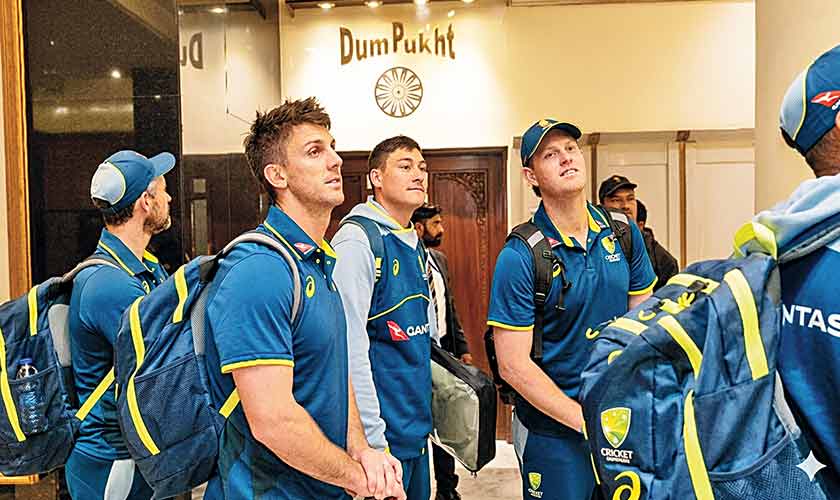
The same applies to captain Mitchell Marsh, whose aggressive style increasingly defines Australia’s white-ball identity. Marsh is at his most dangerous when dictating tempo early. Pakistan cannot afford to let him settle.
In modern ODI cricket, that often means matches are decided less by pure bowling quality and more by execution under pressure. That makes death overs crucial.
Pakistan’s pace trio of Shaheen, Haris Rauf and Naseem Shah gives the hosts genuine firepower. Few teams in world cricket possess this combination of pace, swing, and aggression. Yet Pakistan’s problem has rarely been taking wickets, it has been controlling momentum late in innings.
Australia, meanwhile, arrived with a less experienced pace attack but a system that traditionally adapts quickly. If the surfaces remain true and flat, totals above 320 could become standard. In that scenario, fielding standards and composure under pressure may prove more decisive than bowling attacks.
Another critical factor will be spin. Pakistan will expect Shadab Khan and Abrar Ahmed to disrupt Australia during the middle overs, particularly against batters looking to dominate spin through sweeps and reverse sweeps.
Australia, however, possesses one of the smartest ODI spinners in modern cricket in Adam Zampa. Zampa’s role may become even more influential because Pakistan’s middle order has occasionally struggled when forced to rebuild against quality spin after aggressive powerplays.
This series is not just about winning three ODIs. Pakistan’s management needs answers.
Can the batting lineup maintain tempo without reckless collapses?
Can Shaheen grow into a long-term ODI captain?
Can Pakistan’s younger players handle pressure against elite opposition?
Can the team finally develop a stable and flexible middle-order structure?
These are the questions that matter more than the scorecards themselves.
Pakistan recently showed against Australia in T20 cricket that they can dominate at home with aggressive intent. But ODI cricket remains the format that exposes tactical weaknesses more brutally than any other. Against Australia, there is no room for emotional cricket or reactive planning.
Every mistake is punished. That is why this series could become such an important benchmark.
Whenever Pakistan and Australia meet, the cricket carries edge, pressure, and confrontation. Australia historically dominates the ODI rivalry, but history alone will not win matches.
Pakistan has enough quality to challenge any side at home, especially in conditions tailored for attacking fast bowling and confident stroke-play.
Australia’s younger squad will arrive fearless because expectations are lower. Pakistan, meanwhile, will carry the heavier emotional burden of home pressure and public scrutiny. That psychological balance could shape the entire contest.
One thing feels certain already: Rawalpindi’s long wait for Pakistan-Australia ODI cricket is unlikely to end quietly. With Babar Azam returning, Shaheen Afridi leading, Australia rebuilding, and both teams beginning their road toward the 2027 World Cup, this series has all the ingredients of something bigger than a routine bilateral contest.
And at a venue where boundaries come quickly and momentum changes even faster, the team that handles pressure best, not merely talent, will probably walk away with the series.