Print Story
X




A major factor to this decline appears to be the increasing emphasis on T20 cricket. Pakistani bowlers are now more accustomed to short spells of high-intensity bowling rather than the endurance required for Test matches.

There was a time when Pakistan’s fast bowlers ruled the cricketing world with authority and intimidation. On one hand, Wasim Akram made life extremely difficult for even the best batters with his masterful swing bowling and on the other Waqar Younis dismantled batting line-ups with his lethal yorkers that often-uprooted stumps. Adding to this formidable arsenal was Shoaib Akhtar whose express pace consistently struck fear into batters across the globe.
Following the departure of these legends, Pakistan’s pace attack continued to find support through bowlers like Umar Gul, Mohammad Amir, and Shaheen Shah Afridi. These players, at various stages, upheld the tradition of fast bowling excellence and delivered match-winning performances. However, the current situation paints a worrying picture—one that reflects a steady decline rather than evolution.
In modern-day cricket, Pakistan’s fast bowlers appear to have lost both their edge and intimidation factor. It has reached a point where even lower-order batters from comparatively weaker teams show little hesitation in facing them. A key concern is the noticeable drop in pace. Where Pakistani pacers once consistently clocked speeds above 140 km/h, many now hover around the 130–135 km/h mark. This reduction in pace, combined with a lack of
sustained aggression, has significantly diminished their effectiveness in Test cricket.
A major contributing factor to this decline appears to be the increasing emphasis on T20 cricket. With the rise of franchise leagues and a packed international T20 calendar, many
Pakistani bowlers are now more accustomed to short spells of high-intensity bowling rather than the endurance required for Test matches. The difference in formats is evident: T20 cricket demands four overs of controlled aggression, while Test cricket requires discipline, stamina, and the ability to bowl long spells with consistent line and length.
This imbalance was clearly visible in the recently concluded Test series between Pakistan and Bangladesh. Pakistani fast bowlers repeatedly looked fatigued after bowling just four to five overs. Their inability to maintain intensity over longer spells allowed Bangladeshi batters to settle in and build partnerships.
In contrast, Bangladesh’s bowlers displayed superior fitness and patience, particularly in spin-friendly conditions.
Statistically, the series further exposed Pakistan’s struggles. Bangladesh’s spin attack claimed 12 wickets in key phases of the matches, exploiting conditions effectively. In comparison, Pakistan’s frontline spinners, Nauman Ali and Sajid Khan, managed only four wickets between them in similar conditions. This is particularly concerning given that both bowlers have previously dominated on home soil, often picking up five- and ten-wicket hauls in matches played in Pakistan.
The performance of Pakistan’s fast bowlers was equally underwhelming. Shaheen Shah Afridi, once regarded as the spearhead of the attack, struggled to make early breakthroughs.
Across the series, his wicket tally remained modest and his average and strike rate were far from impactful for a leading fast bowler. His pace, which once regularly touched the high 140s, appeared reduced, and his ability to swing the new ball was inconsistent.
Similarly, Hasan Ali failed to deliver performances expected of an experienced campaigner.
Known for his energy and wicket-taking ability, Hasan appeared ineffective for long stretches, conceding runs without posing a consistent threat. His inability to extract movement or generate reverse swing further compounded Pakistan’s problems.
One of the most alarming aspects of the series was Pakistan’s struggle to dismiss tailenders. Traditionally, Pakistani fast bowlers have been ruthless against lower-order batters, often wrapping up innings swiftly. However, in the recent series, Bangladeshi tailenders added crucial runs, frustrating Pakistan’s bowlers and shifting momentum. This inability to finish innings not only extended Bangladesh’s totals but also drained the energy of Pakistan’s already fatigued bowling unit.
Less than two years ago, Pakistan bought into preparing wickets suited to pace bowling at home, before the plan was quickly shelved, partially because their fast bowlers are a lot more ordinary than they liked to imagine.
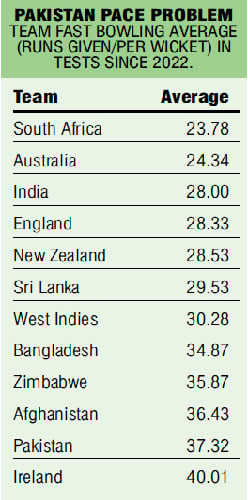
Since the start of 2022,Pakistan’s pacers average 37.32 per wicket; it is a worse average than all Test playing nations bar Ireland. They take 62.4 balls per wicket, with Ireland the only other team with a strike rate above 60.
Fielding and fitness also played a role in the team’s underwhelming performance. Dropped catches and sluggish movement in the field added pressure on the bowlers, who were already struggling to maintain consistency. The lack of stamina among fast bowlers was particularly evident in the latter stages of innings, where their pace dropped further, and their lines became erratic.
The contrast between performances at home and abroad has become increasingly stark.
Pakistani spinners, who thrive on familiar pitches, appeared ineffective on Bangladeshi surfaces, where subtle variations and patience are required. Similarly, fast bowlers who rely on short bursts in T20 cricket seemed ill-prepared for the physical and mental demands of Test cricket.
Experts and former players have raised concerns about workload management and player development. The heavy involvement in T20 leagues may be impacting players’ ability to adapt to longer formats. Without adequate rest and format-specific training, fast bowlers risk losing both their pace and endurance.
In Pakistan, the focus on international leagues, particularly the Pakistan Super League (PSL), has often overshadowed the importance of playing and performing in domestic competitions.
While the PSL is a fantastic platform for showcasing talent, it is a short-format league that doesn’t necessarily help in producing well-rounded cricketers who can handle the demands of Test cricket and longer formats.
A strong domestic circuit provides players with opportunities to play in all formats and allows them to develop their game in various conditions. It also helps players understand the nuances of playing under different scenarios, making them more adaptable when they are called up to the national team.
The current situation calls for a comprehensive reassessment of Pakistan’s cricketing priorities.
Greater emphasis must be placed on fitness, red-ball preparation, and domestic structures that encourage longer-format skills. Rotating players across formats, managing workloads, and investing in specialised coaching could help revive the effectiveness of Pakistan’s bowling attack.
The legacy of Pakistan’s fast bowling is too rich to be allowed to fade without resistance. From the dominance of Wasim, Waqar, and Shoaib to the promise shown by later generations, the foundation remains strong. However, without immediate corrective measures, the decline witnessed in the Bangladesh series may become a recurring theme.
Pakistan cricket now stands at a crossroads. Whether it can reclaim its fast bowling glory or continue on its current trajectory will depend on how seriously these issues are addressed in the coming months.