Print Story
X




Shoaib Hassan speaks about representing Lyari with honesty, transforming from boxer to football coach and choosing stories rooted in courage and reality.
| F |
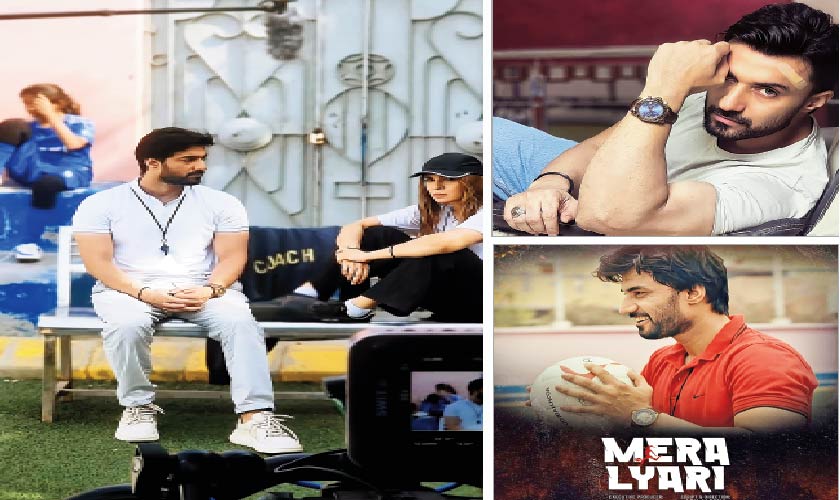
rom the boxing ring in his debut film Doda to the football grounds of Mera Lyari, actor Shoaib Hassan is steadily building a career rooted in physically demanding and emotionally grounded roles.
In Doda (2022), the first Balochi-language film to receive a major nationwide theatrical release, Shoaib played a former boxer struggling with the weight of his past. The performance introduced him as an actor capable of bringing restraint and sincerity to intense characters.
Now, with Mera Lyari, Shoaib returns to the big screen in a very different role. Directed by Abu Aleeha and backed by the Sindh Government, the film shifts focus from the violence often associated with Lyari to the lives and ambitions of young female footballers from the area. Shoaib plays Shah Baloch, a dedicated football coach determined to support the girls chasing their dreams.
Before entering films and television, Shoaib spent several years working in fashion and commercial modelling, inspired by his brother, model Zohaib Hassan. He later transitioned into television with serials such as Shiddat, Mere Sapnay and Nadan Dil. With multiple upcoming projects, he continues to move between television and cinema with ease.
Instep: You are returning to the big screen with Mera Lyari after the success of Doda. How does it feel to see yourself in cinemas again, especially in such a different role?
Shoaib Hassan (SH): It feels incredible. Doda introduced me to audiences, but this role allowed me to present myself in a completely different way. I think it is important for an actor to keep challenging himself. I am excited to see how people respond to this transformation.
Instep: Since the story is deeply rooted in Lyari, how did you approach the character’s authenticity?
SH: After Doda, I became very conscious about representing Lyari truthfully. I paid close attention to the tone, slang and overall energy of the neighbourhood. Even though Doda was also shot there, this time I wanted people to look at my character and immediately feel that he belonged to Lyari. Every gesture and line had to feel natural to that environment.
Instep: Tell us about your character and how you ended up collaborating with director Abu Aleeha.
SH: My character’s name is Shah Baloch. He is reserved, sincere and deeply connected to his community. I actually met Abu Aleeha at a screening of Doda. He appreciated my performance and told me he wanted to make a film centred on Lyari. Since I have always wanted to represent my home positively, the collaboration happened very naturally.
Instep: Football is at the heart of this film. Did you have to prepare specifically to play a coach?
SH: Absolutely. Football has always been my favourite sport, so that connection helped. But playing a coach required a different kind of preparation. I watched footage of real trainers to study their body language, the way they motivate players and how they carry themselves on the field. Since my character is inspired by real people, I wanted the training scenes to feel believable.
Instep: What was the atmosphere like on an Abu Aleeha set?
SH: Abu Aleeha is a wonderful director and an even better person. He creates an atmosphere that feels more like a family than a workplace. When actors feel comfortable on set, it becomes easier to give honest performances and that was very much the case here.
Instep: Shooting in Lyari can be intense. Did you face any particular challenges?
SH: The Karachi heat was definitely the biggest challenge. We spent long hours shooting on football grounds under the sun and everyone ended up getting naturally tanned. But in a way, that added realism to the film. Apart from the weather, the overall experience was very enjoyable.
Instep: Some people may see a sports film about female footballers in Lyari as a risk. Did that concern you?
SH: Not at all. This is an uplifting sports film about talented girls fighting to achieve their dreams despite difficult circumstances. Audiences are ready for stories like this. People want to see films that feel honest and connected to real lives.
Instep: There have been comparisons to other projects like Dhurandhar. Do you see any similarities?
SH: Not really. Our film was completed before the Dhurandhar trailer even came out. More importantly, the intention is very different. Instead of focusing on negative stereotypes, Mera Lyari highlights the talent, sports culture and creative spirit that exist within the community.
Instep: Looking back, how do you see Doda as your film debut?
SH: Doda will always be very important to me. It was not only my first film, but also an important project for Pakistani cinema. It is recognised as the first Balochi-language film to receive a major multi-city theatrical release.
Playing a former boxer carrying emotional and personal burdens was a huge responsibility. The character goes through failure, regret and the struggle to rebuild his life, so I learned a great deal from the experience both professionally and personally.
Instep: How did you prepare for such a physically and emotionally demanding role?
SH: I went through intense physical training to make the boxing look technically accurate. I did not want the performance to feel exaggerated or staged. I wanted audiences to believe they were watching a real boxer, both inside and outside the ring.
Instep: What is next for Shoaib Hassan?
SH: I have recently completed two television serials, and both projects should be released soon, so I am looking forward to audiences seeing them.