Print Story
X




Ichhra Bazaar may have been revamped, but the dynamics of one of Lahore’s most popular marketplaces remains essentially the same
| W |
ith Eid-ul Azha festivities over, the city’s domestic life is adjusting to the ripples of the recent municipal administration overhauls. The district government’s sweeping anti-encroachment drive and infrastructure upgrades, finalised early this season, have targeted several historic commercial hubs. Yet, while the geopolitical and economic pressures of the year dominate evening news broadcasts, the ground-level reality of the city’s oldest bazaars tells a different story of resilience.
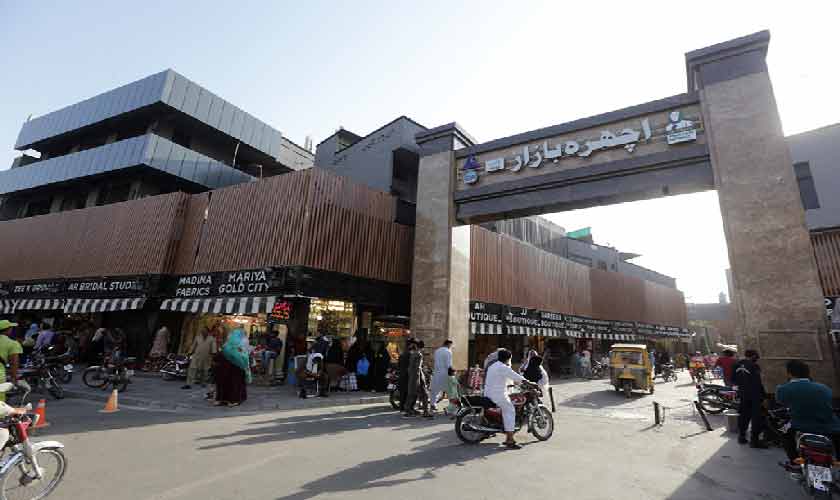
Ichhra Bazaar, a sprawling retail artery that has long served as the primary retail sanctuary for generations of Lahori women, has become a major focal point of the recent infrastructure mandate. For decades, the market operated under an anarchic, self-sustaining rhythm where makeshift stalls, hanging fabrics and moving motorbikes squeezed into narrow lanes. Under the new administrative directive, the district has cleared long-standing encroachments and widened primary walking paths. The storefront boundaries have also been regularised to ease urban congestion.
“We used to brace ourselves before coming here during the Eid rush,” says Bushra, a 45 years old resident of Samanabad who is browsing for unstitched lawn pieces with her daughter. “You had to navigate broken pavements while keeping a constant eye out for the passing motorcycles.”
Bushra looks around at the newly paved lanes, where families move with a degree of physical breathing room previously unseen in the bazaar.
The structural changes have introduced a forceful discipline to Ichhra that might be a good thing on paper but is so unfamiliar it feels odd to the frequent shoppers. The wide walkways have eliminated the aggressive friction of the old crowd dynamics, allowing shoppers to linger without blocking the flow of pedestrian traffic. While the physical constraints have shifted, the underlying economic realities surface in quieter ways. Shopkeepers round up prices of imported laces and embellishments with a weary shrug, citing rising transport costs and local tax adjustments, while customers engage in more calculated, prolonged negotiations over every yard of fabric.
Sonia Bibi has sold fabric at the same spot in Ichhra for over two decades. Her stall, which is technically a counter within a large shop, carries the dark, heavy cottons and plain lawn that women came for specifically in the days before Eid-ul Azha. It isn’t festive cloth; it’s the kind that could take a morning’s work and be rinsed clean before lunch: perfect to wear for meat sorting on Eid.
Business, Bibi says, has been good. Better than she expected, given that the construction disrupted foot traffic for months before completion. “Women know where to find what they need,” she says. “They came back.”
The overhaul has altered the physical stage, but it hasn’t managed to rewrite the ritualistic nature of the space. Bargaining remains a performance built on temporary alliances. “The city can pave the roads all they want, it won’t change how we do business,” says Sarim, a vendor.
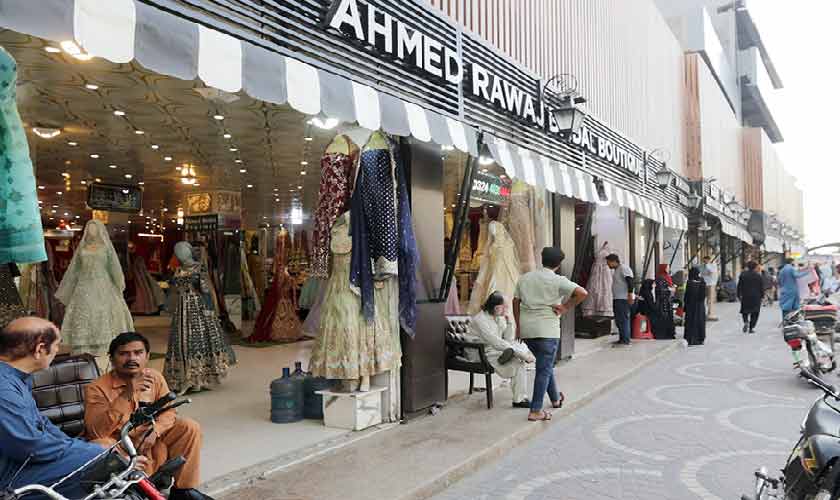
A few stalls down, a group of young women gather outside a traditional bangles shop, testing glass bracelets against their wrists. The clinking of glass mixes with the rhythmic calls of nearby cloth vendors. For the women of Lahore, Ichhra represents a crucial counter-space to the highly masculinised economy of the festive season. While the men of the household navigated the chaotic, mud-filled temporary cattle markets on the outskirts of the city, the complex labour of festive preparation happened within these commercial blocks.
| T |
he overhaul has altered the physical stage, but it hasn’t managed to rewrite the ritualistic nature of the space. Bargaining remains a performance built on temporary alliances. “The city can pave the roads all they want, it won’t change how we do business,” says Sarim, a vendor who has sold traditional embroidery in Ichhra Bazaar for over two decades.
Adjusting a roll of metallic thread, Sarim points to the newly designated boundary line in front of his shop, and says, “The customers still expect the same connection and conversation before a sale is made.”
“I kept looking for the dupatta wala,” says Hira, a woman in her late thirties who has been shopping at Ichhra since her mother first brought her along as a child.
Hira has come for dress material and a specific embroidered dupatta she buys every other year from a vendor she has never learned the name of, only the location. “I knew roughly where he was. But with the new fronts, everything looked the same.”
She finds him eventually. He hasn’t moved. His shopfront, like all the others in the revamped stretch, now carries a uniform signboard and a freshly plastered facade. Inside, the stacks of cloth are exactly as Hira remembers them — they are still organised by a logic belonging entirely to the shopkeeper and that regular customers have spent years learning to read.
Ichhra has always served this particular shopping well. Its prices are honest and its variety is genuine. The vendors, after years of fielding the same requests before the two Eids, know what is needed without being told. A woman who walks in and asks for “something simple, dark colour, stitching should be easy” will not be shown silk.
That institutional knowledge, held in the vendors, worn into the lanes, passed between women across generations, is what the revamp could not touch and did not try to. The cobblestones are new and the streets are wider but the rest is as it was. And the women of Lahore, who have always known how to find what they came for, are still finding it.
Nadia Ahmed Uqaili is a content strategist with over five years of global agency experience. She also writes short fiction on Substack. She can be reached at [email protected]