Print Story
X




Restoring the ‘original’ names of dozens of city’s thoroughfares is a gigantic task
| W |
hat does Lahore look like if the original names of its streets and roads are revived? To historians, heritage experts and lovers of the provincial capital, the prospect is thrilling. But for those tasked with executing it, “correcting” history is a steep, uphill battle.
The ambitious effort to restore pre-Partition and historical names of dozens of Lahore’s thoroughfares is being carried out under a Punjab government initiative. The body spearheading the project is called Lahore Authority for Heritage Revival.
“The purpose [of the project] is to revive Lahore’s original character, structure and historical identity — the very traits for which the city has been best known,” says Fatima Zia, a representative of the LAHR.
To ensure a rigorous and inclusive process, the LAHR has formed a panel of historians, scholars and high-level officials from various government departments.
According to Deputy Commissioner Captain (retd) Muhammad Ali Ijaz, the process requires intense inter-departmental collaboration. “During our discussions, we even debated the foundational names of Lahore’s famous gates — is it Yakki Gate or Zakki Gate?” he tells TNS.
The DC says that when official archives were cross-referenced with records from the municipal corporation and the Walled City of Lahore Authority, officials identified 21 major roads whose old and current names were different. Additionally, historical data on 10 mohallas (old neighbourhoods) and 36 kuchas (narrow residential alleys) was compiled from various sources.
The DC points out that most past renaming efforts occurred without an official notification or legal approval. In fact, only one road in Lahore has been formally renamed in recent years through the proper legal process: Nicholson Road was officially renamed Nawabzada Nasrullah Khan Road under the Punjab Local Councils’ (Road and Street) Rules, 1981.
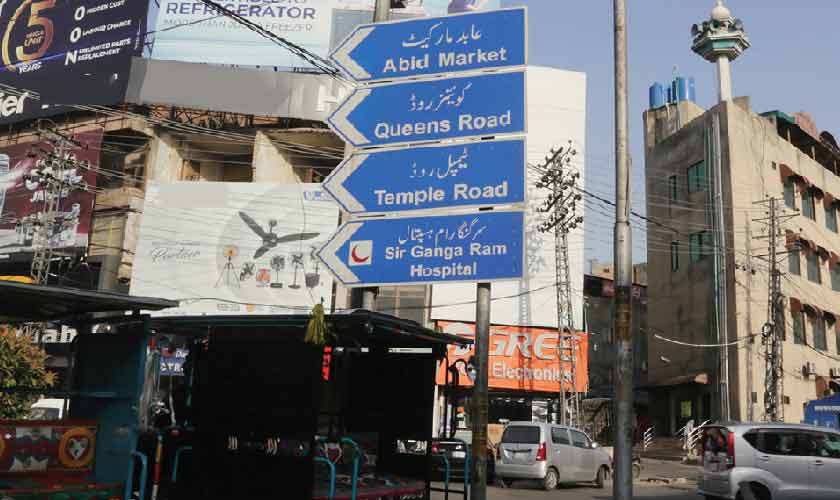
The ad hoc approach has created significant confusion among the general public. On several streets, commuters are greeted by dueling signboards. For instance, both Jail Road and Ghaus-ul Azam Road appear on the same stretch of tarmac. Similar dual identity plagues Queen’s Road/ Fatima Jinnah Road.
Conversely, some roads stubbornly retain colonial era names in the public consciousness and on signboards, despite having been officially renamed decades ago. These include Abbott Road (officially Iftikhar Hussain Mamdot Road), Cooper Road (Khawaja Nizamuddin Road), Davis Road (Sir Aga Khan Road) and Durand Road (officially Sir Syed Ahmad Khan Road).
Google Maps defaults to the historical names for all 21 roads identified by the office of the deputy commissioner.
Beyond major arteries, the project aims to look at some of the kuchas of Old Lahore, which were originally named after the craftsmen who lived and worked there. These include Kucha Teer Garan (lane of the arrow-makers), Kucha Kaman Garan (bow-makers), Kucha Chabak Sawaran (horse trainers) and Kucha Loharan (blacksmiths).
While discussions are under way to restore these names, documentation is scarce. “There is limited data on these lanes,” the DC admits. “If these are to be restored formally, we will require more information and input from experts.”
There is a proposal also to revert the names of entire localities to original/ earlier ones. Under this plan, Islampura might revert to Krishan Nagar and Babri Masjid Chowk officially become Jain Mandir Chowk once again.
| T |
he project is making Lahore confront a philosophical question: why preserve the names of its oppressive colonial rulers?
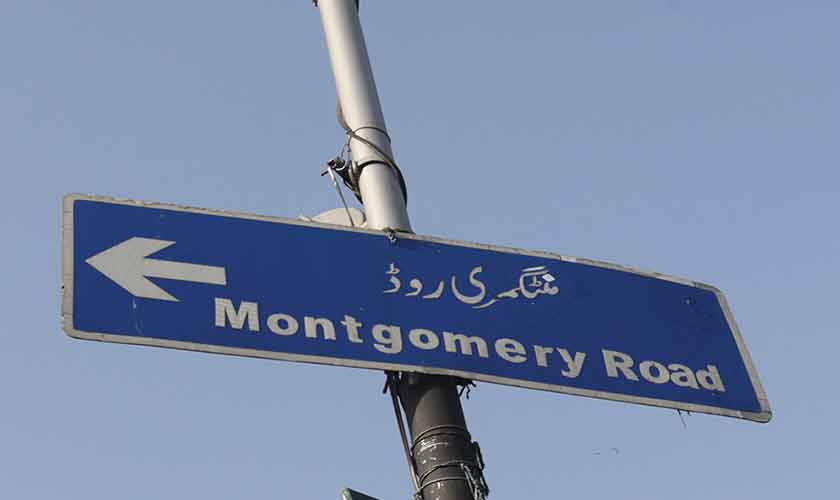
Historian Dr Kanwal Khalid argues that while correcting history is vital, the city must acknowledge that figures like Nicholson, Lawrence and Montgomery were highly controversial. “They were not nice to the locals,” she notes. “Even if we keep the names intact, there should be signboards and plaques installed across these sites to educate the public about who these people actually were.”
Travel writer and historian Salman Rashid highlights a modern grievance, noting that a mechanism is desperately needed for naming new urban developments. “Most of the new chowks are named after local property dealers and thugs who simply put up their signboards. These are then unquestioningly adopted by the LDA in its documents,” he says.
Heritage expert Dr Fauzia Qureshi calls for a balanced, nuanced and historically accurate approach. She believes that Lahore’s history must be understood as a continuous chronological order, rather than erasing specific eras.
Speaking at a recent official meeting of the LAHR, Dr Qureshi said that Lahore had existed long before the Mughals. She noted that Lahore was the capital of the Delhi Sultanate from 1206 to 1210, and several names from that era exist. For example, the site of the shrine of Qutbuddin Aibak was originally known as Lakh Bakhsh.
“Many names connected to Sikh-era Lahore and earlier periods can be found in historical literature, if we look closely enough.”
She also pointed out some inaccuracies and distortions. Davis Road, she said, is actually a corrupted pronunciation of Sir Robert Henry Davies, a former lieutenant governor of the Punjab. Similarly, many believe that McLeod Road was named after a colonial era governor, however, it was actually named after the governor’s father, a lieutenant general in the army.
“Such historical inaccuracies must be corrected and made public,” Dr Qureshi suggested. “The best way to do that is through descriptive plaques and proper historical markers.”
Ahsan Raza is the editor of an English daily. He can be reached at [email protected]