Print Story
X




The China Study Centre, established in 2017 at the University of Peshawar, is meant to strengthen the Sino-Pak socio-economic and cultural ties
| I |
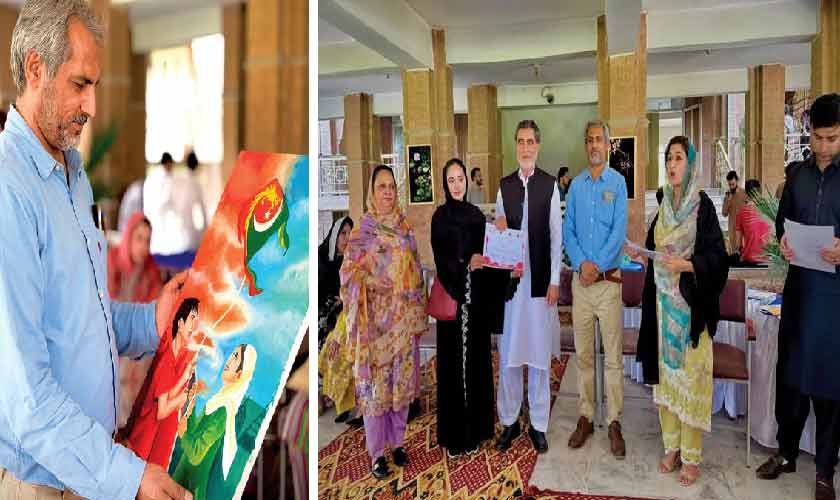
n the bustling corridors of the New Academic Block at the University of Peshawar, vibrant hues of red and gold mingled with the earthy tones of Pakistani landscapes. On a bright spring day, the air hummed with excitement as students, faculty and guests gathered for the Chinese Arts Exhibition and Competition.
Organised by the China Study Centre in collaboration with the Department of Arts and Design, the event was far more than a display of creative work — it was a living testament to the enduring friendship between Pakistan and China.
The China Study Centre was established in 2017 by the Chinese Embassy in Pakistan at the University of Peshawar with the objective of strengthening Sino-Pak socio-economic and cultural ties.
Since its inception, the CSC has actively promoted deeper connections through a wide range of initiatives. Professor Noor Sanauddin Khattak, the chief organiser of the event, told TNS that the Centre has been engaged in numerous activities including holding seminars, conducting research on China Pak Economic Corridors, a scholarly research journal, organising symposia, teaching Chinese language, arranging study scholarships for deserving students, study trips and advancing Sinology — the comprehensive study of Chinese art, culture and history.
This recent exhibition and competition aligned perfectly with that founding mission while coinciding with the 75th anniversary of diplomatic relations between Pakistan and the People’s Republic of China, established in 1951. As both nations mark this milestone in 2026 with various cultural and diplomatic events, the University of Peshawar’s initiative stood out for its grassroots focus on youth and artistic expression.
Against the backdrop of the China-Pakistan Economic Corridor, a flagship project that has transformed infrastructure, energy and trade links, the event underscored a crucial dimension: people-to-people contacts and cultural harmony.
Visitors entering the exhibition hall were greeted by an array of artworks that told stories of two ancient civilisations meeting on canvas, clay and paper. Students from the Department of Fine Arts showcased pieces inspired by traditional Chinese motifs — elegant ink wash landscapes reminiscent of classical Chinese painting, intricate calligraphy spelling out phrases of friendship in both Urdu and Mandarin, and delicate ceramic work echoing the famed porcelain traditions of Jingdezhen.
What made the display particularly compelling was creative fusion. A striking painting depicted the majestic Karakoram Mountains— the natural bridge between Pakistan and China— with a soaring Chinese dragon subtly woven into the clouds, its scales reflecting the green of Pakistan’s valleys. Another ceramic piece blended Pakistani truck art motifs with Chinese cloud patterns, symbolising the journey of goods and ideas along the modern Silk Road. Calligraphy work featured couplets celebrating Pak-China Dosti, where Chinese characters flowed seamlessly alongside the Nastaliq script.
A participating student, Ayesha from the Fine Arts department, spoke about her experience: “Studying Chinese brush techniques opened my eyes to a completely different philosophy of art, one that emphasises harmony with nature. Combining it with our local themes felt like contributing to something bigger than just an exhibition. It’s about showing that our cultures can enrich each other.”
Such fusion of ideas and art forms was exactly the goal. Professor Noor Sanauddin Khattak emphasised this in his address. He highlighted how initiatives like this strengthen people-to-people relations and offer students platforms for intercultural dialogue within the broader CPEC framework, building upon the Centre’s ongoing work in research, language training and cultural studies.
“Art has the power to transcend borders where formal diplomacy sometimes cannot,” Prof Khattak remarked. “By engaging with Chinese artistic heritage, our students are not only honing their skills but also becoming ambassadors of the deep friendship between our two nations. We are grateful to the Chinese Embassy for their generous financial support that made this event possible. We hope to organise more such platforms in the coming years.”
The atmosphere was electric. Faculty members moved thoughtfully from piece to piece, offering feedback and encouragement. Distinguished guests mingled with young artists. The large turnout reflected the growing interest in Chinese language, culture and studies at the university, where the China Study Centre continues to play a pivotal role as a hub for research, exchanges and collaborations nearly a decade after it was established.
Professor Muhammad Naeem Qazi, pro vice chancellor of the University of Peshawar, presided over the closing ceremony. In his remarks, he praised the organisers and participants for embodying the spirit of academic excellence and cultural openness that defines the institution.
Prizes and certificates were awarded to standout performers, recognising not just technical skill but also the creativity in bridging cultural narratives.
This event fits into a wider tapestry of 75th-anniversary celebrations across Pakistan and China. Yet, university-level initiatives like this carry special significance. They nurture the next generation — the young Pakistanis who will work on CPEC Phase II projects, study in Chinese universities or collaborate in fields ranging from technology to tourism.
The exhibition also highlighted the evolving role of higher education in Pakistan-China relations. Thousands of Pakistani students have studied in China, while Chinese scholars and language teachers contribute actively on Pakistani campuses. Programmes in Mandarin, joint research on sustainable development and cultural festivals are becoming increasingly common.
In a region often stereotyped by security challenges and geopolitical complexities, such events serve as powerful counter-narratives. They remind observers that the relationship is not merely transactional — built on roads, ports, and power plants — but deeply human and cultural.
As the exhibition concluded and artworks were carefully packed away, a sense of accomplishment lingered. For the students, it was validation of their talent and a window into a sister civilisation. For the university, it reinforced its commitment to global engagement. For Pak-China friendship, it added another vibrant thread to a tapestry 75 years in the making — one that continues to grow richer with every brushstroke.
Looking ahead, organizers and participants alike expressed hope for expanded programmes: regular workshops by Chinese artists, student exchange exhibitions and perhaps even a permanent gallery showcasing Sino-Pak artistic collaborations. In the words of one young artist, “When we paint together, borders fade.”
The writer is a Peshawar-based journalist. His X handle: @Shinwar-9