Print Story
X




Hadiqa Kiani receives the Sitara-i-Imtiaz, one of Pakistan’s highest civilian honours
| S |
ome artists have a good run, but others completely shape a culture. Hadiqa Kiani absolutely belongs in that second group.
On May 13, she received the Sitara-i-Imtiaz, one of Pakistan’s highest civilian honours, in recognition of a career that has spanned over three decades and a humanitarian legacy that has proven equally formidable. It was a long time coming and frankly, entirely deserved.
The ceremony took place at Lahore’s Governor House, where Punjab Governor Sardar Saleem Haider Khan presented the award on behalf of the President.
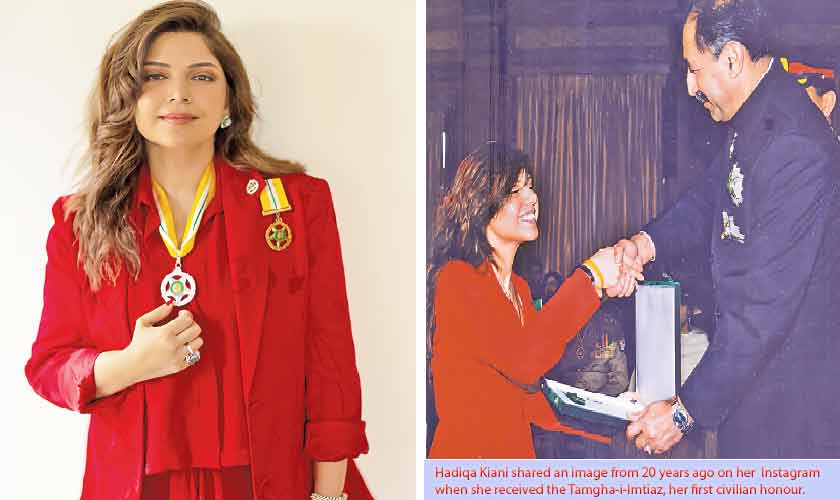
This milestone felt deeply personal to Kiani. In an Instagram post afterwards, she said she felt “extremely proud, happy and humbled,” adding that it was “still hard to believe that 20 years after receiving the Tamgha-i-Imtiaz, I have now been honoured with the Sitara-i-Imtiaz.”
In a beautiful, full-circle moment, she wore red to the ceremony, the same colour she wore two decades ago when she received her first civil honour. She dedicated the award to her family and supporters, writing, “I share this honour with my son, my listeners, supporters, family and everyone who has been part of this journey over the years,” and added, “I am deeply grateful that this journey continues today with all of you.”
It was a typically gracious response from someone who has always carried her success with dignity.
Kiani arrived as a force of nature in the 1990s, with a voice and stage presence that were entirely her own. Her second album, Roshni, produced two of her most defining songs. ‘Dupatta’, with its quasi-bhangra rhythm and techno-inflected production, listed among the 20 best Pakistani pop songs ever written. ‘Boohey Barian’ went on to surpass even that, and remains to this day her most celebrated track. In 1998, she also recorded the opera-esque ‘Intehai Shauq’, the official theme song for the 1999 Cricket World Cup.
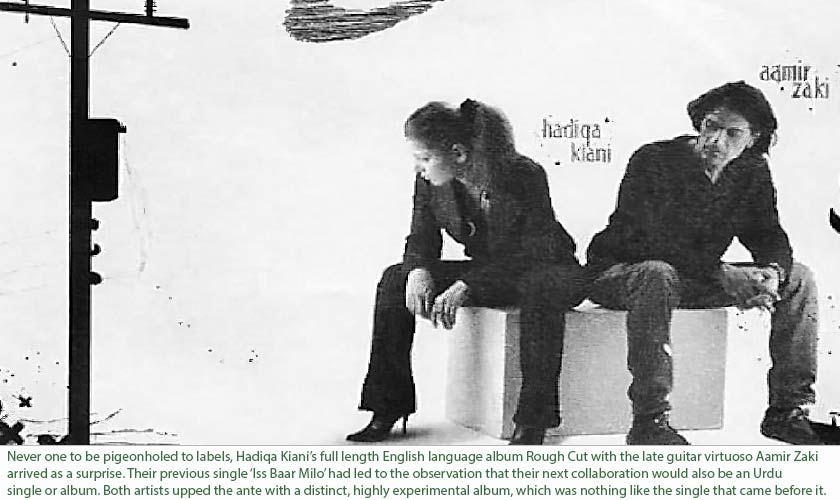
What followed was a career defined by an almost deliberate refusal to stand still. Prior to releasing Rough Cut, she teamed up with the brilliant guitarist Aamir Zaki for the Urdu single ‘Iss Baar Milo’, whose video, directed by Jami and starring Humayun Saeed opposite Kiani, drew considerable attention for her portrayal of a patient in a psychiatric hospital, a performance that earned wide praise. In 2007, the full Rough Cut album followed, making her the first mainstream Pakistani artist to release an album entirely in English.
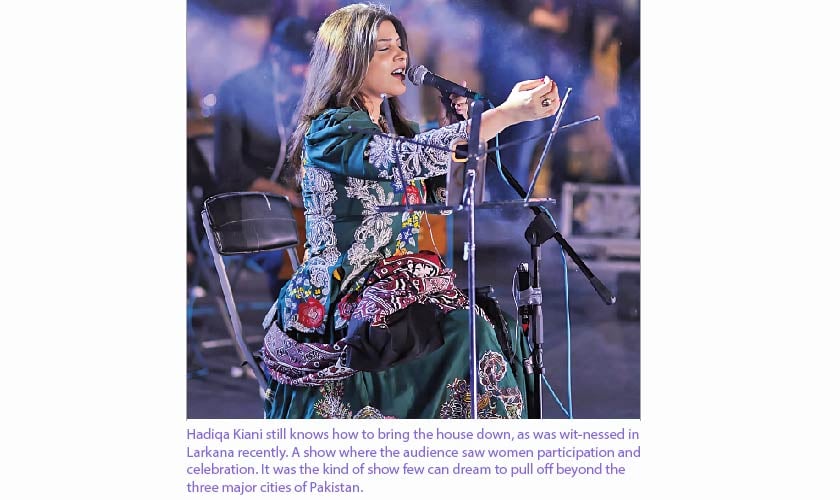
The years that followed brought more music and more evolution, leading to Wajd in 2017, a visually striking album of folk renderings that won Album of the Year at the Lux Style Awards 2018.
By this point, Kiani had also made a striking pivot into acting. Her debut in the drama Raqeeb Se alongside Nauman Ijaz and Sania Saeed won her the Lux Style Award for Best TV Actress. She followed that with Dobara, Pinjra and most recently Hadsa on Geo TV. The range she brought to each role confirmed that her move into acting was not a detour but a natural extension of her artistry.
In December 2024, the BBC named her on its 100 Women list, recognising her contributions to music and her philanthropic work. That philanthropic thread is not incidental to her story. Following the 2022 floods, Kiani launched Vaseela-e-Raah, a non-profit relief campaign through which she personally managed supplies, delivered medical aid and oversaw the rebuilding of entire communities across Balochistan and South Punjab. The campaign constructed 370 homes, two maternity centres, two mosques, a school and a grocery store. Her long-standing role as a UNDP Goodwill Ambassador sits alongside this work, not as a title but as a reflection of how she has consistently shown up.
Receiving the Sitara-i-Imtiaz at this point in her career is both a recognition of everything she has built and, one suspects, entirely beside the point for her. The awards matter, but they are not what drives her. Pakistan has many celebrated voices. Hadiqa Kiani remains, three decades in, one of its most essential ones.